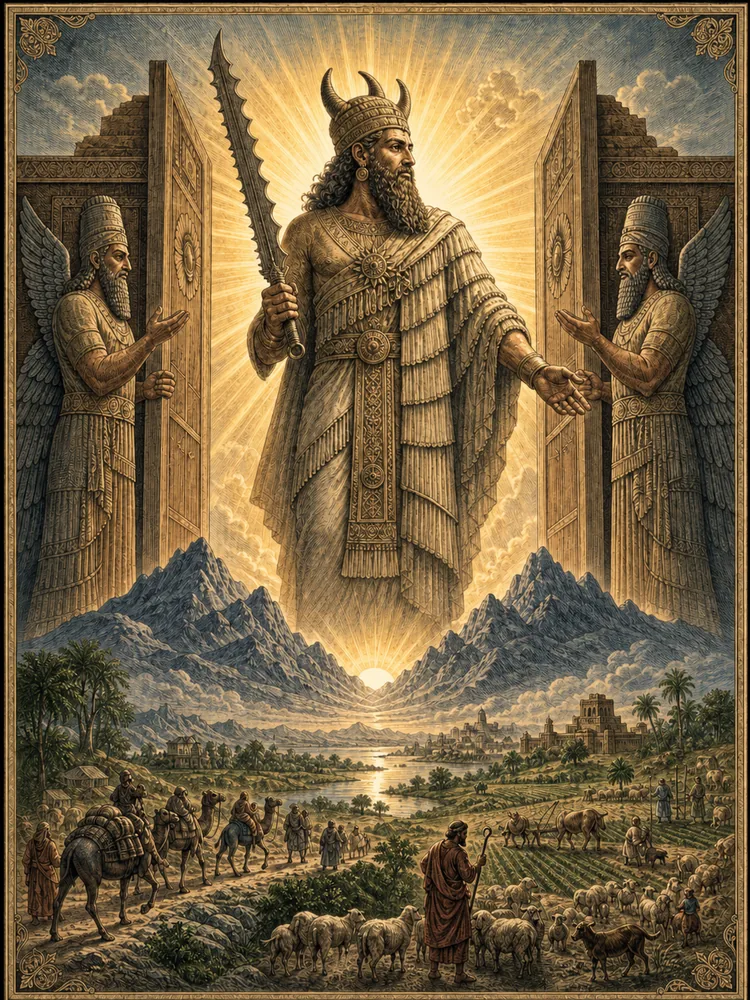
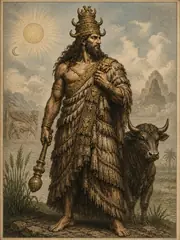
Utu was the sun, who rose each morning in the east through the gates of the mountain, traversed the heavens by day, and descended at evening through the western gate to traverse the underworld by night. He was the son of Nanna and the brother of Inanna; and his city was Sippar, with a second seat at Larsa. But because the sun sees all that is done upon the earth, and his eye misses nothing, Utu was also the great judge among the gods: the unjust deal struck in the dark could not escape him; the cry of the oppressed reached his ears.
His sister Inanna would call upon him in her need: when Dumuzi fled the demons, it was to Utu his brother-in-law that he prayed, and Utu changed him into a snake and into a gazelle that he might escape; when the wild man Enkidu lay near death, Utu was invoked over his bedside; when Gilgamesh and Enkidu set out to slay Humbaba in the cedar forest, it was Utu's blessing they sought first.
Curator’s note
What the sources say, and what later tradition added. The sources for this bay
Utu/Shamash is the patron of justice par excellence in the Mesopotamian pantheon. The famous Code of Hammurabi (Old Babylonian, c. 1750 BCE), inscribed upon a basalt stele now in the Louvre, shows in its relief Hammurabi standing before Shamash, who hands him the rod and ring of authority — the symbols of just rulership. Shamash's hymn (the Great Shamash Hymn, preserved in Standard Babylonian) is one of the longest theological poems of the corpus, treating the god's omniscience and his patronage of the merchant, the traveler, and the wronged. The orientation of the Mesopotamian temple, with the principal shrine often on the eastern side, reflects the religious importance of the rising sun.
When the sources speak
Dated witnesses for Sumer. A date marks when the evidence was written down, not when the belief began. The whole timeline
- c. 3400–3000 BCE
- Uruk-period writing and monumental temple economies create the earliest recoverable administrative setting for named divine institutions.
- c. 2900–2350 BCE
- Early Dynastic city-states preserve local cults, hymns, royal inscriptions, and god lists; later copies often transmit older compositions.
- c. 2334–2154 BCE
- The Akkadian Empire expands bilingual and imperial patterns of divine identification without erasing local cult titles.
- c. 2112–2004 BCE
- Ur III administration and scribal schooling standardize many Sumerian literary and liturgical forms.
- c. 2000–1600 BCE
- Old Babylonian schools copy major myths, laments, hymns, debates, and heroic narratives in the form most often used by modern editors.
- c. 1650–1200 BCE
- Hittite and Hurrian archives at Hattusa transmit Anatolian myths, imported Syrian materials, and ritual compositions.
- c. 1400–1190 BCE
- The tablets of Ugarit preserve the Baal Cycle, Kirta, Aqhat, ritual lists, and a dense Late Bronze Age West Semitic pantheon.
- c. 1000–612 BCE
- Neo-Assyrian and Neo-Babylonian empires collect, revise, and politically reinterpret older learned traditions.