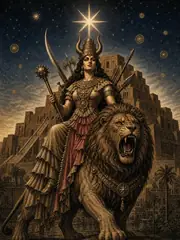
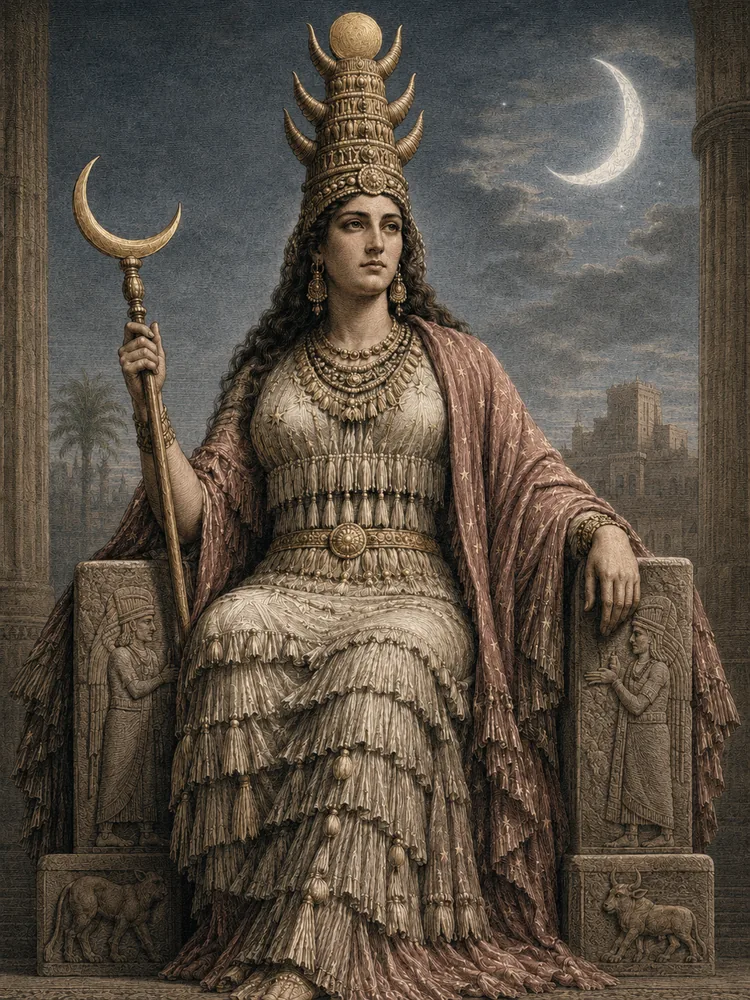
To the moon-god Nanna, who shone upon Ur from his great temple the Egishnugal, was wedded Ningal the Great Lady, who shared his rule of the night and bore to him the most famous of his children: the goddess Inanna of Uruk and the sun-god Utu. Her own cult-center was at Ur alongside Nanna's; she was queen of that city no less than he was its king, and the lamentations sung over Ur after its fall to the Elamites in c. 2004 BCE were placed, by their authors, in her mouth.
For of all the great Sumerian poems of mourning, the Lamentation over the Destruction of Ur is the most powerful, and Ningal is its speaker. The poem describes how the great winds of Enlil swept down upon her city, how the storm-gods levelled its walls, how the bodies lay unburied in the streets, how the sheepfolds were emptied and the marsh-reeds went silent. Throughout, Ningal pleads with the assembled gods that they might revoke their decision; she beats her breast like a mortal mother for her city; and at the end she sits in the rubble with her face veiled, mourning for what cannot be restored. It is one of the earliest sustained female literary voices preserved in any language.
Her cult continued at Ur through Babylonian and Assyrian times, and was carried, with that of Nanna, to Harran in the north — the cult-center to which the Sumerian moon-religion fled when Ur faded, and where, under the form Nikkal alongside Sin, it persisted into the Roman and even Islamic periods.