A Compendium of the Ancient Gods
Ninkasi, plate

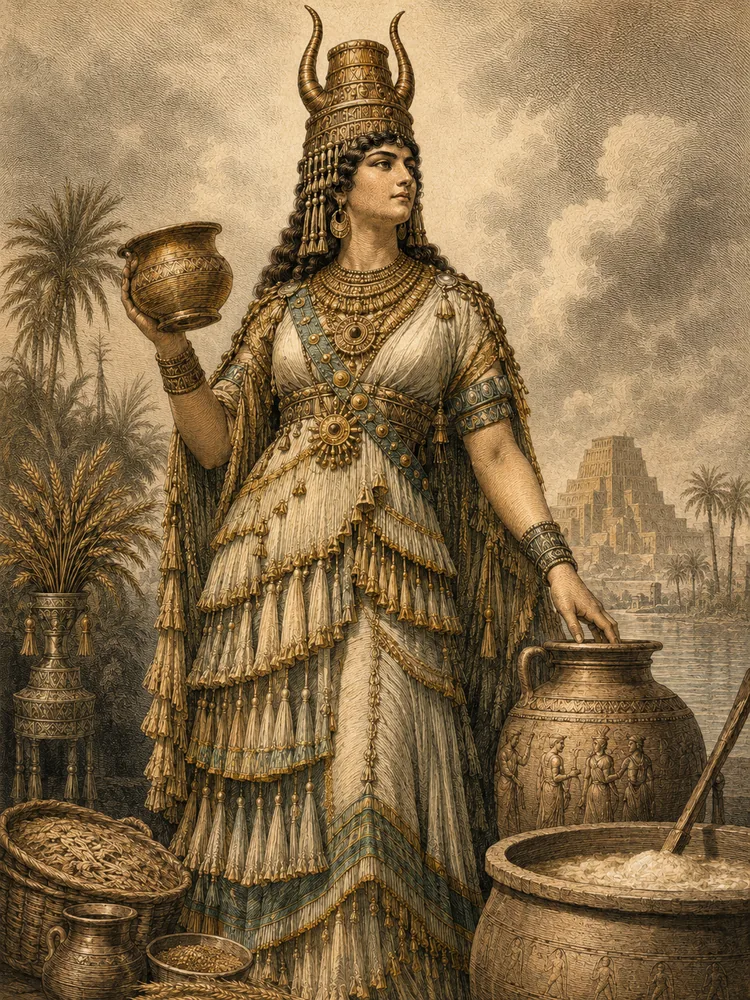
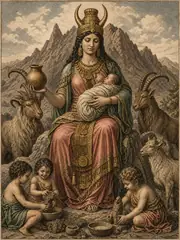
Beer was, in Mesopotamia, neither luxury nor vice but staple; it was bread in liquid form, the daily nourishment of laboring men and the daily libation of the temples. The grain that became beer was holy, the brewing was holy, and the goddess who presided over the brewing — Ninkasi, the Lady Who Fills the Mouth — was a deity to whom the Sumerians turned with that practical and grateful affection reserved for the powers that supply the body's wants.

She was the daughter of Enki and of Ninti the Lady of the Rib (or, in another tradition, of Ninhursag); and her hymn, which has come down to us in Old Babylonian copies of an older Sumerian original, is among the oddest documents to survive from the ancient world. For it is at once a prayer and a recipe. The hymn praises Ninkasi as she pours the bappir-bread upon the great oven, soaks it in sweet aromatics, mixes the cooked mash with sweet wort, takes the filtered beer of the collector vat — and so on through every step of brewing, in language which the brewer might follow as instruction and the worshipper recite as devotion. The two were not, in Sumer, distinct activities.

When her beer was poured, it was poured before her image; and the brewer's craft was held to be itself a form of prayer. To know how to brew was to know how to honor her, and the same words sufficed for both.
Curator’s note

What the sources say, and what later tradition added. The sources for this bay

The Hymn to Ninkasi survives in Old Babylonian copies, the principal of which was published by Miguel Civil in 1964 and has since been translated and reconstructed many times. The hymn is widely recognized as the oldest written recipe in human history. In 1989 the Anchor Brewing Company of San Francisco, working with the Sumerologist Solomon Katz of the University of Pennsylvania, attempted to brew a beer following the hymn's instructions; the result, called Ninkasi Beer, was served at a single ceremony at the University Museum and not reproduced commercially. The dual character of the hymn — at once sacred composition and practical text — reflects the Mesopotamian tendency to regard skilled human work as continuous with divine activity, the brewer's hands extending the goddess's own.

Kin in the sources

Each tie is quoted from the entry that states it.

When the sources speak

Dated witnesses for Sumer. A date marks when the evidence was written down, not when the belief began. The whole timeline

c. 3400–3000 BCE
Uruk-period writing and monumental temple economies create the earliest recoverable administrative setting for named divine institutions.
c. 2900–2350 BCE
Early Dynastic city-states preserve local cults, hymns, royal inscriptions, and god lists; later copies often transmit older compositions.
c. 2334–2154 BCE
The Akkadian Empire expands bilingual and imperial patterns of divine identification without erasing local cult titles.
c. 2112–2004 BCE
Ur III administration and scribal schooling standardize many Sumerian literary and liturgical forms.
c. 2000–1600 BCE
Old Babylonian schools copy major myths, laments, hymns, debates, and heroic narratives in the form most often used by modern editors.
c. 1650–1200 BCE
Hittite and Hurrian archives at Hattusa transmit Anatolian myths, imported Syrian materials, and ritual compositions.
c. 1400–1190 BCE
The tablets of Ugarit preserve the Baal Cycle, Kirta, Aqhat, ritual lists, and a dense Late Bronze Age West Semitic pantheon.
c. 1000–612 BCE
Neo-Assyrian and Neo-Babylonian empires collect, revise, and politically reinterpret older learned traditions.

Floor plan

The rooms follow one another in the order their peoples first appear in the written record.

  1. The Cradle of Citiesc. 3400 BCE to 395 CE. 115 works
  2. The Gift of the Nilec. 4000 BCE to 395 CE. 73 works
  3. The Olympian Orderc. 1600 BCE to 750 CE. 152 works
  4. The Persian Worldc. 2000 BCE to 1010 CE. 30 works
  5. The Levantine Borderlandsc. 1200 BCE to 500 CE. 20 works
  6. The Edges of Empirec. 2000 BCE to 1500 CE. 33 works
  7. The Etruscan Worldc. 900 BCE to 750 CE. 22 works
  8. The Roman Inheritancec. 1200 BCE to 500 CE. 58 works
  9. The Northern Inheritancec. 2000 BCE to 1600 CE. 131 works