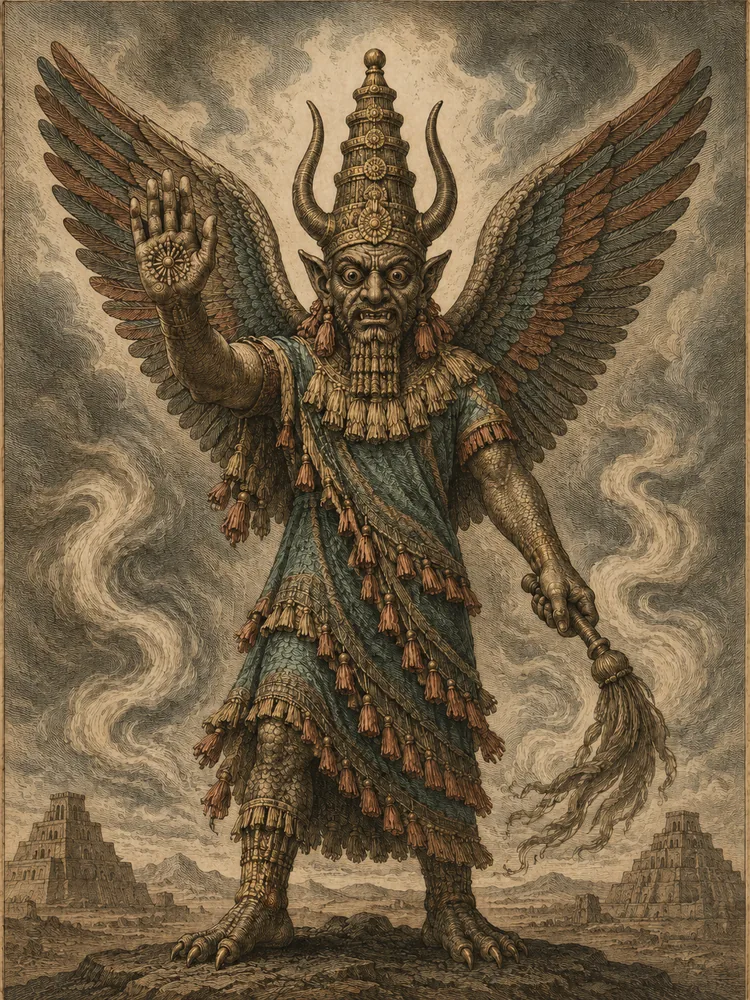
Pazuzu was a demon of the wind — specifically of the dry, scorching south-east wind that blew up from the deserts and brought fever, locusts, and pestilence with it. He was a horror to look upon: the body of a man, the head of a lion or a hound, the talons of an eagle, two pairs of wings folded at his back, a serpent for a phallus, and a tail in the manner of a scorpion. He was, by his own description in the inscriptions upon his images, "the king of the evil spirits of the air"; and yet he was not invoked against humans, but against worse than himself. Lamashtu, who killed the children, feared him; and amulets of Pazuzu were hung above the cradle to frighten her away.
 Before thisNinshubur
 Next on the wallNinkasi
Curator’s note
What the sources say, and what later tradition added. The sources for this bay
Pazuzu's iconography is among the most distinctive of any Mesopotamian figure; bronze and clay amulets and statuettes survive in considerable numbers from the first millennium BCE, particularly from Assyrian contexts. The image was made famous to modern audiences through William Friedkin's film The Exorcist (1973), where Pazuzu serves as the demonic antagonist; the statuette in the opening Iraq sequence of that film is a recognizable rendering of the type. The Mesopotamian Pazuzu was, however, a beneficent demon — his evil being precisely what made him useful against worse evils. The amulets often bear his self-introducing inscription: "I am Pazuzu, son of Hanbu, king of the evil wind-demons. From the violent mountain I have come down."
Kin in the sources
Each tie is quoted from the entry that states it.
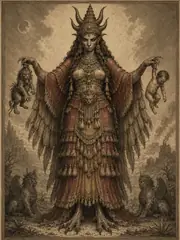 Rival ofLamashtu
Lamashtu, who killed the children, feared him
When the sources speak
Dated witnesses for Sumer. A date marks when the evidence was written down, not when the belief began. The whole timeline
- c. 3400–3000 BCE
- Uruk-period writing and monumental temple economies create the earliest recoverable administrative setting for named divine institutions.
- c. 2900–2350 BCE
- Early Dynastic city-states preserve local cults, hymns, royal inscriptions, and god lists; later copies often transmit older compositions.
- c. 2334–2154 BCE
- The Akkadian Empire expands bilingual and imperial patterns of divine identification without erasing local cult titles.
- c. 2112–2004 BCE
- Ur III administration and scribal schooling standardize many Sumerian literary and liturgical forms.
- c. 2000–1600 BCE
- Old Babylonian schools copy major myths, laments, hymns, debates, and heroic narratives in the form most often used by modern editors.
- c. 1650–1200 BCE
- Hittite and Hurrian archives at Hattusa transmit Anatolian myths, imported Syrian materials, and ritual compositions.
- c. 1400–1190 BCE
- The tablets of Ugarit preserve the Baal Cycle, Kirta, Aqhat, ritual lists, and a dense Late Bronze Age West Semitic pantheon.
- c. 1000–612 BCE
- Neo-Assyrian and Neo-Babylonian empires collect, revise, and politically reinterpret older learned traditions.