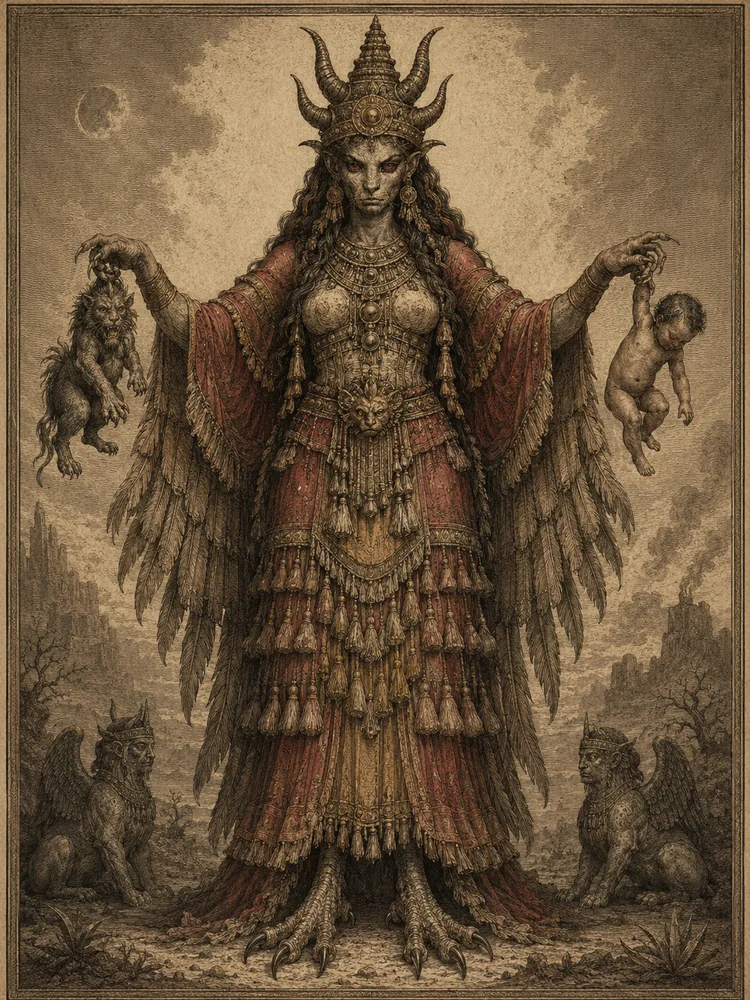
Lamashtu was the great demoness who hated mothers and the children at their breast. She was a daughter of the sky-god Anu, expelled from heaven for her cruelty; she walked the earth in the form of a hag with the head of a lioness and the feet of a bird of prey, and she crept into the rooms where women lay in childbed, that she might steal the unborn from the womb, or strangle the new-born at the breast, or send fever upon the suckling. Against her, the women hung amulets at the door and at the bedpost, and called upon Pazuzu — himself a demon, but stronger — to drive her back. The amulets that survive show her on one side and Pazuzu on the other, the lesser horror set against the greater for the saving of the child.
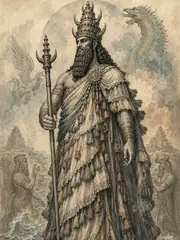 Before thisKingu
 Next on the wallNinazu
Curator’s note
What the sources say, and what later tradition added. The sources for this bay
Lamashtu (Sumerian Dimme) is among the best-attested Mesopotamian demons, and amulets bearing her image — clay or bronze tablets showing her gripping serpents, suckling a dog and a piglet at her breasts, with a donkey and a boat representing her transit to the netherworld — survive in considerable numbers from the second and first millennia BCE. The standard ritual against her is the Lamashtu Series, a compilation of incantations preserved on three large tablets. Her relationship to the Hebrew Lilith — a demoness similarly hostile to women in childbirth — is debated; the names are unrelated etymologically, but the function is plainly cognate, and Mesopotamian demonology contributed to later Jewish and Mandaean traditions of nocturnal female demons.
Kin in the sources
Each tie is quoted from the entry that states it.
 Child ofAnu
She was a daughter of the sky-god Anu, expelled from heaven for her cruelty
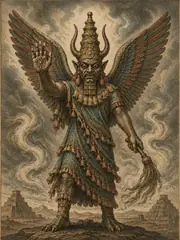 Rival ofPazuzu
called upon Pazuzu — himself a demon, but stronger — to drive her back
When the sources speak
Dated witnesses for Sumer. A date marks when the evidence was written down, not when the belief began. The whole timeline
- c. 3400–3000 BCE
- Uruk-period writing and monumental temple economies create the earliest recoverable administrative setting for named divine institutions.
- c. 2900–2350 BCE
- Early Dynastic city-states preserve local cults, hymns, royal inscriptions, and god lists; later copies often transmit older compositions.
- c. 2334–2154 BCE
- The Akkadian Empire expands bilingual and imperial patterns of divine identification without erasing local cult titles.
- c. 2112–2004 BCE
- Ur III administration and scribal schooling standardize many Sumerian literary and liturgical forms.
- c. 2000–1600 BCE
- Old Babylonian schools copy major myths, laments, hymns, debates, and heroic narratives in the form most often used by modern editors.
- c. 1650–1200 BCE
- Hittite and Hurrian archives at Hattusa transmit Anatolian myths, imported Syrian materials, and ritual compositions.
- c. 1400–1190 BCE
- The tablets of Ugarit preserve the Baal Cycle, Kirta, Aqhat, ritual lists, and a dense Late Bronze Age West Semitic pantheon.
- c. 1000–612 BCE
- Neo-Assyrian and Neo-Babylonian empires collect, revise, and politically reinterpret older learned traditions.