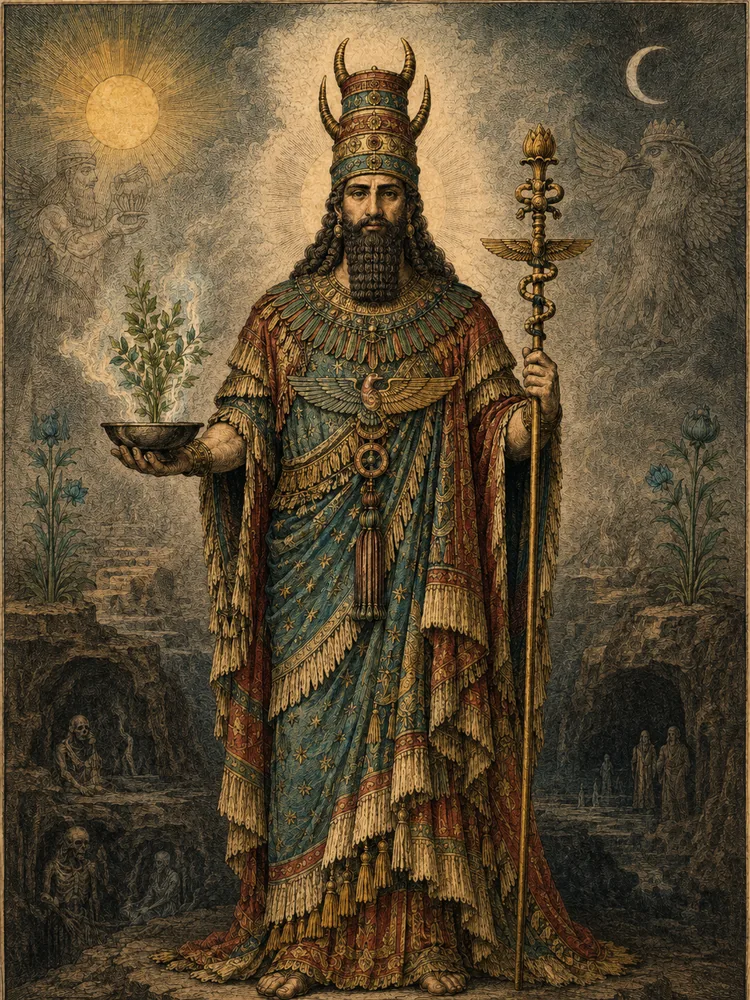
Ninazu, whose name signifies "Lord Physician," was a son of the underworld queen Ereshkigal (and, by some accounts, of Enlil and Ninlil). His city was Eshnunna, and a second seat at Enegi; he was a chthonic god, with serpent associations, and a healer like his attendant Ningishzida. The medical and the underworld offices commingled in him: he could send the sickness, and he could withhold it.
 Before thisLamashtu
 Next on the wallNinshubur
Curator’s note
What the sources say, and what later tradition added. The sources for this bay
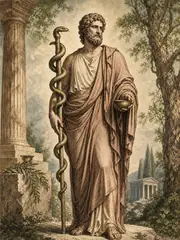
Ninazu is attested from at least the Early Dynastic period (mid-third millennium BCE). His cult at Eshnunna was important in the Old Babylonian period. By the second millennium, much of his medical office was transferred to Gula. The conjunction of underworld and healing in a single deity is paralleled in the later Greek Asclepius, whose chthonic associations and serpent emblem also derive from a long Aegean tradition of subterranean healing-cults; the Mesopotamian and Greek traditions are very probably independent expressions of a widespread ancient pattern.
Kin in the sources
Each tie is quoted from the entry that states it.
 Child ofEreshkigal
was a son of the underworld queen Ereshkigal
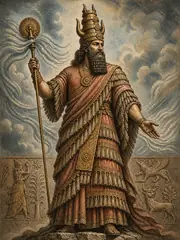 Child ofEnlil
(and, by some accounts, of Enlil and Ninlil)
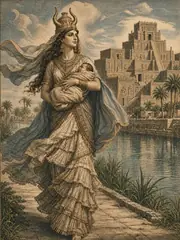 Child ofNinlil
(and, by some accounts, of Enlil and Ninlil)
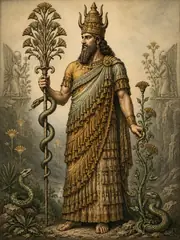 Companion ofNingishzida
a healer like his attendant Ningishzida
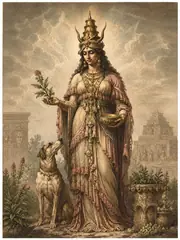 Merged intoGula
much of his medical office was transferred to Gula
 Compared withAsclepius
is paralleled in the later Greek Asclepius, whose chthonic associations and serpent emblem
When the sources speak
Dated witnesses for Sumer. A date marks when the evidence was written down, not when the belief began. The whole timeline
- c. 3400–3000 BCE
- Uruk-period writing and monumental temple economies create the earliest recoverable administrative setting for named divine institutions.
- c. 2900–2350 BCE
- Early Dynastic city-states preserve local cults, hymns, royal inscriptions, and god lists; later copies often transmit older compositions.
- c. 2334–2154 BCE
- The Akkadian Empire expands bilingual and imperial patterns of divine identification without erasing local cult titles.
- c. 2112–2004 BCE
- Ur III administration and scribal schooling standardize many Sumerian literary and liturgical forms.
- c. 2000–1600 BCE
- Old Babylonian schools copy major myths, laments, hymns, debates, and heroic narratives in the form most often used by modern editors.
- c. 1650–1200 BCE
- Hittite and Hurrian archives at Hattusa transmit Anatolian myths, imported Syrian materials, and ritual compositions.
- c. 1400–1190 BCE
- The tablets of Ugarit preserve the Baal Cycle, Kirta, Aqhat, ritual lists, and a dense Late Bronze Age West Semitic pantheon.
- c. 1000–612 BCE
- Neo-Assyrian and Neo-Babylonian empires collect, revise, and politically reinterpret older learned traditions.