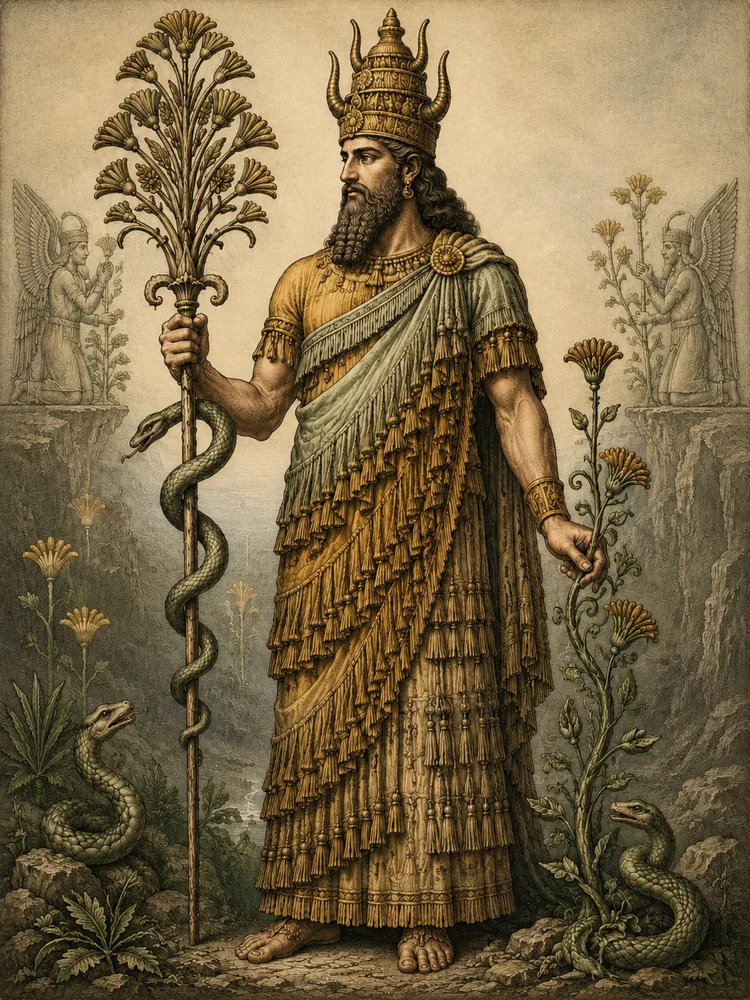
Ningishzida was "Lord of the Steadfast Tree," a god of the underworld and of vegetation that springs from it; his emblem was a serpent, or rather two serpents intertwined upon a staff, an image preserved on Sumerian seals from at least the third millennium BCE. He was the throne-bearer of Ereshkigal, and a guardian of the gates of the great below. The kings of the city of Lagash, in particular Gudea, claimed him as their personal god, and Gudea's many statues regularly invoke his name.
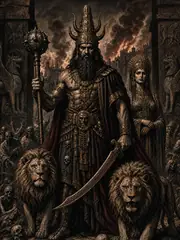 Before thisNergal
 Next on the wallNinlil
Curator’s note
What the sources say, and what later tradition added. The sources for this bay
The image of two snakes entwined upon a staff associated with Ningishzida is, to all appearances, the most ancient ancestor of the caduceus that came centuries later to be associated with Hermes. Whether the iconography was transmitted continuously, or whether the resemblance is convergent, is debated; but the form is certainly attested in Mesopotamia far earlier than in Greece. Ningishzida's myth is preserved chiefly in the lament Ningishzida's Journey to the Netherworld (Sumerian, Old Babylonian copies), in which the young god is taken below, mourned by his sister, and received among the dead.
Kin in the sources
Each tie is quoted from the entry that states it.
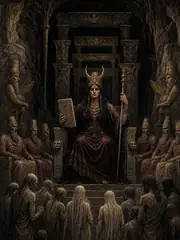 Companion ofEreshkigal
He was the throne-bearer of Ereshkigal, and a guardian of the gates of the great below
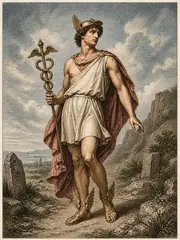 Compared withHermes
the most ancient ancestor of the caduceus that came centuries later to be associated with Hermes
When the sources speak
Dated witnesses for Sumer. A date marks when the evidence was written down, not when the belief began. The whole timeline
- c. 3400–3000 BCE
- Uruk-period writing and monumental temple economies create the earliest recoverable administrative setting for named divine institutions.
- c. 2900–2350 BCE
- Early Dynastic city-states preserve local cults, hymns, royal inscriptions, and god lists; later copies often transmit older compositions.
- c. 2334–2154 BCE
- The Akkadian Empire expands bilingual and imperial patterns of divine identification without erasing local cult titles.
- c. 2112–2004 BCE
- Ur III administration and scribal schooling standardize many Sumerian literary and liturgical forms.
- c. 2000–1600 BCE
- Old Babylonian schools copy major myths, laments, hymns, debates, and heroic narratives in the form most often used by modern editors.
- c. 1650–1200 BCE
- Hittite and Hurrian archives at Hattusa transmit Anatolian myths, imported Syrian materials, and ritual compositions.
- c. 1400–1190 BCE
- The tablets of Ugarit preserve the Baal Cycle, Kirta, Aqhat, ritual lists, and a dense Late Bronze Age West Semitic pantheon.
- c. 1000–612 BCE
- Neo-Assyrian and Neo-Babylonian empires collect, revise, and politically reinterpret older learned traditions.