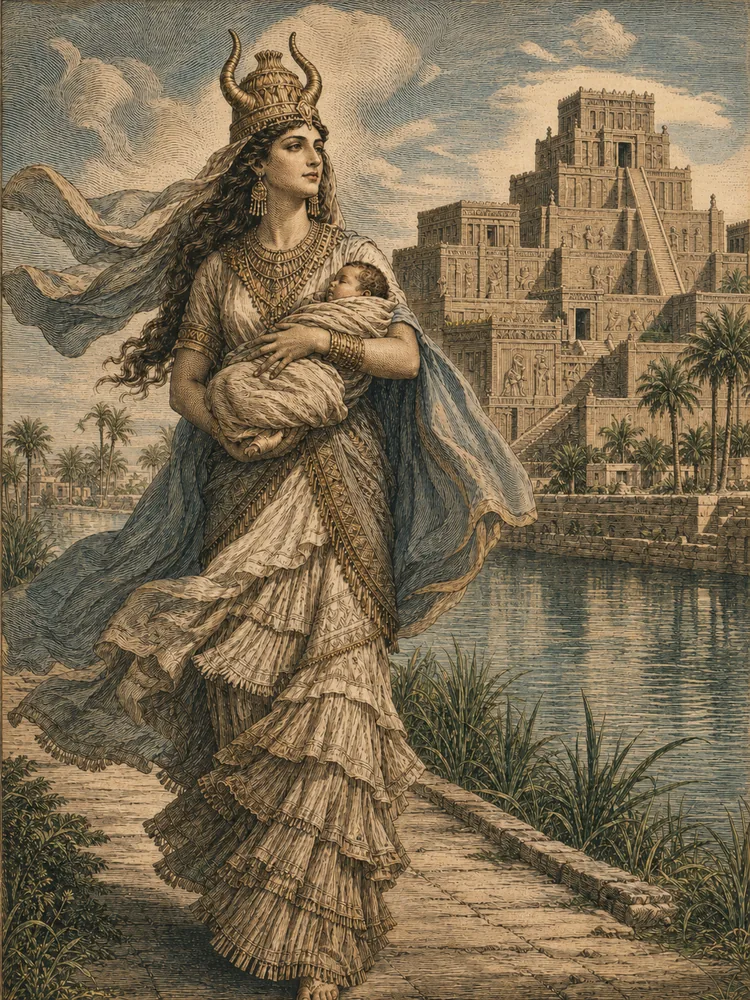
Ninlil was the consort of Enlil, the lady whose name signifies "Lady of the Open Field" or "Lady of the Wind." She was the mother of Nanna the moon, of Nergal, of Ninazu, of Enbilulu — children begotten upon her in light and in dark, as the tale of Enlil's exile (told above) records. She was honored at Nippur alongside her husband, in the great temple Tummal.
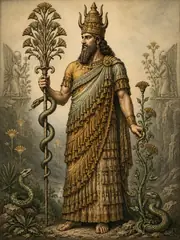 Before thisNingishzida
 Next on the wallNinurta
Curator’s note
What the sources say, and what later tradition added. The sources for this bay
Ninlil's principal myth, Enlil and Ninlil, is preserved in copies from Nippur and Ur. Her name in earlier sources is sometimes Sud, and the composition Enlil and Sud may represent an originally distinct courtship narrative subsequently grafted onto her cult. Her Akkadian counterpart is Mullissu (which becomes the title "Mylitta" in Herodotus), and in late Assyrian theology she becomes the consort of Ashur and is often equated with Ishtar.
Kin in the sources
Each tie is quoted from the entry that states it.
 Consort ofEnlil
Ninlil was the consort of Enlil
 Parent ofNanna
She was the mother of Nanna the moon, of Nergal, of Ninazu, of Enbilulu
 Parent ofNergal
She was the mother of Nanna the moon, of Nergal, of Ninazu, of Enbilulu
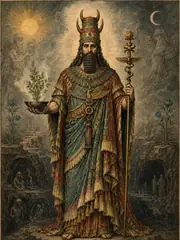 Parent ofNinazu
She was the mother of Nanna the moon, of Nergal, of Ninazu, of Enbilulu
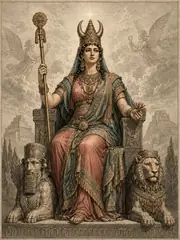 Named as the same god asMullissu
Her Akkadian counterpart is Mullissu (which becomes the title "Mylitta" in Herodotus)
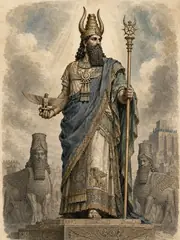 Consort ofAshur
in late Assyrian theology she becomes the consort of Ashur and is often equated with Ishtar
The same god in other rooms
The ancient sources themselves name these as one god under different names. See Ninlil and Mullissu hung together
When the sources speak
Dated witnesses for Sumer. A date marks when the evidence was written down, not when the belief began. The whole timeline
- c. 3400–3000 BCE
- Uruk-period writing and monumental temple economies create the earliest recoverable administrative setting for named divine institutions.
- c. 2900–2350 BCE
- Early Dynastic city-states preserve local cults, hymns, royal inscriptions, and god lists; later copies often transmit older compositions.
- c. 2334–2154 BCE
- The Akkadian Empire expands bilingual and imperial patterns of divine identification without erasing local cult titles.
- c. 2112–2004 BCE
- Ur III administration and scribal schooling standardize many Sumerian literary and liturgical forms.
- c. 2000–1600 BCE
- Old Babylonian schools copy major myths, laments, hymns, debates, and heroic narratives in the form most often used by modern editors.
- c. 1650–1200 BCE
- Hittite and Hurrian archives at Hattusa transmit Anatolian myths, imported Syrian materials, and ritual compositions.
- c. 1400–1190 BCE
- The tablets of Ugarit preserve the Baal Cycle, Kirta, Aqhat, ritual lists, and a dense Late Bronze Age West Semitic pantheon.
- c. 1000–612 BCE
- Neo-Assyrian and Neo-Babylonian empires collect, revise, and politically reinterpret older learned traditions.