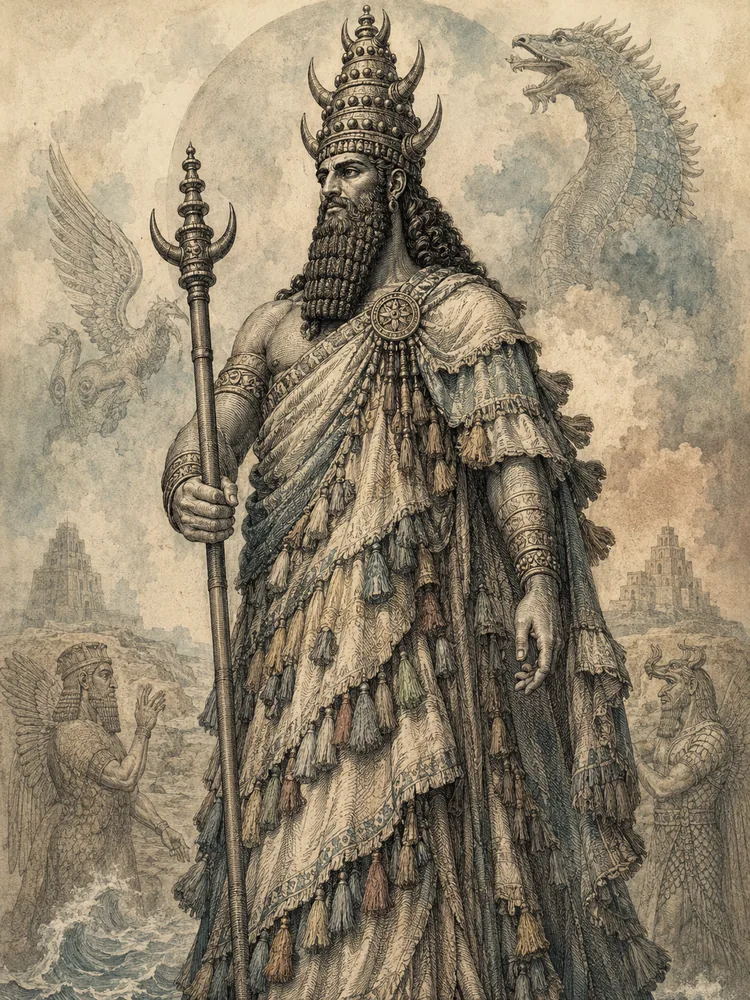
Kingu was a son of Tiamat. After the slaying of Apsu, when Tiamat resolved upon war, she chose Kingu out of her children to be her general and her new consort, and she fastened to his breast the Tablet of Destinies, that he might command the host. He led her army of monsters against Marduk, but in the great battle his courage failed him; he saw Tiamat slain, and he himself was bound and led captive. The Tablet of Destinies Marduk took from him, and fastened upon his own breast. Then Kingu was tried before the assembly of the gods; and the gods decreed that he should die, and that from his blood mankind should be fashioned, that mankind might bear the labor of the gods upon their behalf. So Kingu was slain, and Ea took his blood and mixed it with clay, and the human race was made.
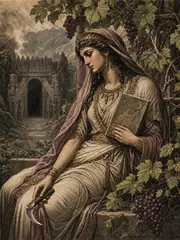 Before thisGeshtinanna
 Next on the wallLamashtu
Curator’s note
What the sources say, and what later tradition added. The sources for this bay
Kingu's tale is told in Tablets I and VI of the Enuma Elish. The motif of mankind made from divine blood mixed with clay is also found, with variations, in the Atrahasis Epic, where the slain god is named We-ila or Geshtu-e. The doctrine that human nature contains, by its very composition, the rebellious blood of a slain god is one of the more striking theological statements of Mesopotamian thought, and has been compared with various later anthropological mythologies, including Orphic doctrines about the Titans and Dionysus.
Kin in the sources
Each tie is quoted from the entry that states it.
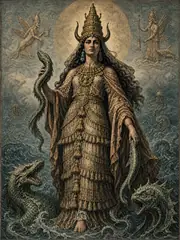 Child ofTiamat
Kingu was a son of Tiamat
- Consort ofTiamat
she chose Kingu out of her children to be her general and her new consort
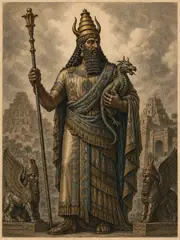 Rival ofMarduk
He led her army of monsters against Marduk
When the sources speak
Dated witnesses for Sumer. A date marks when the evidence was written down, not when the belief began. The whole timeline
- c. 3400–3000 BCE
- Uruk-period writing and monumental temple economies create the earliest recoverable administrative setting for named divine institutions.
- c. 2900–2350 BCE
- Early Dynastic city-states preserve local cults, hymns, royal inscriptions, and god lists; later copies often transmit older compositions.
- c. 2334–2154 BCE
- The Akkadian Empire expands bilingual and imperial patterns of divine identification without erasing local cult titles.
- c. 2112–2004 BCE
- Ur III administration and scribal schooling standardize many Sumerian literary and liturgical forms.
- c. 2000–1600 BCE
- Old Babylonian schools copy major myths, laments, hymns, debates, and heroic narratives in the form most often used by modern editors.
- c. 1650–1200 BCE
- Hittite and Hurrian archives at Hattusa transmit Anatolian myths, imported Syrian materials, and ritual compositions.
- c. 1400–1190 BCE
- The tablets of Ugarit preserve the Baal Cycle, Kirta, Aqhat, ritual lists, and a dense Late Bronze Age West Semitic pantheon.
- c. 1000–612 BCE
- Neo-Assyrian and Neo-Babylonian empires collect, revise, and politically reinterpret older learned traditions.