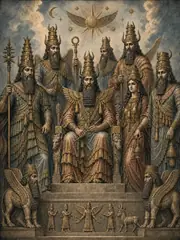
A Compendium of the Ancient Gods
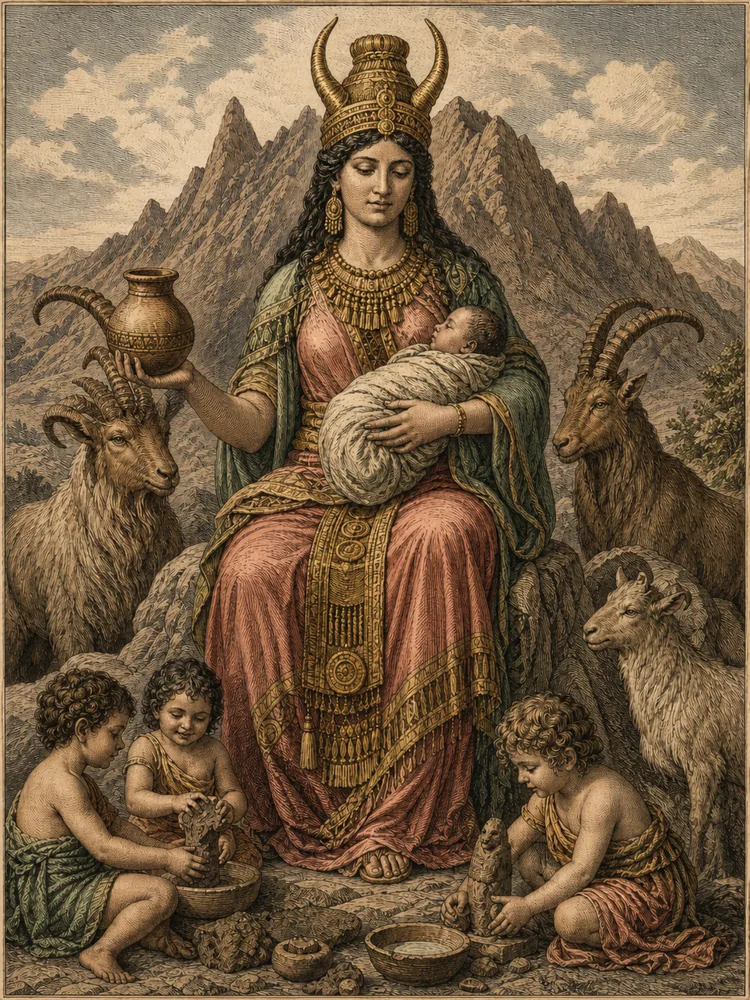
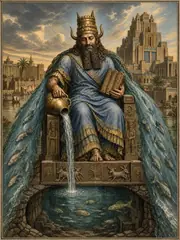
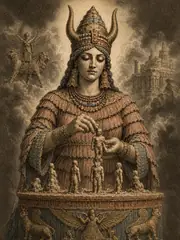
Ninhursag, plate

Ninhursag was the mother goddess of Sumer, the lady of the rocky uplands where the wild beasts brought forth their young. Her names were many — Ninmah "the Exalted Lady," Nintu "the Lady of Birth," Damgalnuna "the Great Wife of the Prince," Mami — and her offices ran the length of every threshold at which a thing came into being. She was the midwife of the gods at their first generation; she fashioned the human form alongside Enki when humankind was made; and she was the patroness of all that is born from the earth — kid, lamb, calf, and child.

Of her quarrel with Enki the Sumerians told a strange and tender tale. In the paradise-garden of Dilmun, where there was no sickness and no death, Enki and Ninhursag begat a daughter, and upon that daughter another daughter, and upon her another, until at last Enki, going through the marshes, came upon eight new plants and ate them all; for he wished to know their natures. Then Ninhursag was angry — for those plants were her own offspring — and she cursed Enki, saying, "Until thou diest, I will not look upon thee with the eye of life." And Enki sickened in eight places of his body, and was at the point of death.

Then a fox went to the gods and said, "If I bring back Ninhursag, what will ye give me?" And they promised the fox great honors. The fox went and persuaded Ninhursag to return; and she came, and set Enki upon her vulva, and asked him, "My brother, what part hurts thee?" And as he named each part — "my jaw, my mouth, my tooth, my throat, my arm, my rib, my side" — for each she brought forth a healing goddess, eight in all; and so she undid her curse, and Enki rose from his bed.
Curator’s note

What the sources say, and what later tradition added. The sources for this bay

This is the myth Enki and Ninhursag, preserved on a single Old Babylonian tablet from Nippur, with a duplicate from Ur. It is among the most enigmatic of Sumerian compositions, and the symbolic logic of the eight body-parts producing eight healing goddesses (whose names are puns on the body-parts) is plainly older than the surviving text. The Dilmun in which the action is set was a real place — modern Bahrain — but is presented in the myth as a mythic paradise. The story has been compared, since the early days of Assyriology, with the garden of Eden narrative in Genesis; the comparison is suggestive but should not be pressed into identity. Ninhursag's name ("Lady of the Foothills") locates her originally in the rocky country east of the Tigris, where the great cult-centers of mother-goddesses were ancient. Her Akkadian counterpart Belet-ili ("Lady of the Gods") and Mami carry on her offices in the later Mesopotamian pantheon.

Kin in the sources

Each tie is quoted from the entry that states it.

The same god in other rooms

The ancient sources themselves name these as one god under different names. See Ninhursag and Belet-Ili hung together

When the sources speak

Dated witnesses for Sumer. A date marks when the evidence was written down, not when the belief began. The whole timeline

c. 3400–3000 BCE
Uruk-period writing and monumental temple economies create the earliest recoverable administrative setting for named divine institutions.
c. 2900–2350 BCE
Early Dynastic city-states preserve local cults, hymns, royal inscriptions, and god lists; later copies often transmit older compositions.
c. 2334–2154 BCE
The Akkadian Empire expands bilingual and imperial patterns of divine identification without erasing local cult titles.
c. 2112–2004 BCE
Ur III administration and scribal schooling standardize many Sumerian literary and liturgical forms.
c. 2000–1600 BCE
Old Babylonian schools copy major myths, laments, hymns, debates, and heroic narratives in the form most often used by modern editors.
c. 1650–1200 BCE
Hittite and Hurrian archives at Hattusa transmit Anatolian myths, imported Syrian materials, and ritual compositions.
c. 1400–1190 BCE
The tablets of Ugarit preserve the Baal Cycle, Kirta, Aqhat, ritual lists, and a dense Late Bronze Age West Semitic pantheon.
c. 1000–612 BCE
Neo-Assyrian and Neo-Babylonian empires collect, revise, and politically reinterpret older learned traditions.

Floor plan

The rooms follow one another in the order their peoples first appear in the written record.

  1. The Cradle of Citiesc. 3400 BCE to 395 CE. 115 works
  2. The Gift of the Nilec. 4000 BCE to 395 CE. 73 works
  3. The Olympian Orderc. 1600 BCE to 750 CE. 152 works
  4. The Persian Worldc. 2000 BCE to 1010 CE. 30 works
  5. The Levantine Borderlandsc. 1200 BCE to 500 CE. 20 works
  6. The Edges of Empirec. 2000 BCE to 1500 CE. 33 works
  7. The Etruscan Worldc. 900 BCE to 750 CE. 22 works
  8. The Roman Inheritancec. 1200 BCE to 500 CE. 58 works
  9. The Northern Inheritancec. 2000 BCE to 1600 CE. 131 works