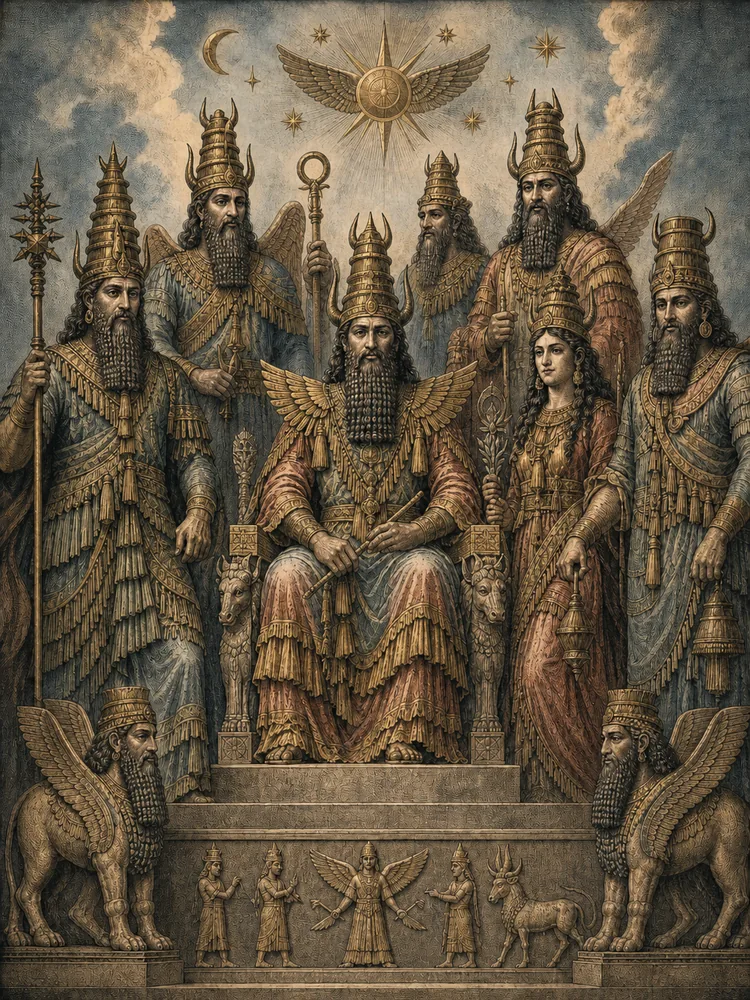
The Anunnaki were the gods of Sumer in their full assembly: the children of Anu, the great gods who held the offices of heaven and earth and decreed the destinies of cities and of men. The name signifies "the princely seed," or "those who came down from heaven": all the high gods together, distinguished from the lesser Igigi who served them. In the early literature, the line between Anunnaki and Igigi is fluid; in the Enuma Elish, the distinction is firm — three hundred Anunnaki ruled in heaven, three hundred in the underworld, and the Igigi were assigned the labor of the earth. When the Igigi mutinied at their burdens, it was for their relief that mankind was created.
In council, the Anunnaki are seen most often debating the fate of cities or of mortals: when Inanna descends to the underworld, it is the seven Anunnaki of the dark realm who pass judgment upon her; when the Flood is decreed, it is the Anunnaki who weep at the sight of mankind drowning. They are, in short, the divine senate of Mesopotamia: august, somewhat formal, and at their best when sitting in conclave.
Curator’s note
What the sources say, and what later tradition added. The sources for this bay
The term Anunnaki appears throughout Sumerian, Akkadian, Babylonian, and Assyrian literature, with shifting referents. In the third millennium BCE, the Anunna are the high gods generally; by the late second millennium, in the Enuma Elish and Atrahasis traditions, they are sharply distinguished from the laboring Igigi. Modern speculative literature, beginning with the works of Zecharia Sitchin in the 1970s, has constructed elaborate "ancient astronaut" theories around this name; these have no basis whatever in the cuneiform record, which is concerned simply with assembling and ranking the gods of the great cities. The reader is cautioned to distinguish the genuine ancient term from its modern misappropriation.
When the sources speak
Dated witnesses for Sumer. A date marks when the evidence was written down, not when the belief began. The whole timeline
- c. 3400–3000 BCE
- Uruk-period writing and monumental temple economies create the earliest recoverable administrative setting for named divine institutions.
- c. 2900–2350 BCE
- Early Dynastic city-states preserve local cults, hymns, royal inscriptions, and god lists; later copies often transmit older compositions.
- c. 2334–2154 BCE
- The Akkadian Empire expands bilingual and imperial patterns of divine identification without erasing local cult titles.
- c. 2112–2004 BCE
- Ur III administration and scribal schooling standardize many Sumerian literary and liturgical forms.
- c. 2000–1600 BCE
- Old Babylonian schools copy major myths, laments, hymns, debates, and heroic narratives in the form most often used by modern editors.
- c. 1650–1200 BCE
- Hittite and Hurrian archives at Hattusa transmit Anatolian myths, imported Syrian materials, and ritual compositions.
- c. 1400–1190 BCE
- The tablets of Ugarit preserve the Baal Cycle, Kirta, Aqhat, ritual lists, and a dense Late Bronze Age West Semitic pantheon.
- c. 1000–612 BCE
- Neo-Assyrian and Neo-Babylonian empires collect, revise, and politically reinterpret older learned traditions.