A Compendium of the Ancient Gods
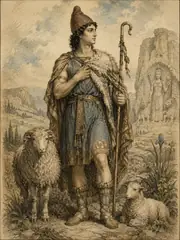
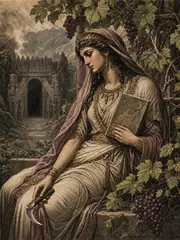
Dumuzi, plate

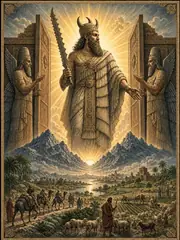
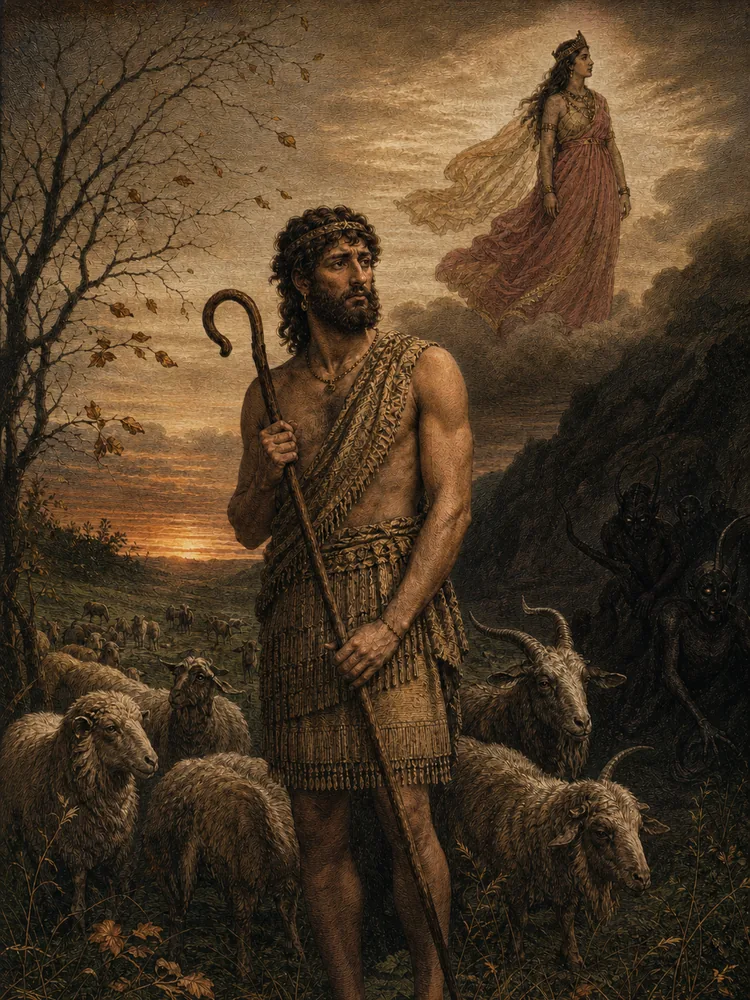
Dumuzi was a shepherd, the lord of the sheepfolds, and his name signified "the faithful son." He was the chosen lover of Inanna, queen of heaven; and the songs of their courtship were among the most beautiful that the Sumerians sang. "As I was passing the city of Erech," Inanna says in one of these poems, "the shepherd offered me cream, the gardener offered me dates. I took the dates from the gardener, but I took the shepherd into my bed." Their wedding was the great festival of the spring, when the king of Uruk, in the role of Dumuzi, was wedded to the high priestess of Inanna, that the land might be fruitful.

But the marriage ended ill. Inanna descended into the underworld, was slain there by her sister Ereshkigal, and was at length restored — on the condition that another should take her place below. She rose in fury through the streets, accompanied by demons of the dark realm; and she found Dumuzi seated upon her throne, dressed in royal robes, taking his ease, and not mourning her. Then her eye fastened upon him with the eye of death, and she gave him over to the demons. "This one," she said, "take him." The demons seized Dumuzi, and beat him, and bound him; and Dumuzi wept, and called upon the sun-god Utu his brother-in-law for help, and was changed into a snake, and into a gazelle, and fled across the steppe. But the demons hunted him down at last, and dragged him into the underworld.

Then Inanna's anger turned to grief, for she had loved him. And his sister Geshtinanna, the lady of the vine, also wept; and she begged that she might take her brother's place. So at the last it was decreed: half the year Dumuzi should dwell in the underworld, and half the year his sister Geshtinanna; and when he came up, the spring would come up with him, and when he went down, the autumn would lay her hand upon the land.
Curator’s note

What the sources say, and what later tradition added. The sources for this bay

Dumuzi (Akkadian Tammuz) is one of the central figures of Mesopotamian religion. His myths are preserved in the Sumerian Inanna and Dumuzi cycle, the Descent of Inanna, the Dream of Dumuzi, and various lament-compositions used in the seasonal mourning rites. The lament-songs (gala-balag) preserve some of the most personal poetry of the ancient Near East. The cult of Dumuzi/Tammuz was widespread; the prophet Ezekiel (Ezekiel 8:14, 6th c. BCE), in his vision of the abominations in the Jerusalem temple, sees the women of Israel "weeping for Tammuz" — a clear reference to the seasonal lament. The figure stands at the head of a long line of dying-and-rising consorts of mother goddesses (Adonis, Attis, Osiris by some readings) whose interrelations were much theorized by Sir James Frazer in The Golden Bough; modern scholarship has tempered Frazer's grand synthesis but has not abolished the family resemblance.

Kin in the sources

Each tie is quoted from the entry that states it.

The same god in other rooms

The ancient sources themselves name these as one god under different names. See Dumuzi and Adonis hung together

When the sources speak

Dated witnesses for Sumer. A date marks when the evidence was written down, not when the belief began. The whole timeline

c. 3400–3000 BCE
Uruk-period writing and monumental temple economies create the earliest recoverable administrative setting for named divine institutions.
c. 2900–2350 BCE
Early Dynastic city-states preserve local cults, hymns, royal inscriptions, and god lists; later copies often transmit older compositions.
c. 2334–2154 BCE
The Akkadian Empire expands bilingual and imperial patterns of divine identification without erasing local cult titles.
c. 2112–2004 BCE
Ur III administration and scribal schooling standardize many Sumerian literary and liturgical forms.
c. 2000–1600 BCE
Old Babylonian schools copy major myths, laments, hymns, debates, and heroic narratives in the form most often used by modern editors.
c. 1650–1200 BCE
Hittite and Hurrian archives at Hattusa transmit Anatolian myths, imported Syrian materials, and ritual compositions.
c. 1400–1190 BCE
The tablets of Ugarit preserve the Baal Cycle, Kirta, Aqhat, ritual lists, and a dense Late Bronze Age West Semitic pantheon.
c. 1000–612 BCE
Neo-Assyrian and Neo-Babylonian empires collect, revise, and politically reinterpret older learned traditions.

Floor plan

The rooms follow one another in the order their peoples first appear in the written record.

  1. The Cradle of Citiesc. 3400 BCE to 395 CE. 115 works
  2. The Gift of the Nilec. 4000 BCE to 395 CE. 73 works
  3. The Olympian Orderc. 1600 BCE to 750 CE. 152 works
  4. The Persian Worldc. 2000 BCE to 1010 CE. 30 works
  5. The Levantine Borderlandsc. 1200 BCE to 500 CE. 20 works
  6. The Edges of Empirec. 2000 BCE to 1500 CE. 33 works
  7. The Etruscan Worldc. 900 BCE to 750 CE. 22 works
  8. The Roman Inheritancec. 1200 BCE to 500 CE. 58 works
  9. The Northern Inheritancec. 2000 BCE to 1600 CE. 131 works