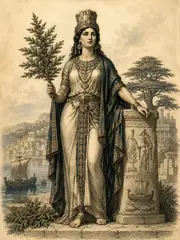
A Compendium of the Ancient Gods
Adonis, plate

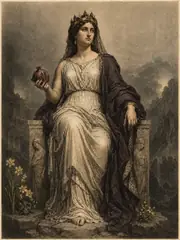
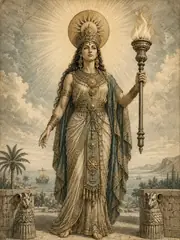
From the Phoenician word ʾadon — "lord" — the Greeks took the name of a god whose annual death and resurrection became, in the Hellenistic and Roman periods, one of the most popular cult-festivals of the eastern Mediterranean: Adonis, lover of Astarte, slain by a wild boar and mourned by his goddess until, with the new year, he rose again. Behind the Greek figure stands an older Levantine substrate. The Phoenicians did not call him Adonis; they used the title alone, the lord of so-and-so, as one used Baal of so-and-so. The Greeks took the title for the name and made it personal.

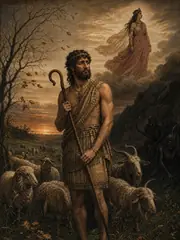
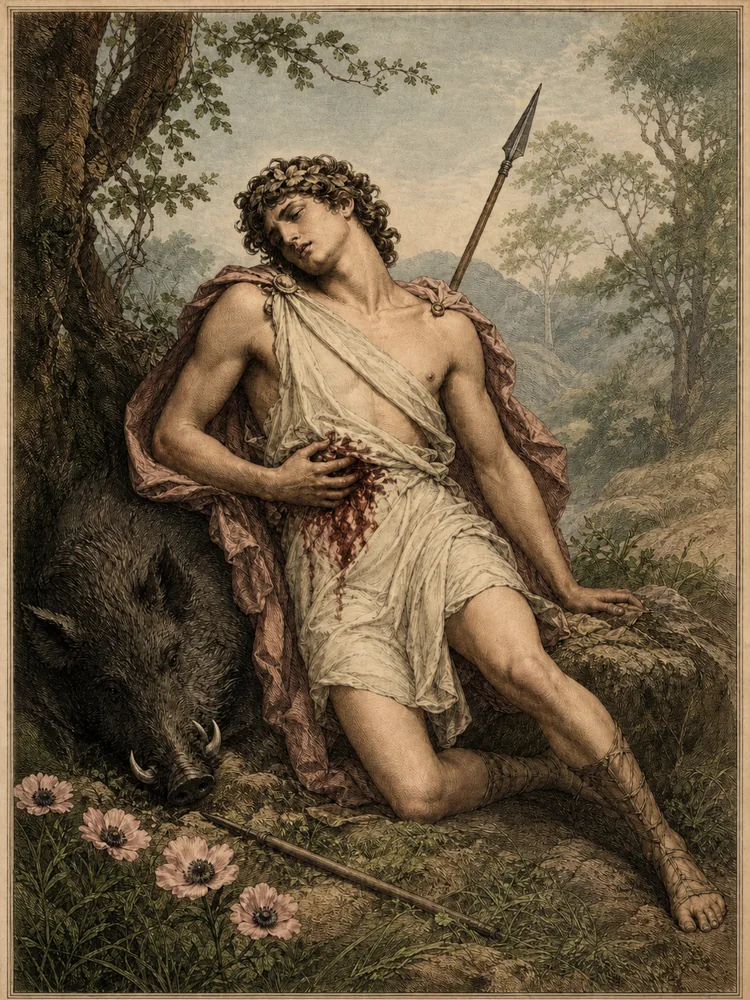
The myth in its standard Greek form (as told by Apollodorus, Ovid, and others) runs that Adonis was the son of Myrrha by her own father, transformed into the myrrh-tree to escape his wrath; that he was beautiful beyond all youths, beloved of Aphrodite who hid him as an infant in a chest entrusted to Persephone of the underworld; that Persephone, opening the chest, fell in love with him also, and refused to return him; that Zeus, called to arbitrate, ruled that Adonis should spend a third of the year with each goddess and a third where he chose; and that Adonis, as a man, hunted and was slain by a wild boar, dying in Aphrodite's arms while she sought to staunch his blood with red roses.

The annual festival of his mourning — celebrated at Byblos, at Alexandria, at Athens, and in many other cities — included the planting of "gardens of Adonis" (small pots of fast-growing seedlings which the women set on the rooftops in the summer heat, where they sprouted quickly and as quickly withered, in mimicry of the god's brief life) and the loud lamentation of his death by women in procession. Theocritus (Idyll 15) describes the Alexandrian Adonia of the third century BCE with affectionate humor; Ezekiel 8:14 records, with disapproval, the women weeping for Tammuz at the gate of the Jerusalem Temple — the same dying-god under his older Mesopotamian name.
Curator’s note

What the sources say, and what later tradition added. The sources for this bay

The name Adonis is the Hellenization of Phoenician ʾdn, "lord," and represents a transfer of cultic vocabulary across linguistic boundaries: what was an honorific epithet in Phoenician became a personal divine name in Greek. The principal Greek narrative sources are Apollodorus 3.14.4, Ovid Metamorphoses 10.298-559, and (for the cult) Theocritus Idyll 15. The Levantine substrate — Phoenician dying-god rites mourned by women — is documented in earlier sources including Ezekiel 8:14 (Tammuz being the Mesopotamian name for the Sumerian Dumuzi, into whose family of dying-and-rising fertility gods Adonis fits). The principal cult-center of Adonis was Byblos (Phoenician Gebal), where the river Adonis (modern Nahr Ibrahim) was said to run red each spring with the god's blood — actually the seasonal staining of the water by red soil washed down from the Lebanon mountains. The festival pattern, including the rooftop "gardens," is one of the better-documented women's religious practices of the ancient Mediterranean.

Kin in the sources

Each tie is quoted from the entry that states it.

The same god in other rooms

The ancient sources themselves name these as one god under different names. See Dumuzi and Adonis hung together

When the sources speak

Dated witnesses for Canaan and Phoenicia. A date marks when the evidence was written down, not when the belief began. The whole timeline

c. 3400–3000 BCE
Uruk-period writing and monumental temple economies create the earliest recoverable administrative setting for named divine institutions.
c. 2900–2350 BCE
Early Dynastic city-states preserve local cults, hymns, royal inscriptions, and god lists; later copies often transmit older compositions.
c. 2334–2154 BCE
The Akkadian Empire expands bilingual and imperial patterns of divine identification without erasing local cult titles.
c. 2112–2004 BCE
Ur III administration and scribal schooling standardize many Sumerian literary and liturgical forms.
c. 2000–1600 BCE
Old Babylonian schools copy major myths, laments, hymns, debates, and heroic narratives in the form most often used by modern editors.
c. 1650–1200 BCE
Hittite and Hurrian archives at Hattusa transmit Anatolian myths, imported Syrian materials, and ritual compositions.
c. 1400–1190 BCE
The tablets of Ugarit preserve the Baal Cycle, Kirta, Aqhat, ritual lists, and a dense Late Bronze Age West Semitic pantheon.
c. 1000–612 BCE
Neo-Assyrian and Neo-Babylonian empires collect, revise, and politically reinterpret older learned traditions.

Floor plan

The rooms follow one another in the order their peoples first appear in the written record.

  1. The Cradle of Citiesc. 3400 BCE to 395 CE. 115 works
  2. The Gift of the Nilec. 4000 BCE to 395 CE. 73 works
  3. The Olympian Orderc. 1600 BCE to 750 CE. 152 works
  4. The Persian Worldc. 2000 BCE to 1010 CE. 30 works
  5. The Levantine Borderlandsc. 1200 BCE to 500 CE. 20 works
  6. The Edges of Empirec. 2000 BCE to 1500 CE. 33 works
  7. The Etruscan Worldc. 900 BCE to 750 CE. 22 works
  8. The Roman Inheritancec. 1200 BCE to 500 CE. 58 works
  9. The Northern Inheritancec. 2000 BCE to 1600 CE. 131 works