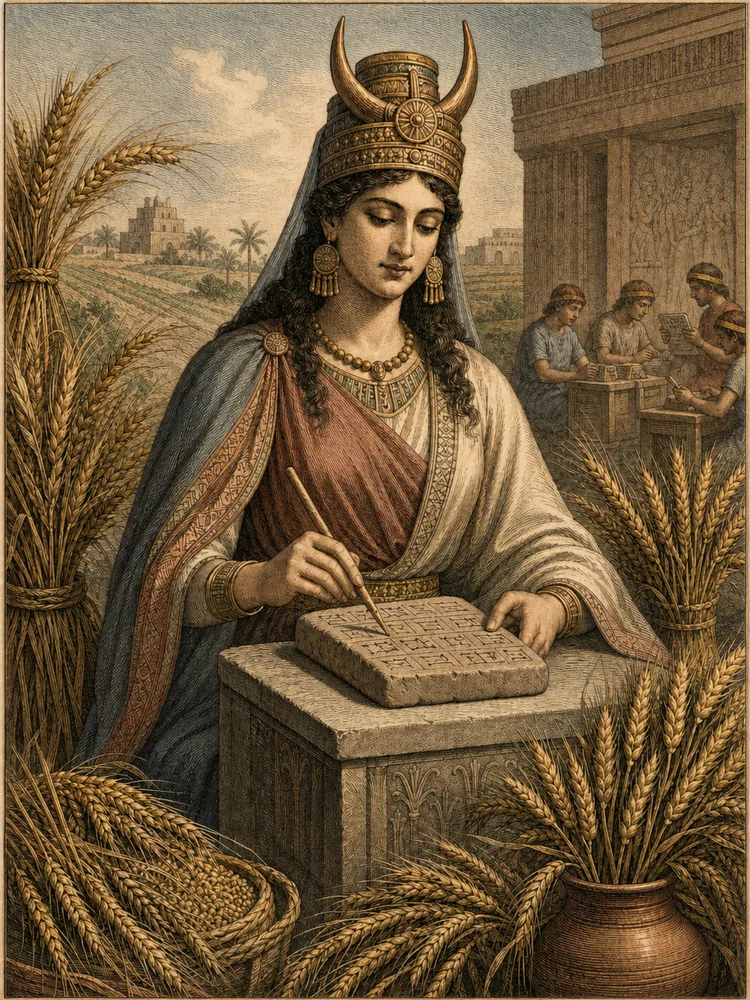
Nisaba was the goddess of grain — barley first of all — and of the reed that grew beside the grain in the marshes; and because the reed cut into a stylus made the marks upon the wet clay tablets, she was also the goddess of writing, of accounting, and of the schools where scribes were taught. The Sumerian scribe ended his composition with the formula: "Praise be to Nisaba." The whole literate tradition of Sumer placed itself under her hand.
 Before thisNinurta
 Next on the wallUtu
Curator’s note
What the sources say, and what later tradition added. The sources for this bay
Nisaba's literary patronage is attested in countless colophons. The Hymn to Nisaba and the Examination Text A (a Sumerian school text describing scribal training) are the principal compositions devoted to her. By the second millennium BCE, much of her scribal office had been transferred to the male god Nabu of Borsippa, the son of Marduk, who became in the Babylonian system the patron of writing — a transfer that paralleled the political eclipse of the Sumerian cities by the rising Babylonian state.
When the sources speak
Dated witnesses for Sumer. A date marks when the evidence was written down, not when the belief began. The whole timeline
- c. 3400–3000 BCE
- Uruk-period writing and monumental temple economies create the earliest recoverable administrative setting for named divine institutions.
- c. 2900–2350 BCE
- Early Dynastic city-states preserve local cults, hymns, royal inscriptions, and god lists; later copies often transmit older compositions.
- c. 2334–2154 BCE
- The Akkadian Empire expands bilingual and imperial patterns of divine identification without erasing local cult titles.
- c. 2112–2004 BCE
- Ur III administration and scribal schooling standardize many Sumerian literary and liturgical forms.
- c. 2000–1600 BCE
- Old Babylonian schools copy major myths, laments, hymns, debates, and heroic narratives in the form most often used by modern editors.
- c. 1650–1200 BCE
- Hittite and Hurrian archives at Hattusa transmit Anatolian myths, imported Syrian materials, and ritual compositions.
- c. 1400–1190 BCE
- The tablets of Ugarit preserve the Baal Cycle, Kirta, Aqhat, ritual lists, and a dense Late Bronze Age West Semitic pantheon.
- c. 1000–612 BCE
- Neo-Assyrian and Neo-Babylonian empires collect, revise, and politically reinterpret older learned traditions.