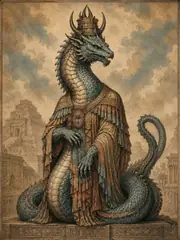
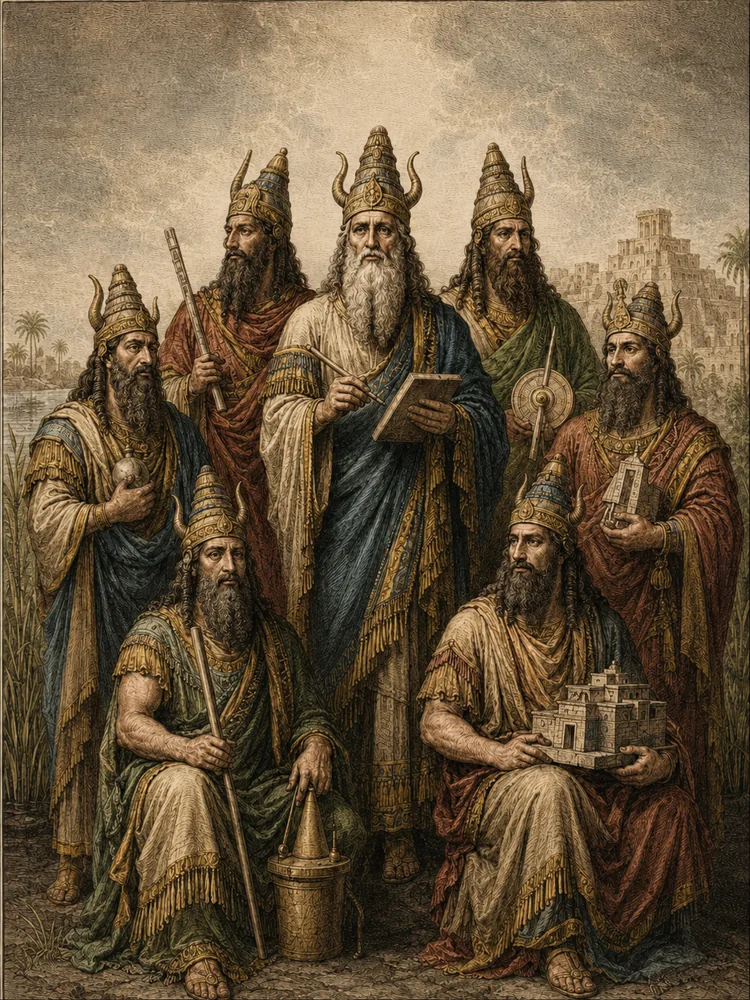
Before the great Flood, there appeared upon the shore of the Persian Gulf, where the freshwater of Eridu mingled with the saltwater of the sea, seven beings whom the Sumerians called the Abgal and the Akkadians the Apkallu — "the Sages." They had the bodies of fish from the waist down and the bodies of men above; they emerged from the water at dawn and returned to it at evening; and during the daytime they instructed the people of Sumer in the arts of civilization. From them, said the tradition, mankind learned the letters of writing, the measurement of fields, the founding of cities, the framing of laws, the making of bricks, the brewing of beer.
The first of these Sages was Adapa-Uan, who came up from the Apsu in the time of the first king Alulim of Eridu. There were six who followed him, each in the reign of a different antediluvian king; and after the Flood, the tradition continued in attenuated form, with sages of human birth taking the place of the divine instructors. The Babylonians compiled lists; they preserved the names; they fashioned protective figurines of the Apkallu in clay and buried them in pairs at the corners and thresholds of buildings — that the founding wisdom of the world might attend the foundations of houses.
The figures came down to the Greek world through Berossus, the Babylonian priest who in the third century BCE wrote a history of his civilization in Greek; he reported that the chief of the Sages, whom he called Oannes, had emerged from the Persian Gulf and had taught mankind "all things which contribute to a regular life, and to take away the rude and savage way of living." The Greeks read Berossus with curiosity; later writers, both classical and modern, have read the figures of the Sages with various imaginations, sometimes overheated.
Curator’s note
What the sources say, and what later tradition added. The sources for this bay
The Apkallu (singular apkallu) are documented in the Bīt mēseri ritual texts, in the antediluvian-king lists, and most extensively in the astronomical compendium known as the Uruk List of Kings and Sages, which pairs each pre-Flood king with his sage-counsellor. Apotropaic figurines of the Apkallu — sometimes fish-cloaked, sometimes bird-headed, sometimes in the guise of pure-water sprinklers — are among the most common Mesopotamian ritual objects, recovered in great numbers from the foundations and corners of Neo-Assyrian palaces. Berossus's account, preserved in fragments by Christian writers (Eusebius, Syncellus, and others), is the principal vector by which the Sages entered classical and later esoteric literature. The figure of Oannes/Adapa-Uan has been a perennial subject of speculation by enthusiasts of "ancient astronaut" and similar theories, who read the fish-suit literally as a diving apparatus; serious scholarship treats the iconography as a sacred costume worn by exorcist-priests in their rituals, who took on the role of the Sages in their professional capacity.
When the sources speak
Dated witnesses for Akkad, Babylon and Assyria. A date marks when the evidence was written down, not when the belief began. The whole timeline
- c. 3400–3000 BCE
- Uruk-period writing and monumental temple economies create the earliest recoverable administrative setting for named divine institutions.
- c. 2900–2350 BCE
- Early Dynastic city-states preserve local cults, hymns, royal inscriptions, and god lists; later copies often transmit older compositions.
- c. 2334–2154 BCE
- The Akkadian Empire expands bilingual and imperial patterns of divine identification without erasing local cult titles.
- c. 2112–2004 BCE
- Ur III administration and scribal schooling standardize many Sumerian literary and liturgical forms.
- c. 2000–1600 BCE
- Old Babylonian schools copy major myths, laments, hymns, debates, and heroic narratives in the form most often used by modern editors.
- c. 1650–1200 BCE
- Hittite and Hurrian archives at Hattusa transmit Anatolian myths, imported Syrian materials, and ritual compositions.
- c. 1400–1190 BCE
- The tablets of Ugarit preserve the Baal Cycle, Kirta, Aqhat, ritual lists, and a dense Late Bronze Age West Semitic pantheon.
- c. 1000–612 BCE
- Neo-Assyrian and Neo-Babylonian empires collect, revise, and politically reinterpret older learned traditions.