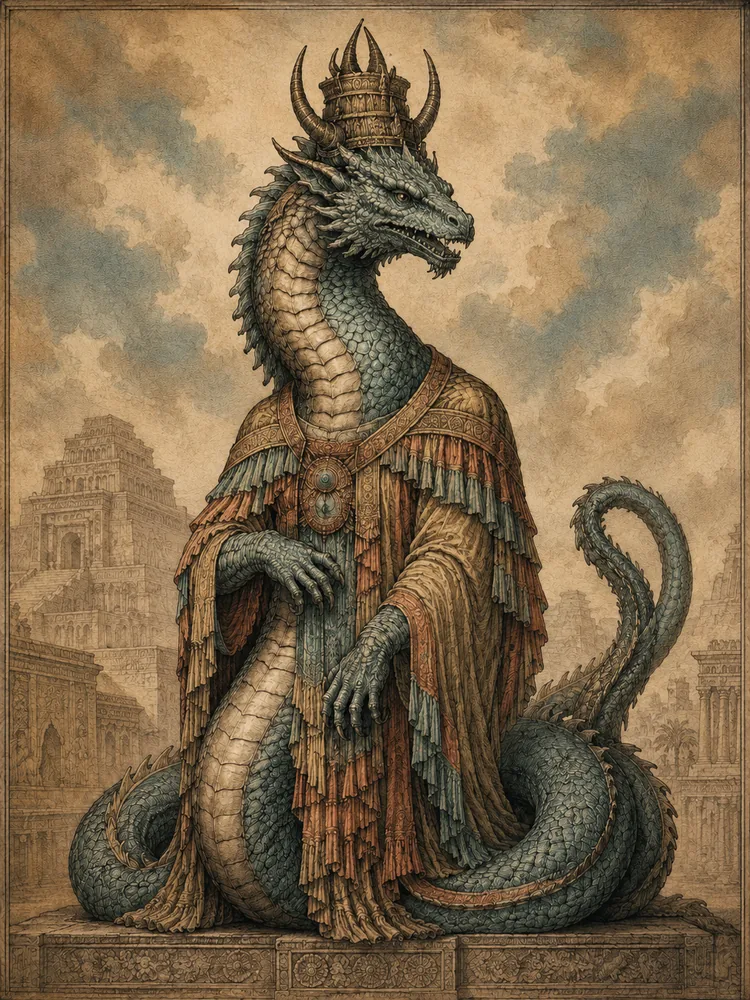
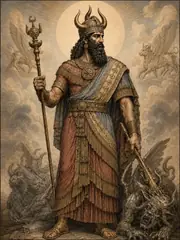
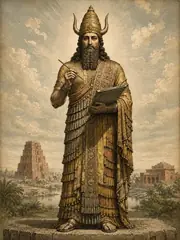
When the Babylonians wished to give visible form to the divine power that defended Marduk's throne, they imagined a creature compounded of the most formidable parts of the most formidable beasts: the body of a serpent, the forelegs of a lion, the hindlegs of an eagle, the head of a horned dragon, the long forked tongue, the upright ears, the lashing tail. They called this composite Mušḫuššu — the Furious Snake — and they set its image upon the gates and walls of their holy places, that none should approach without remembering whose city Babylon was.
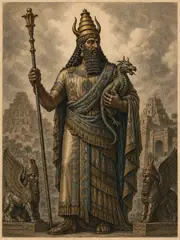
The dragon was originally, perhaps, the creature of the older god Tishpak of Eshnunna; but when Marduk rose to supremacy in the early second millennium BCE, the dragon transferred to him, and from Marduk, in time, to Nabu his son, who inherited the iconography. By the Neo-Babylonian period under Nebuchadnezzar II, the Mušḫuššu was the principal animal-attribute of the Babylonian state cult.
Its most famous representation, and that by which it is now generally known to modern visitors of museums, is found upon the Ishtar Gate of Babylon, built by Nebuchadnezzar around 575 BCE: a procession of dragons in glazed blue brick, alternating with bulls, marching along the wall on either side of the great gateway, in stately and unceasing parade. That gate, dismantled by German archaeologists in the early twentieth century and reconstructed in the Pergamon Museum at Berlin, is among the principal monuments by which Babylonian religion is now visually known.
Curator’s note
What the sources say, and what later tradition added. The sources for this bay
The Mušḫuššu's image is best preserved on the glazed-brick reliefs of the Ishtar Gate (c. 575 BCE), now in the Pergamon Museum, and on processional ways and palace decorations of the Neo-Babylonian and Achaemenid periods. The composite-monster type is widespread in ancient Near Eastern art (compare the Egyptian griffin, the Anatolian sphinx, the Hittite mountain-monsters); the Mušḫuššu is its most architecturally monumental Mesopotamian instance. The creature's name is sometimes anglicized as "sirrush," a corruption first popularized by Robert Koldewey, the excavator of Babylon. It has been suggested, never with persuasive evidence, that the Mušḫuššu represents some real animal — a monitor lizard, an exotic reptile imported from Africa, even a surviving dinosaur. The composite character of the figure makes any such literal identification implausible; what the Mušḫuššu represents is a theological idea, not a zoological specimen.
When the sources speak
Dated witnesses for Akkad, Babylon and Assyria. A date marks when the evidence was written down, not when the belief began. The whole timeline
- c. 3400–3000 BCE
- Uruk-period writing and monumental temple economies create the earliest recoverable administrative setting for named divine institutions.
- c. 2900–2350 BCE
- Early Dynastic city-states preserve local cults, hymns, royal inscriptions, and god lists; later copies often transmit older compositions.
- c. 2334–2154 BCE
- The Akkadian Empire expands bilingual and imperial patterns of divine identification without erasing local cult titles.
- c. 2112–2004 BCE
- Ur III administration and scribal schooling standardize many Sumerian literary and liturgical forms.
- c. 2000–1600 BCE
- Old Babylonian schools copy major myths, laments, hymns, debates, and heroic narratives in the form most often used by modern editors.
- c. 1650–1200 BCE
- Hittite and Hurrian archives at Hattusa transmit Anatolian myths, imported Syrian materials, and ritual compositions.
- c. 1400–1190 BCE
- The tablets of Ugarit preserve the Baal Cycle, Kirta, Aqhat, ritual lists, and a dense Late Bronze Age West Semitic pantheon.
- c. 1000–612 BCE
- Neo-Assyrian and Neo-Babylonian empires collect, revise, and politically reinterpret older learned traditions.