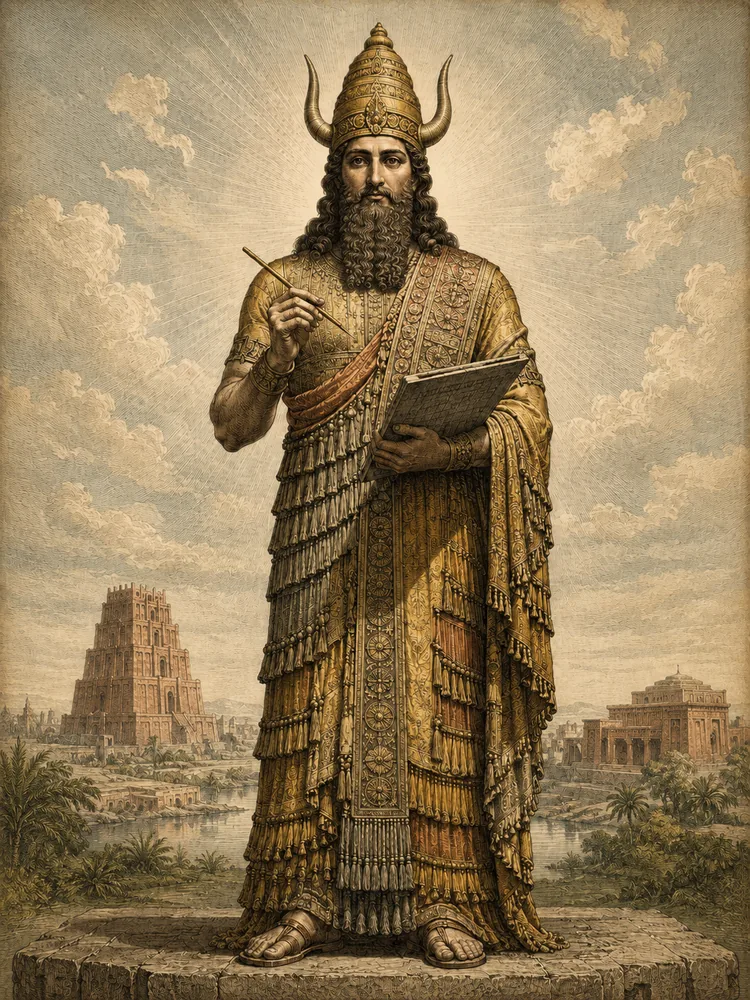
Nabu was the divine scribe, the keeper of the Tablet of Destinies, the patron of writing and of all the arts of the educated. He was the son of Marduk and his consort Sarpanitum; his city was Borsippa, just south of Babylon, where his temple Ezida — "the True House" — stood. Each year at the Babylonian New Year, the image of Nabu was carried in solemn procession from Borsippa to Babylon, that he might attend his father in the great festival. His emblem was the writing-stylus and the clay tablet.
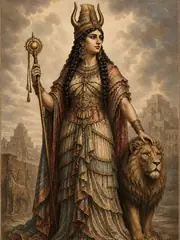 Before thisIshtar of Nineveh
 Next on the wallGallu
Curator’s note
What the sources say, and what later tradition added. The sources for this bay
Nabu's rise paralleled Marduk's. As Marduk took over Enlil's office of supreme god, Nabu took over Nisaba's (and partially Nidaba's) office of scribal patron; the transfer of literary patronage from female to male deity is one of the marked features of the Old and Middle Babylonian theological reorganization. Nabu's name underlies the biblical theophoric names Nebuchadnezzar (Nabu-kudurri-uṣur, "Nabu, protect my boundary") and Nabopolassar (Nabu-apla-uṣur, "Nabu, protect the heir"). His cult survived in Babylonia into the early centuries of the common era; the Sabian sect of Harran, which preserved Mesopotamian polytheism into the Islamic period, included Nabu among its principal deities.
Kin in the sources
Each tie is quoted from the entry that states it.
 Child ofMarduk
He was the son of Marduk and his consort Sarpanitum
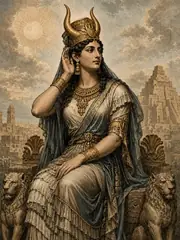 Consort ofTashmetum
To the scribe-god Nabu, son of Marduk and patron of writing, was wedded Tashmetum
When the sources speak
Dated witnesses for Akkad, Babylon and Assyria. A date marks when the evidence was written down, not when the belief began. The whole timeline
- c. 3400–3000 BCE
- Uruk-period writing and monumental temple economies create the earliest recoverable administrative setting for named divine institutions.
- c. 2900–2350 BCE
- Early Dynastic city-states preserve local cults, hymns, royal inscriptions, and god lists; later copies often transmit older compositions.
- c. 2334–2154 BCE
- The Akkadian Empire expands bilingual and imperial patterns of divine identification without erasing local cult titles.
- c. 2112–2004 BCE
- Ur III administration and scribal schooling standardize many Sumerian literary and liturgical forms.
- c. 2000–1600 BCE
- Old Babylonian schools copy major myths, laments, hymns, debates, and heroic narratives in the form most often used by modern editors.
- c. 1650–1200 BCE
- Hittite and Hurrian archives at Hattusa transmit Anatolian myths, imported Syrian materials, and ritual compositions.
- c. 1400–1190 BCE
- The tablets of Ugarit preserve the Baal Cycle, Kirta, Aqhat, ritual lists, and a dense Late Bronze Age West Semitic pantheon.
- c. 1000–612 BCE
- Neo-Assyrian and Neo-Babylonian empires collect, revise, and politically reinterpret older learned traditions.