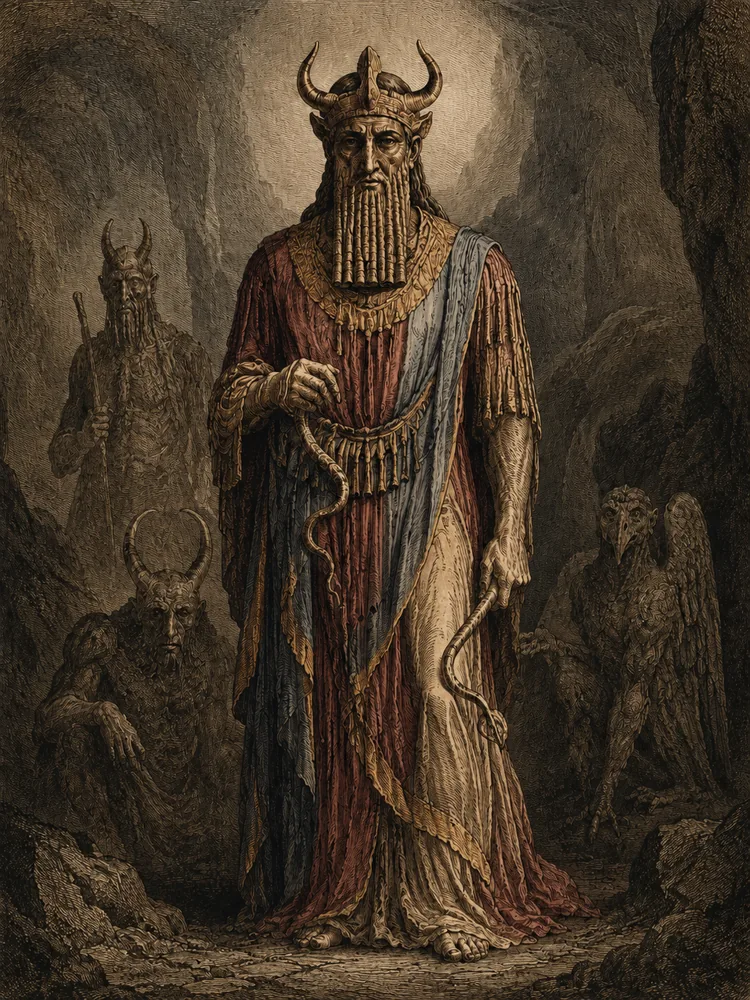
The Gallu were the demons of the great below, sent up to drag down those whose time had come or whose substitute was required. They had no ear for pleading, no taste for offerings, no use for the gentle words of women or the bribes of merchants. "They eat no food, they drink no water, they accept no offerings; they sniff not at the burning incense, they take no bread to the mouth. They tear the wife from the bosom of the husband; they tear the child from the knees of the father." When Inanna was raised from the dead, it was the Gallu who came up with her, fastened upon her, and would not loose their grip until she had named her substitute. So they took Dumuzi.
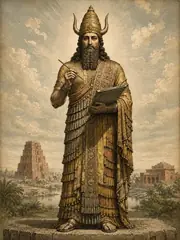 Before thisNabu
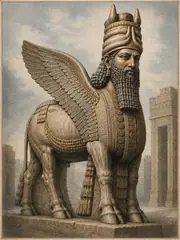 Next on the wallLamassu
Curator’s note
What the sources say, and what later tradition added. The sources for this bay
The Gallu are the most prominent of the various classes of Mesopotamian underworld demons (others include the Sebitti, the Lilu, the Asakku). The line above ("They eat no food, they drink no water...") is paraphrased from passages in The Descent of Inanna and from incantation literature. The Gallu's name was loaned into Hebrew as gallabhim and may stand behind the Greek Galloi, the self-castrated priests of Cybele, though the connection is debated.
Kin in the sources
Each tie is quoted from the entry that states it.
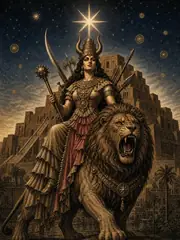 Rival ofInanna
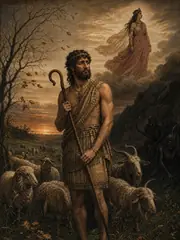
it was the Gallu who came up with her, fastened upon her, and would not loose their grip
 Rival ofDumuzi
would not loose their grip until she had named her substitute. So they took Dumuzi
When the sources speak
Dated witnesses for Akkad, Babylon and Assyria. A date marks when the evidence was written down, not when the belief began. The whole timeline
- c. 3400–3000 BCE
- Uruk-period writing and monumental temple economies create the earliest recoverable administrative setting for named divine institutions.
- c. 2900–2350 BCE
- Early Dynastic city-states preserve local cults, hymns, royal inscriptions, and god lists; later copies often transmit older compositions.
- c. 2334–2154 BCE
- The Akkadian Empire expands bilingual and imperial patterns of divine identification without erasing local cult titles.
- c. 2112–2004 BCE
- Ur III administration and scribal schooling standardize many Sumerian literary and liturgical forms.
- c. 2000–1600 BCE
- Old Babylonian schools copy major myths, laments, hymns, debates, and heroic narratives in the form most often used by modern editors.
- c. 1650–1200 BCE
- Hittite and Hurrian archives at Hattusa transmit Anatolian myths, imported Syrian materials, and ritual compositions.
- c. 1400–1190 BCE
- The tablets of Ugarit preserve the Baal Cycle, Kirta, Aqhat, ritual lists, and a dense Late Bronze Age West Semitic pantheon.
- c. 1000–612 BCE
- Neo-Assyrian and Neo-Babylonian empires collect, revise, and politically reinterpret older learned traditions.