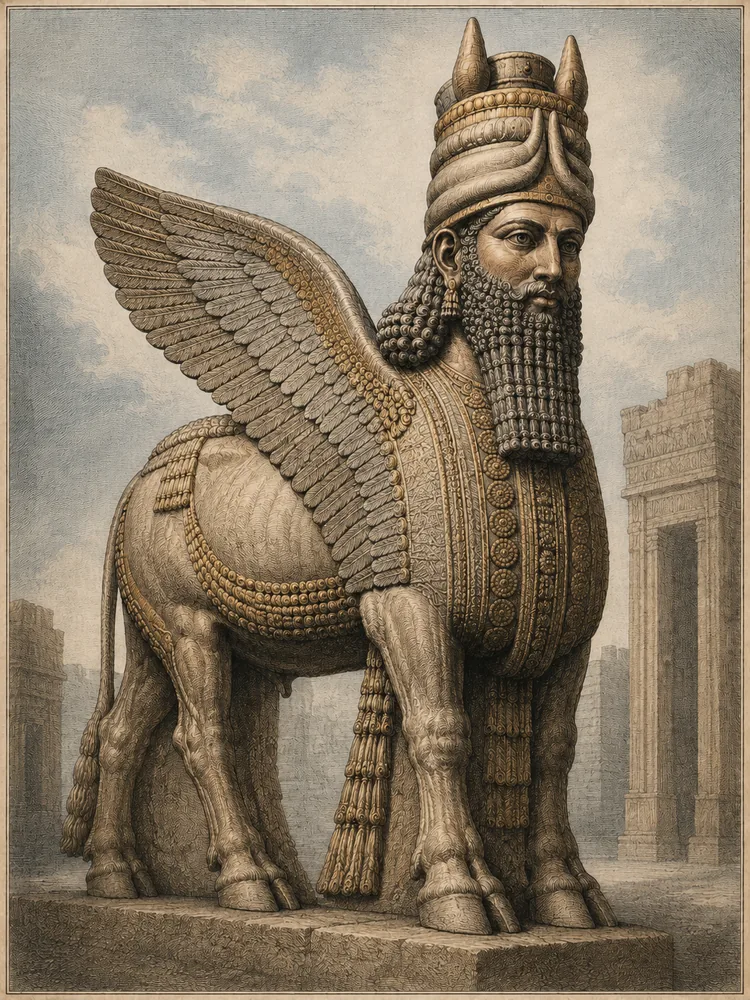
The Lamassu was a protective spirit, female in her origin, set as a guardian at the gates and the doorways of Mesopotamian palaces and temples. In her most famous Assyrian form she had the body of a winged bull (or sometimes lion), the wings of an eagle, and the bearded face of a man crowned with the horned tiara of divinity; and she was set in pairs at the great entrances of the palaces of Khorsabad, Nimrud, and Nineveh, that no evil might enter beneath her gaze. She had her male counterpart in the Shedu. To enter under her was to be received into the protection of the king's house.
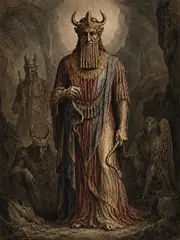 Before thisGallu
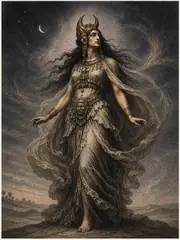 Next on the wallLilitu
Curator’s note
What the sources say, and what later tradition added. The sources for this bay
The colossal lamassu of the Assyrian palaces — particularly those of Sargon II at Khorsabad and Ashurbanipal at Nineveh — are among the most familiar images of Mesopotamian art, and several stand in the British Museum, the Louvre, and the Oriental Institute of Chicago. The figure has five legs, so that it appears to stand still when viewed from the front and to stride forward when viewed from the side; the doubling is a characteristic Assyrian visual convention. In private religion, the lamassu was understood as a guardian spirit assigned to each individual — analogous to the later Greek daimon or the Roman genius. The destruction of several lamassu reliefs by ISIS militants in Iraq and Syria between 2014 and 2017 was a major cultural loss.
Kin in the sources
Each tie is quoted from the entry that states it.
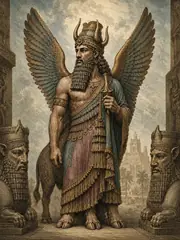 Companion ofShedu
She had her male counterpart in the Shedu.
 Compared withGenius
analogous to the later Greek daimon or the Roman genius
When the sources speak
Dated witnesses for Akkad, Babylon and Assyria. A date marks when the evidence was written down, not when the belief began. The whole timeline
- c. 3400–3000 BCE
- Uruk-period writing and monumental temple economies create the earliest recoverable administrative setting for named divine institutions.
- c. 2900–2350 BCE
- Early Dynastic city-states preserve local cults, hymns, royal inscriptions, and god lists; later copies often transmit older compositions.
- c. 2334–2154 BCE
- The Akkadian Empire expands bilingual and imperial patterns of divine identification without erasing local cult titles.
- c. 2112–2004 BCE
- Ur III administration and scribal schooling standardize many Sumerian literary and liturgical forms.
- c. 2000–1600 BCE
- Old Babylonian schools copy major myths, laments, hymns, debates, and heroic narratives in the form most often used by modern editors.
- c. 1650–1200 BCE
- Hittite and Hurrian archives at Hattusa transmit Anatolian myths, imported Syrian materials, and ritual compositions.
- c. 1400–1190 BCE
- The tablets of Ugarit preserve the Baal Cycle, Kirta, Aqhat, ritual lists, and a dense Late Bronze Age West Semitic pantheon.
- c. 1000–612 BCE
- Neo-Assyrian and Neo-Babylonian empires collect, revise, and politically reinterpret older learned traditions.