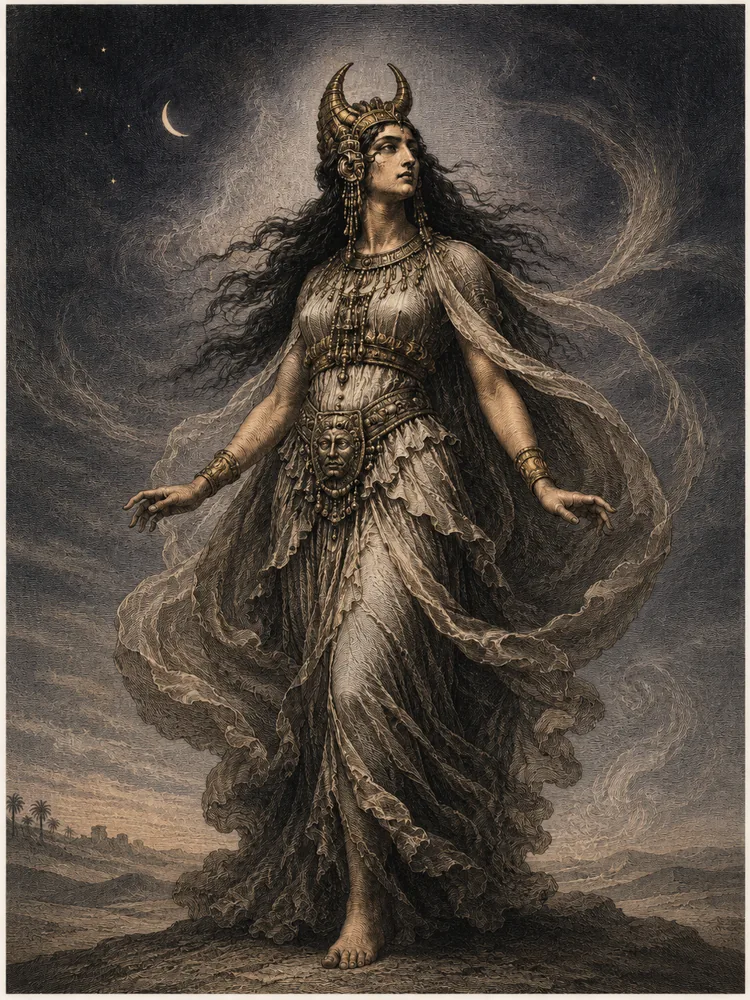
Lilitu was a demon of the night and of the wind, one of the three associated demons (Lilu, Lilitu, and Ardat-Lili) who haunted the dark hours and pursued the lonely. She was unmarried — that was indeed half the trouble — and she came at night to young men in their sleep, and to women in their childbed; she had no proper home, but flew where the wind drove her. The cure was incantation, and the binding of her with the names of the gods.
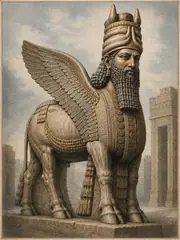 Before thisLamassu
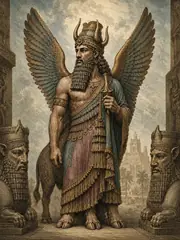 Next on the wallShedu
Curator’s note
What the sources say, and what later tradition added. The sources for this bay
The Mesopotamian Lilitu is the demonological ancestor of the better-known Hebrew Lilith, who appears once in the Hebrew Bible (Isaiah 34:14) and elaborately in later Jewish folklore (the Alphabet of Ben Sira, the Zohar, etc.). The name is cognate, but the figure was developed extensively in the Jewish tradition into Adam's first wife, etc. — a body of mythology that has no Mesopotamian counterpart. The Babylonian Lilitu remained a relatively minor wind-demon throughout her career; it was Jewish elaboration that made Lilith a major figure.
When the sources speak
Dated witnesses for Akkad, Babylon and Assyria. A date marks when the evidence was written down, not when the belief began. The whole timeline
- c. 3400–3000 BCE
- Uruk-period writing and monumental temple economies create the earliest recoverable administrative setting for named divine institutions.
- c. 2900–2350 BCE
- Early Dynastic city-states preserve local cults, hymns, royal inscriptions, and god lists; later copies often transmit older compositions.
- c. 2334–2154 BCE
- The Akkadian Empire expands bilingual and imperial patterns of divine identification without erasing local cult titles.
- c. 2112–2004 BCE
- Ur III administration and scribal schooling standardize many Sumerian literary and liturgical forms.
- c. 2000–1600 BCE
- Old Babylonian schools copy major myths, laments, hymns, debates, and heroic narratives in the form most often used by modern editors.
- c. 1650–1200 BCE
- Hittite and Hurrian archives at Hattusa transmit Anatolian myths, imported Syrian materials, and ritual compositions.
- c. 1400–1190 BCE
- The tablets of Ugarit preserve the Baal Cycle, Kirta, Aqhat, ritual lists, and a dense Late Bronze Age West Semitic pantheon.
- c. 1000–612 BCE
- Neo-Assyrian and Neo-Babylonian empires collect, revise, and politically reinterpret older learned traditions.