A Compendium of the Ancient Gods
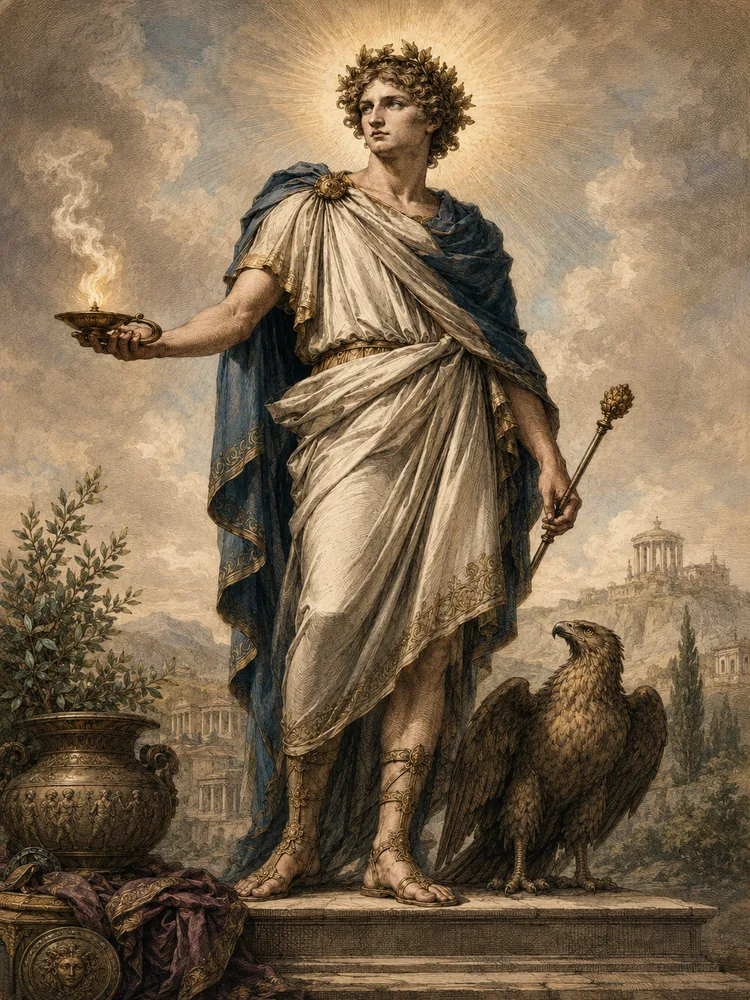
Genius, plate

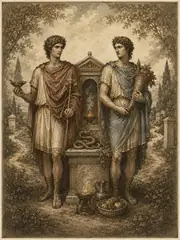
The Genius was the personal divine companion of every Roman man — born with him, accompanying him through life, and (in some accounts) departing with him at death; though a parallel tradition made the Genius the immortal element of the personality, surviving its mortal partner. Every man had his Genius; every woman had her parallel Juno (a feminine analog, distinct from Juno the great goddess but bearing her name). The Genius was the spiritual principle of fatherhood, of generation (genus, the same root, gives "genius" and "genealogy"); it was honored particularly on the man's birthday, when he made a small offering of cake, wine, and incense to his own Genius, and on great family occasions. Slaves swore by the Genius of their master; clients invoked the Genius of their patron; soldiers honored the Genius of their commander; the Genius of the head of household was, in the household cult, a tutelary power second only to the Lares and Penates.

The institution was extended in the imperial period to the Genius of the emperor, whose cult became one of the main loyalty-tests of imperial Roman religion: refusal to swear by the Genius of Caesar was a political act (the early Christian martyrs found this requirement particularly difficult, and many of their martyrdom-narratives turn on this point). It was further extended to the Genius loci — the spirit of a place — and to the Genius of various corporate entities (the Genius of the people of Rome, the Genius of the legion, the Genius of the trade-guild). The genius loci has had a long subsequent literary life, surfacing in Pope's poetry of the eighteenth century and in countless modern uses; the original Roman conception was both more concrete (a personal divine companion in the literal sense) and more pervasive (every man, every place, every collective had its Genius) than the modern echo of the term suggests.
Curator’s note

What the sources say, and what later tradition added. The sources for this bay

The principal sources are Censorinus, De Die Natali 3 (the most extensive ancient discussion); Horace, Epistles 2.2.187–189; Tibullus 2.2; the inscriptional record (immense) of Genius dedications. The imperial Genius cult is treated by Suetonius in the Lives of the Caesars at various points; Tertullian, Apologeticum 28–35, gives the Christian objection. The relationship of the Genius to the Greek conception of the daimon (Plato's, or Socrates's) is sometimes overstated; the Roman institution was more concrete and less philosophical.

Kin in the sources

Each tie is quoted from the entry that states it.

When the sources speak

Dated witnesses for The Household and Ancestral Spirits. A date marks when the evidence was written down, not when the belief began. The whole timeline

c. 1000–750 BCE
Iron Age communities of Latium and neighboring peoples develop the cult landscapes later absorbed into Roman tradition.
traditional 753 BCE
Roman foundation chronology places Romulus and the first civic institutions at the beginning of the city’s sacred history.
traditional 7th–6th centuries BCE
The regal period is credited with priesthoods, calendars, temples, and the organization of public rites.
509–264 BCE
Republican expansion incorporates Latin, Sabine, Etruscan, and Italian cults through treaty, migration, and evocatio.
264–146 BCE
Mediterranean conquest accelerates Greek interpretation and the importation or redefinition of foreign gods.
204 BCE
The Magna Mater is formally brought from Pessinus during the Second Punic War.
1st century BCE
Varro, Cicero, and other antiquarians document rites and divine names amid civil war and institutional change.
27 BCE–14 CE
Augustan restoration monumentalizes selected ancestral cults and rewrites Roman sacred history.

Floor plan

The rooms follow one another in the order their peoples first appear in the written record.

  1. The Cradle of Citiesc. 3400 BCE to 395 CE. 115 works
  2. The Gift of the Nilec. 4000 BCE to 395 CE. 73 works
  3. The Olympian Orderc. 1600 BCE to 750 CE. 152 works
  4. The Persian Worldc. 2000 BCE to 1010 CE. 30 works
  5. The Levantine Borderlandsc. 1200 BCE to 500 CE. 20 works
  6. The Edges of Empirec. 2000 BCE to 1500 CE. 33 works
  7. The Etruscan Worldc. 900 BCE to 750 CE. 22 works
  8. The Roman Inheritancec. 1200 BCE to 500 CE. 58 works
  9. The Northern Inheritancec. 2000 BCE to 1600 CE. 131 works