A Compendium of the Ancient Gods
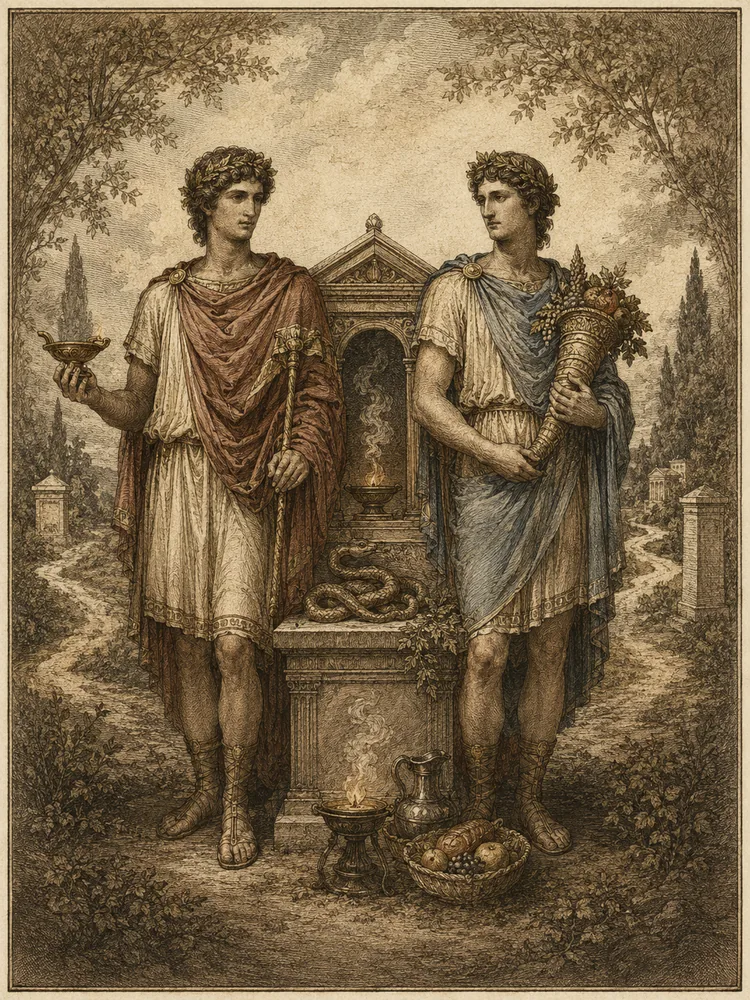
Penates, plate

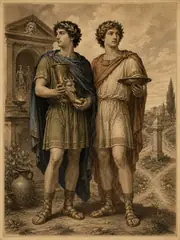
The Penates were the spirits of the household pantry — of the storeroom (penus, whence their name) where the family's provisions were kept. They were the guardians of plenty, of the food-supply, of the sustaining material basis of family life. They were honored at the family hearth (where the offering of food was made jointly to them, to the Lares, and to Vesta), and their small images stood within the lararium alongside those of the Lares. They were not, like the Lares, individualized characters; they were a collective, normally invoked in the plural, often paired with named greater gods (Jupiter, Juno, Minerva — the great gods who were the household's particular tutelaries — whom Vergil specifically calls Penates in some passages of the Aeneid).

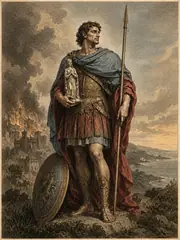
The state had its own Penates Publici — the great Penates of the Roman people — whose images were said to have been brought from Troy by Aeneas himself (a tradition Vergil makes much of in the Aeneid, where Aeneas escapes burning Troy carrying his father Anchises on his shoulders, his son Iulus by the hand, and the Penates of the city in his arms). These public Penates were preserved in the Temple of Vesta in the Forum, alongside the eternal flame and the Palladium (a sacred image of Pallas Athena, also brought from Troy); the Vestal Virgins were their guardians, and the safety of the city was held to depend on their preservation. They were viewed only by the chief priests; their precise nature (whether statues, or sacred objects, or something else) was not made public, and modern scholarship has not been able to recover what they were.
Curator’s note

What the sources say, and what later tradition added. The sources for this bay

The principal sources are Vergil, Aeneid 1.378, 2.293, 2.717 (the Trojan Penates rescued from the burning city); Cicero, De Natura Deorum 2.68; Macrobius, Saturnalia 3.4 (an extensive antiquarian treatment); Varro fragments. The Trojan-origin tradition for the public Penates is one of the principal threads of the Roman foundation-myth; its cult-reality (the actual sacred objects in Vesta's temple) is securely attested but their nature remains unrecoverable. The Penates Publici were rescued by L. Caecilius Metellus from the burning Temple of Vesta in 241 BCE — at the cost, by tradition, of his sight, which he lost in the flames; the deed was remembered and Metellus was given the right of being conveyed in a chariot to the Senate-house thereafter.

Kin in the sources

Each tie is quoted from the entry that states it.

When the sources speak

Dated witnesses for The Household and Ancestral Spirits. A date marks when the evidence was written down, not when the belief began. The whole timeline

c. 1000–750 BCE
Iron Age communities of Latium and neighboring peoples develop the cult landscapes later absorbed into Roman tradition.
traditional 753 BCE
Roman foundation chronology places Romulus and the first civic institutions at the beginning of the city’s sacred history.
traditional 7th–6th centuries BCE
The regal period is credited with priesthoods, calendars, temples, and the organization of public rites.
509–264 BCE
Republican expansion incorporates Latin, Sabine, Etruscan, and Italian cults through treaty, migration, and evocatio.
264–146 BCE
Mediterranean conquest accelerates Greek interpretation and the importation or redefinition of foreign gods.
204 BCE
The Magna Mater is formally brought from Pessinus during the Second Punic War.
1st century BCE
Varro, Cicero, and other antiquarians document rites and divine names amid civil war and institutional change.
27 BCE–14 CE
Augustan restoration monumentalizes selected ancestral cults and rewrites Roman sacred history.

Floor plan

The rooms follow one another in the order their peoples first appear in the written record.

  1. The Cradle of Citiesc. 3400 BCE to 395 CE. 115 works
  2. The Gift of the Nilec. 4000 BCE to 395 CE. 73 works
  3. The Olympian Orderc. 1600 BCE to 750 CE. 152 works
  4. The Persian Worldc. 2000 BCE to 1010 CE. 30 works
  5. The Levantine Borderlandsc. 1200 BCE to 500 CE. 20 works
  6. The Edges of Empirec. 2000 BCE to 1500 CE. 33 works
  7. The Etruscan Worldc. 900 BCE to 750 CE. 22 works
  8. The Roman Inheritancec. 1200 BCE to 500 CE. 58 works
  9. The Northern Inheritancec. 2000 BCE to 1600 CE. 131 works