A Compendium of the Ancient Gods
Lares, plate

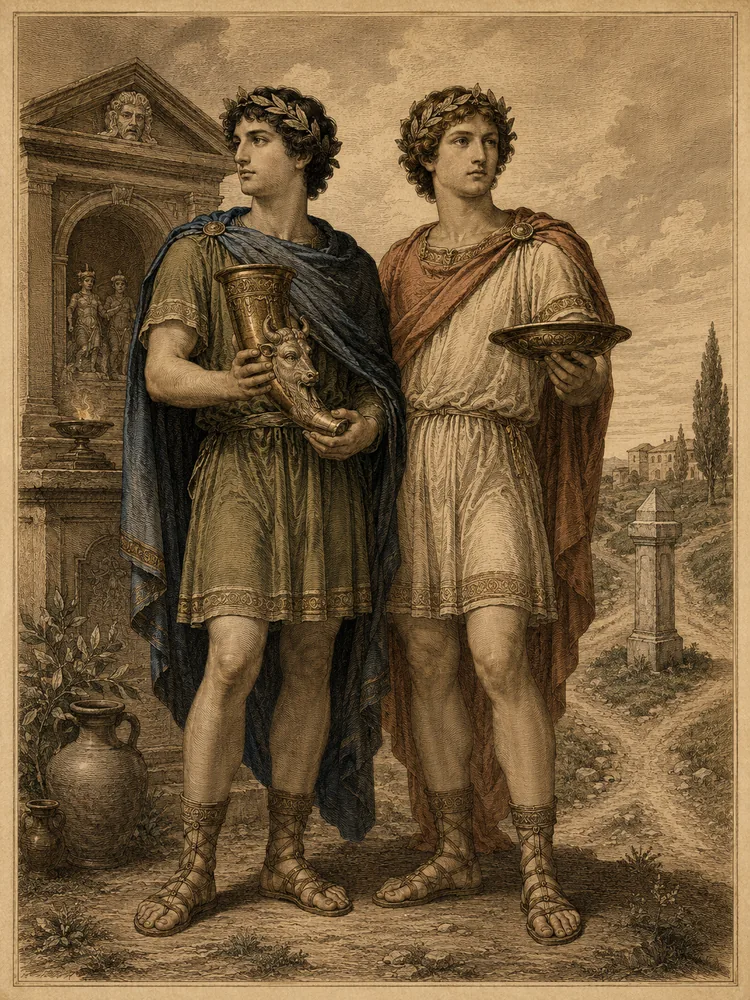
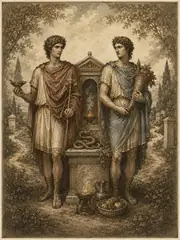
The Lares were the protective spirits of the Roman household — the guardian-divinities of the dwelling itself, of the family's boundaries, and (in a separate but related cult) of the crossroads and the property-lines outside. They were honored in every Roman home at the lararium — a small shrine, often built into the wall of the atrium, decorated with paintings of two dancing youths in short tunics raising drinking-horns above their heads, with a serpent (the protective genius of the place) often depicted below. Daily offerings were made: a small portion of every meal was set aside for them, and on special days (the Kalends, Nones, and Ides of every month, family birthdays, marriages, and journeys) more elaborate sacrifices were offered. They were invoked at every important domestic moment — the bringing-home of a bride, the birth of a child, the assumption of the toga virilis by a son, the family's departure on a journey or return.

There were several distinct types of Lares. The Lares Familiares (or Lares Domestici) were the household-spirits proper, presiding over the dwelling and the family. The Lares Compitales were the crossroads-spirits, honored at the small shrines (compita) that stood at the meeting of property lines and rural lanes; their festival, the Compitalia, was held annually shortly after the winter solstice and was an occasion for slaves and free to celebrate together (since the crossroads were liminal places where social distinctions were temporarily suspended). The Lares Praestites were the public Lares of the city of Rome itself, whose temple stood at the head of the Sacred Way. The Lares Permarini were the protectors of seafarers. The Lares Viales protected travelers on the roads. The category was elastic and could be multiplied as occasion required.

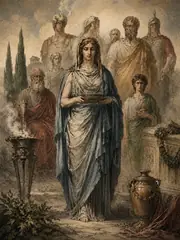
The origin of the Lares was much disputed in antiquity. The most plausible interpretation, supported by both ancient testimony (Varro and others) and modern scholarship, is that they were originally the spirits of the dead — particularly of the family's ancestors, whose protective power continued to bear upon the dwelling they had once inhabited — and that their cult and that of the Manes (treated below) were anciently overlapping. By the historical period the two had largely separated, with the Lares as the protective spirits of the place and the Manes as the dead generally; but the original connection is still detectable in the iconography and in the patterns of cult.
Curator’s note

What the sources say, and what later tradition added. The sources for this bay

The principal sources are Plautus's Aulularia (the prologue is spoken by the Lar Familiaris of the household); Cato, De Agri Cultura 143 (the Lares of the farm); Tibullus 1.10.15–28; Ovid, Fasti 5.129–146 (the Lares Praestites); Apuleius, Apologia 32. The connection of the Lares to the dead is in Varro (preserved by Augustine, City of God 9.11) and is supported by the iconographic survival of the snake-attribute in lararium painting (the snake being a chthonic attribute associated with ancestral spirits in many Mediterranean traditions). The Compitalia and Augustan reforms of the cult (the institution of the Lares Augusti) are extensively studied in modern scholarship; see Niebling and others.

Kin in the sources

Each tie is quoted from the entry that states it.

When the sources speak

Dated witnesses for The Household and Ancestral Spirits. A date marks when the evidence was written down, not when the belief began. The whole timeline

c. 1000–750 BCE
Iron Age communities of Latium and neighboring peoples develop the cult landscapes later absorbed into Roman tradition.
traditional 753 BCE
Roman foundation chronology places Romulus and the first civic institutions at the beginning of the city’s sacred history.
traditional 7th–6th centuries BCE
The regal period is credited with priesthoods, calendars, temples, and the organization of public rites.
509–264 BCE
Republican expansion incorporates Latin, Sabine, Etruscan, and Italian cults through treaty, migration, and evocatio.
264–146 BCE
Mediterranean conquest accelerates Greek interpretation and the importation or redefinition of foreign gods.
204 BCE
The Magna Mater is formally brought from Pessinus during the Second Punic War.
1st century BCE
Varro, Cicero, and other antiquarians document rites and divine names amid civil war and institutional change.
27 BCE–14 CE
Augustan restoration monumentalizes selected ancestral cults and rewrites Roman sacred history.

Floor plan

The rooms follow one another in the order their peoples first appear in the written record.

  1. The Cradle of Citiesc. 3400 BCE to 395 CE. 115 works
  2. The Gift of the Nilec. 4000 BCE to 395 CE. 73 works
  3. The Olympian Orderc. 1600 BCE to 750 CE. 152 works
  4. The Persian Worldc. 2000 BCE to 1010 CE. 30 works
  5. The Levantine Borderlandsc. 1200 BCE to 500 CE. 20 works
  6. The Edges of Empirec. 2000 BCE to 1500 CE. 33 works
  7. The Etruscan Worldc. 900 BCE to 750 CE. 22 works
  8. The Roman Inheritancec. 1200 BCE to 500 CE. 58 works
  9. The Northern Inheritancec. 2000 BCE to 1600 CE. 131 works