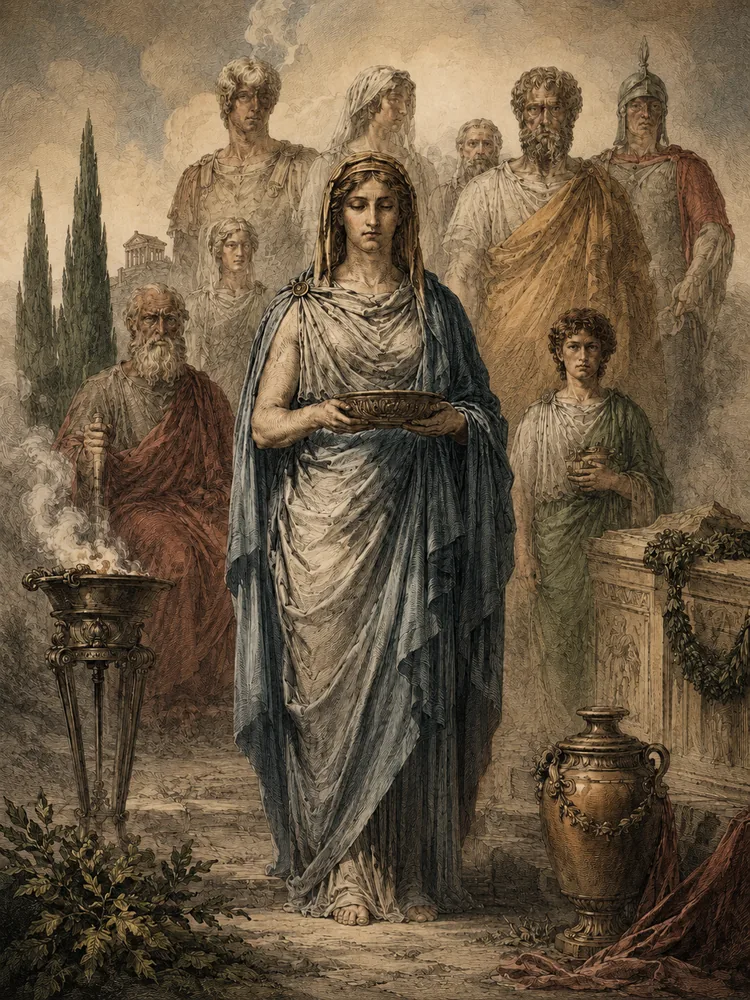
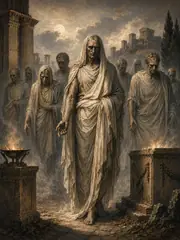
The Manes were the spirits of the ancestral dead — the deceased members of the family, collectively honored as a divine company. The phrase Dii Manes ("the divine Manes") on Roman tombstones is so universal as to be the standard funerary formula; the abbreviation D.M. opens almost every Roman epitaph from the early imperial period onward. The Manes were the dead in their honored aspect — the dead as proper recipients of the family cult, the dead with whom the living maintained a continuing relationship through annual observances. They were not, in classical Roman religion, individualized; they were a collective, the assembly of one's forebears, and the cult to them was directed to the company rather than to the individual.
The principal festivals of the Manes were two. The Parentalia (February 13–21) was the annual nine-day commemoration during which families visited the family tombs, decked them with garlands, and made offerings of bread soaked in wine, milk, honey, and salt. During this period, all temples were closed; marriages were not celebrated; magistrates put off their badges of office; the city was in a state of pious mourning. The festival concluded with the Feralia (February 21), the public observance of the Parentalia, and was followed on February 22 by the Caristia (or Cara Cognatio), a more cheerful family meal at which living relatives reconciled their differences. The other observance was the Lemuria (treated next), which dealt not with the honored dead but with the unappeased and dangerous dead.
The cult of the Manes preserved a Roman conception of family continuity that the modern mind, with its sharper division between living and dead, may have difficulty fully recovering. The Roman family included its dead; the father of a family addressed his ancestors at the family altar as continuing presences; the duty to the dead was as real as the duty to the living, and was as much a matter of practical observance. The Christian cult of the saints, which Pope Gregory I deliberately allowed to absorb the rhythm of the older ancestral observances, took on some of the same patterns of feast-days and graveside visits.