A Compendium of the Ancient Gods
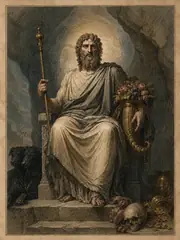
Mania, plate

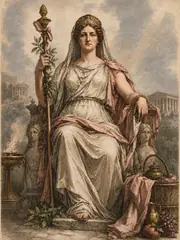
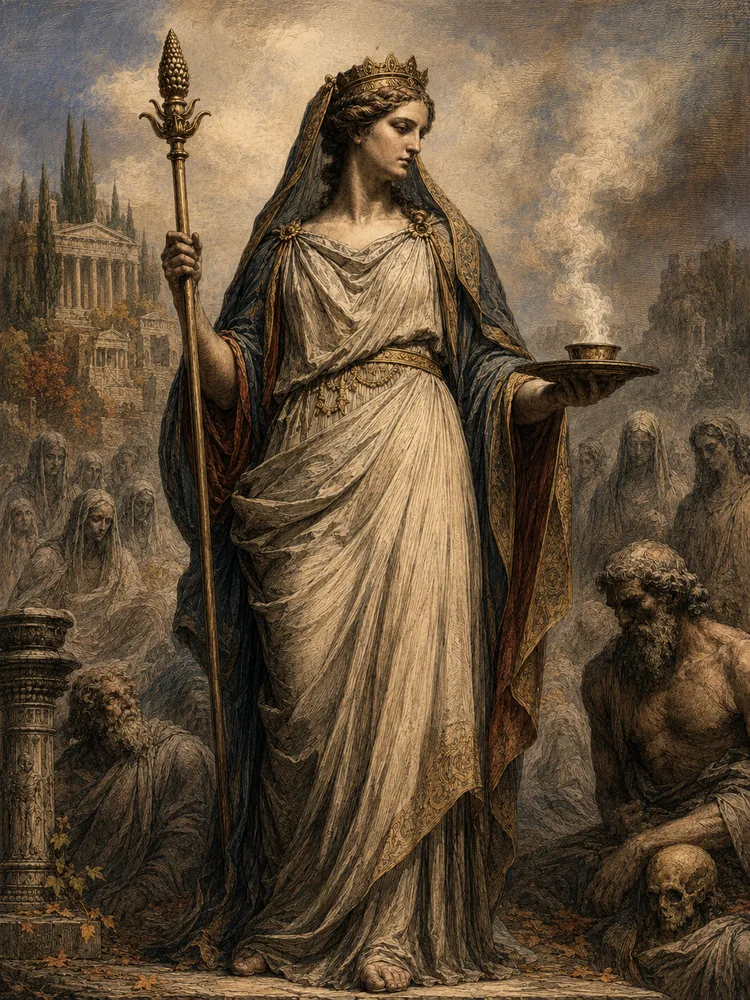
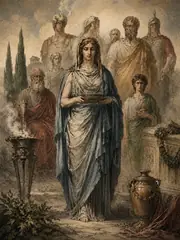
Mania was an old Italic goddess, the mother of the Manes — those collective spirits of the family dead who were honored at every Roman tomb and at every household shrine. She was a chthonic figure, as old as Dis Pater and older than the codified Roman religion of the Republic, and her name was understood by the Romans to derive either from manus, "good" (the Manes being euphemistically called "the Good Ones" out of fear), or from a more archaic root signifying the dead themselves.

In the early period — before the Tarquinian kings, the Romans believed — there had been human sacrifices to Mania. Children were ritually killed at her altars in the rite of the Compitalia (the festival of the crossroad-shrines), to propitiate the spirits of the dead and to ward off plague. The first Brutus, after the expulsion of the kings, abolished this rite and substituted heads of garlic and poppy for the heads of children — a substitution that was both legal and apotropaic, the harmless plant taking the place of the human victim. Thereafter the Compitalia was kept with these substitute offerings, hung up at every crossroads-shrine.

By the late Republic, Mania had largely faded from public worship; her place was taken by the more individualized Manes of each family, who were addressed at the Parentalia in February. But the wax effigies — the maniae — that mothers hung about their children's necks as protective amulets were called by her name, and her old function as protectress of the young (paradoxically, given the human sacrifice tradition) survived in this domestic form.
Curator’s note

What the sources say, and what later tradition added. The sources for this bay

Mania is described by Macrobius (Saturnalia 1.7.34-35, the Compitalia and the Brutus reform), Varro (De Lingua Latina 9.61, the maniae effigies), Festus (s.v. Maniae), and Augustine (City of God 4.16). The story of human sacrifice in early Rome is reported with apparent acceptance by the antiquarian sources; whether it preserves real practice or merely an etiological legend explaining the substituted offerings is uncertain, but parallel evidence (the Sacred Spring rites, the Argeii — the rush-figures thrown into the Tiber by the Vestal Virgins) makes it possible that authentic memories of such practices survived. The Compitalia remained an important plebeian festival into the imperial period and is described in the Augustan calendars.

Kin in the sources

Each tie is quoted from the entry that states it.

When the sources speak

Dated witnesses for The Household and Ancestral Spirits. A date marks when the evidence was written down, not when the belief began. The whole timeline

c. 1000–750 BCE
Iron Age communities of Latium and neighboring peoples develop the cult landscapes later absorbed into Roman tradition.
traditional 753 BCE
Roman foundation chronology places Romulus and the first civic institutions at the beginning of the city’s sacred history.
traditional 7th–6th centuries BCE
The regal period is credited with priesthoods, calendars, temples, and the organization of public rites.
509–264 BCE
Republican expansion incorporates Latin, Sabine, Etruscan, and Italian cults through treaty, migration, and evocatio.
264–146 BCE
Mediterranean conquest accelerates Greek interpretation and the importation or redefinition of foreign gods.
204 BCE
The Magna Mater is formally brought from Pessinus during the Second Punic War.
1st century BCE
Varro, Cicero, and other antiquarians document rites and divine names amid civil war and institutional change.
27 BCE–14 CE
Augustan restoration monumentalizes selected ancestral cults and rewrites Roman sacred history.

Floor plan

The rooms follow one another in the order their peoples first appear in the written record.

  1. The Cradle of Citiesc. 3400 BCE to 395 CE. 115 works
  2. The Gift of the Nilec. 4000 BCE to 395 CE. 73 works
  3. The Olympian Orderc. 1600 BCE to 750 CE. 152 works
  4. The Persian Worldc. 2000 BCE to 1010 CE. 30 works
  5. The Levantine Borderlandsc. 1200 BCE to 500 CE. 20 works
  6. The Edges of Empirec. 2000 BCE to 1500 CE. 33 works
  7. The Etruscan Worldc. 900 BCE to 750 CE. 22 works
  8. The Roman Inheritancec. 1200 BCE to 500 CE. 58 works
  9. The Northern Inheritancec. 2000 BCE to 1600 CE. 131 works