A Compendium of the Ancient Gods
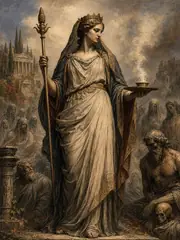
The Indigitamenta, plate

The Romans had a peculiar conception of the divine that was perhaps theirs alone among ancient peoples: that every action, every moment, every aspect of human life had its own specialist god — and that one had to know these gods by their proper names, and address them rightly, or the action would not prosper. The lists of these specialist gods were called the Indigitamenta, the books of the namings; they were kept by the pontifices and were the secret texts by which the priests knew which power to invoke at each juncture.

Of the gods named in the Indigitamenta we have only fragments, preserved in the polemics of the Christian fathers (who quoted them to mock) and in the antiquarian works of Varro (whose great Antiquitates Rerum Divinarum, in fifteen books, survives only in fragments). At the birth of a child, for example, the Roman parents could pray to Vagitanus (who oversees the first cry), Cunina (who watches the cradle), Levana (who lifts the child from the floor in the recognition rite), Rumina (who oversees the suckling), Educa (who teaches eating), Potina (who teaches drinking), Statanus and Statilinus (who teach standing), Abeona (who teaches the child to leave), Adeona (who teaches the child to return), Fabulinus (who teaches speech), Numina (who teaches counting), Camena (who teaches singing) — and these were only some.

Augustine, in his great mockery of Roman polytheism, made the rounds of the Indigitamenta in book IV of his City of God: there were gods, he reported, for the door's leaf and the door's hinge and the door's threshold, gods for the seed in the ground and gods for the sprout coming up, gods for the milling of grain and gods for the kneading of dough; there were Vatican (whose business was to attend to the first cry of an infant) and Cuba (who put the child to bed). What Augustine took as the absurdity of pagan religion was in fact the Roman religious genius — the conviction that every transition was numinous, every moment had its god, and the ritual specialist had to know them all by name.

Curator’s note

What the sources say, and what later tradition added. The sources for this bay

The Indigitamenta themselves are entirely lost. What we know of them comes from quotations in Varro (much of it preserved only in Augustine's City of God 4-7, especially 4.8-11, 6.9, 7.2-3), Tertullian (Ad Nationes 2.11.10-12, the great catalog), and the late mythographers and Christian polemicists. Wissowa (Religion und Kultus der Römer, 1912) and Dumézil (La Religion Romaine Archaïque, 1966) attempted to reconstruct the system; the picture remains incomplete. The Indigitamenta represent a stratum of Roman religion older than the Hellenized Olympian system; the spirits named are not personalities but functions — closer to the Mesopotamian "hand" or Hebrew theophoric names than to Greek divinities — and they testify to a pre-Hellenic Roman conception of the divine that the educated elite found embarrassing in later centuries but that the priesthood preserved with care.

When the sources speak

Dated witnesses for The Household and Ancestral Spirits. A date marks when the evidence was written down, not when the belief began. The whole timeline

c. 1000–750 BCE
Iron Age communities of Latium and neighboring peoples develop the cult landscapes later absorbed into Roman tradition.
traditional 753 BCE
Roman foundation chronology places Romulus and the first civic institutions at the beginning of the city’s sacred history.
traditional 7th–6th centuries BCE
The regal period is credited with priesthoods, calendars, temples, and the organization of public rites.
509–264 BCE
Republican expansion incorporates Latin, Sabine, Etruscan, and Italian cults through treaty, migration, and evocatio.
264–146 BCE
Mediterranean conquest accelerates Greek interpretation and the importation or redefinition of foreign gods.
204 BCE
The Magna Mater is formally brought from Pessinus during the Second Punic War.
1st century BCE
Varro, Cicero, and other antiquarians document rites and divine names amid civil war and institutional change.
27 BCE–14 CE
Augustan restoration monumentalizes selected ancestral cults and rewrites Roman sacred history.

Floor plan

The rooms follow one another in the order their peoples first appear in the written record.

  1. The Cradle of Citiesc. 3400 BCE to 395 CE. 115 works
  2. The Gift of the Nilec. 4000 BCE to 395 CE. 73 works
  3. The Olympian Orderc. 1600 BCE to 750 CE. 152 works
  4. The Persian Worldc. 2000 BCE to 1010 CE. 30 works
  5. The Levantine Borderlandsc. 1200 BCE to 500 CE. 20 works
  6. The Edges of Empirec. 2000 BCE to 1500 CE. 33 works
  7. The Etruscan Worldc. 900 BCE to 750 CE. 22 works
  8. The Roman Inheritancec. 1200 BCE to 500 CE. 58 works
  9. The Northern Inheritancec. 2000 BCE to 1600 CE. 131 works