A Compendium of the Ancient Gods
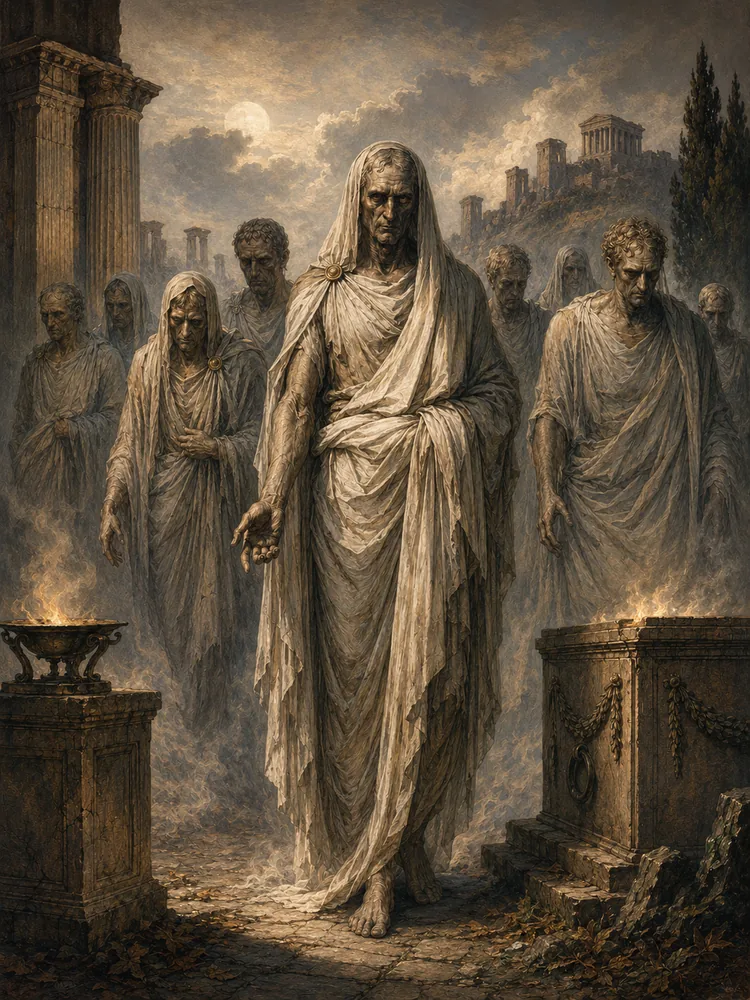
Lemures, plate

The Lemures were the dark counterpart of the Manes — the restless and unappeased spirits of those who had died badly (without proper burial, by violence, untimely, or in some way that left the spirit unable to find its rest) and who returned to trouble the living. They were dangerous; they had to be propitiated; their festival, the Lemuria, on the nights of May 9, 11, and 13 (the odd days, May being a month already considered ill-omened — the Romans avoided weddings in May because of the Lemuria), was a strange and apotropaic rite quite unlike the affectionate Parentalia.

The rite, as Ovid describes it from antiquarian sources, was performed by the head of the household alone at midnight. He rose from bed, made the apotropaic gesture (the mano fica, with the thumb between two fingers), bathed his hands in a spring three times, took into his mouth nine black beans and walked through the house, throwing the beans behind him over his shoulder one by one and saying nine times, "With these I redeem me and mine" (Haec ego mitto; his redimo meque meosque fabis). The spirits, said the tradition, gathered behind him to pick up the beans; he was forbidden to look back. He then washed his hands again, struck a bronze vessel nine times, and repeated nine times the formula, "Manes of my fathers, depart!" (Manes exite paterni). The rite concluded; the spirits were placated for another year.

The Lemuria's shaped strangeness, its midnight setting, its silent and solitary execution, reflect the Roman recognition that not all the dead were gentle. The figure of the night-walking unappeased spirit was real to the Romans; the Lemuria's archaic elements (the bronze vessel, the beans, the ritual gestures) suggest very ancient origins, possibly pre-Indo-European. The festival declined in observance during the imperial period but never quite disappeared; its echoes survive in various European folk-traditions of midsummer or autumn nights when the dead walk.

Curator’s note

What the sources say, and what later tradition added. The sources for this bay

The principal source is Ovid, Fasti 5.419–492, who attributes the description to Roman antiquarian sources now lost; the rite is also mentioned by Persius (5.185) and by Augustine (City of God 9.11). The aetiological connection of the Lemuria with the unburied Remus (Ovid: "the Remuria," later corrupted to Lemuria) is Ovid's playful etymology and not to be taken seriously; the festival's actual origins are pre-historic. The avoidance of weddings in May because of the Lemuria is widely attested (Plutarch, Quaestiones Romanae 86; Ovid himself).

Kin in the sources

Each tie is quoted from the entry that states it.

When the sources speak

Dated witnesses for The Household and Ancestral Spirits. A date marks when the evidence was written down, not when the belief began. The whole timeline

c. 1000–750 BCE
Iron Age communities of Latium and neighboring peoples develop the cult landscapes later absorbed into Roman tradition.
traditional 753 BCE
Roman foundation chronology places Romulus and the first civic institutions at the beginning of the city’s sacred history.
traditional 7th–6th centuries BCE
The regal period is credited with priesthoods, calendars, temples, and the organization of public rites.
509–264 BCE
Republican expansion incorporates Latin, Sabine, Etruscan, and Italian cults through treaty, migration, and evocatio.
264–146 BCE
Mediterranean conquest accelerates Greek interpretation and the importation or redefinition of foreign gods.
204 BCE
The Magna Mater is formally brought from Pessinus during the Second Punic War.
1st century BCE
Varro, Cicero, and other antiquarians document rites and divine names amid civil war and institutional change.
27 BCE–14 CE
Augustan restoration monumentalizes selected ancestral cults and rewrites Roman sacred history.

Floor plan

The rooms follow one another in the order their peoples first appear in the written record.

  1. The Cradle of Citiesc. 3400 BCE to 395 CE. 115 works
  2. The Gift of the Nilec. 4000 BCE to 395 CE. 73 works
  3. The Olympian Orderc. 1600 BCE to 750 CE. 152 works
  4. The Persian Worldc. 2000 BCE to 1010 CE. 30 works
  5. The Levantine Borderlandsc. 1200 BCE to 500 CE. 20 works
  6. The Edges of Empirec. 2000 BCE to 1500 CE. 33 works
  7. The Etruscan Worldc. 900 BCE to 750 CE. 22 works
  8. The Roman Inheritancec. 1200 BCE to 500 CE. 58 works
  9. The Northern Inheritancec. 2000 BCE to 1600 CE. 131 works