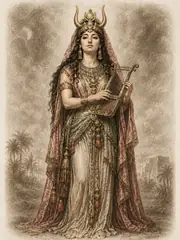
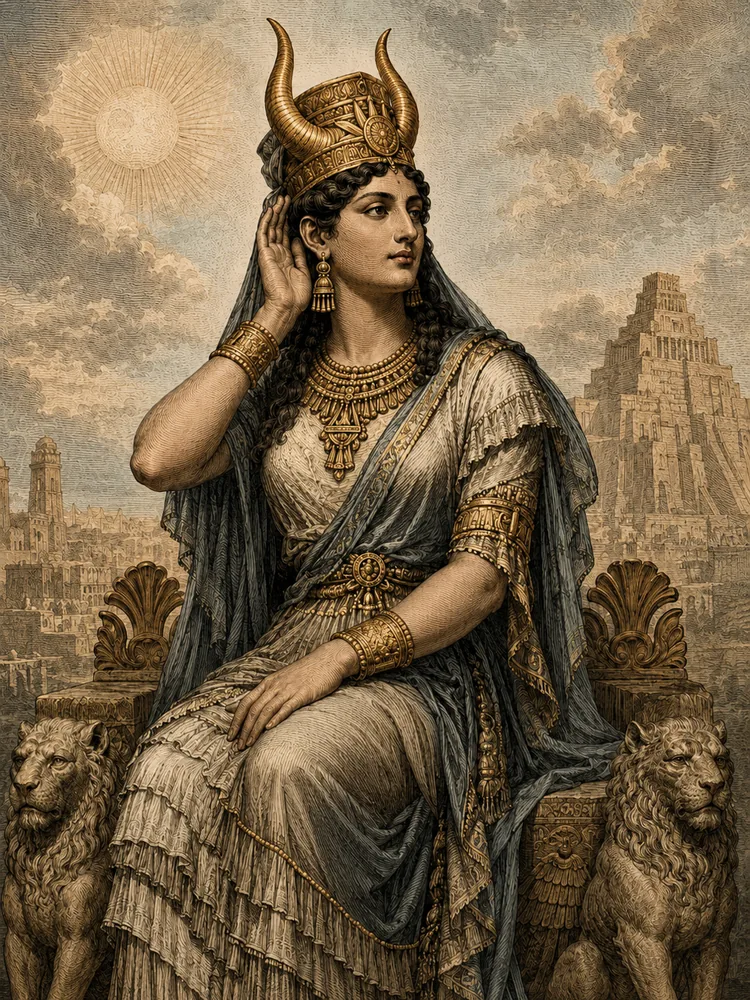
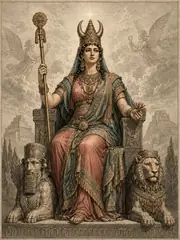
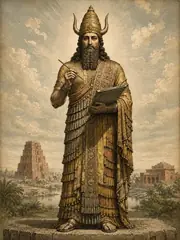
To the scribe-god Nabu, son of Marduk and patron of writing, was wedded Tashmetum, whose name in Akkadian means simply "the Hearing" or "the Listening." She was the goddess to whom prayers might be addressed when the great gods were too remote to be approached directly; her ear, said the cult, was nearer than theirs. She was patroness of intercession and of the petitioner, of the small request brought up to the highest court by way of the proper channels.
Her cult, like Nabu's, was centered at Borsippa, the lesser city beside Babylon, in the temple Ezida. Her sacred marriage to Nabu was celebrated annually with a procession of images and a great public festival; and the prayers of Babylonian women in particular were often addressed to her, in the assumption that an intercessor's wife knew best how to commend petitions to her husband.
Curator’s note
What the sources say, and what later tradition added. The sources for this bay
Tashmetum is well-attested in Akkadian hymns from the Old Babylonian period onward, and in royal inscriptions of the Neo-Babylonian and Achaemenid kings, who endowed her temple at Borsippa with offerings. Her function as intercessor — distinct from the high gods themselves but closer to ordinary petitioners — is theologically interesting: it shows the Mesopotamians acknowledging, in their pantheon's structure, the same problem that monotheistic religions would later solve through angels and saints. The pairing of Nabu (writing, record) with Tashmetum (hearing, intercession) gives the divine couple a complementary set of communicative functions: he writes down what is decreed, she hears what is requested.
When the sources speak
Dated witnesses for Akkad, Babylon and Assyria. A date marks when the evidence was written down, not when the belief began. The whole timeline
- c. 3400–3000 BCE
- Uruk-period writing and monumental temple economies create the earliest recoverable administrative setting for named divine institutions.
- c. 2900–2350 BCE
- Early Dynastic city-states preserve local cults, hymns, royal inscriptions, and god lists; later copies often transmit older compositions.
- c. 2334–2154 BCE
- The Akkadian Empire expands bilingual and imperial patterns of divine identification without erasing local cult titles.
- c. 2112–2004 BCE
- Ur III administration and scribal schooling standardize many Sumerian literary and liturgical forms.
- c. 2000–1600 BCE
- Old Babylonian schools copy major myths, laments, hymns, debates, and heroic narratives in the form most often used by modern editors.
- c. 1650–1200 BCE
- Hittite and Hurrian archives at Hattusa transmit Anatolian myths, imported Syrian materials, and ritual compositions.
- c. 1400–1190 BCE
- The tablets of Ugarit preserve the Baal Cycle, Kirta, Aqhat, ritual lists, and a dense Late Bronze Age West Semitic pantheon.
- c. 1000–612 BCE
- Neo-Assyrian and Neo-Babylonian empires collect, revise, and politically reinterpret older learned traditions.