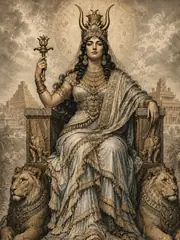
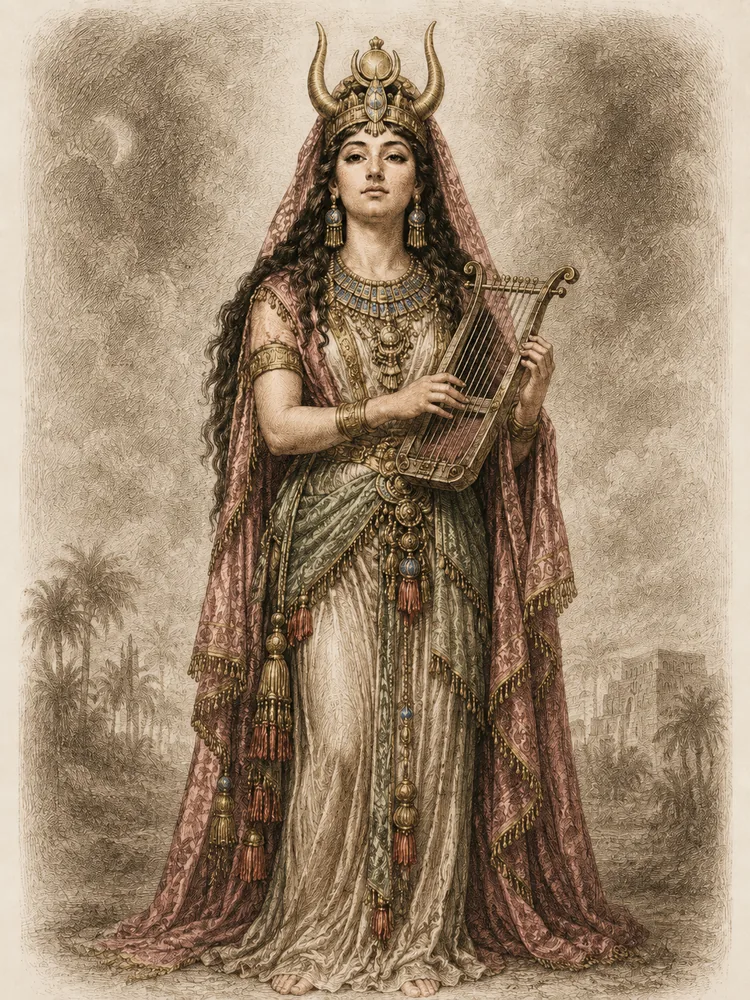
Among the goddesses of love which Mesopotamia produced, the great central figure was always Inanna or her Akkadian counterpart Ishtar; but beside her, sharing some of her functions and many of her attributes, stood the goddess Nanaya, the Sweet One. Her cult-city was Uruk, where Inanna also reigned; her sacred animal was the lion, in some traditions, the dove in others; her gift was sensual love unmixed with the violence that often attended Inanna's. She was the goddess of love-songs.
The most extraordinary fact about Nanaya, however, is the geographical reach of her cult. From her origins in southern Mesopotamia she traveled — in the wake of trade, conquest, and royal patronage — eastward, into Iran, into Bactria; and there, under the form Nana, she became one of the principal goddesses of the Kushan Empire of the early centuries CE, appearing on the gold coinage of Kushan kings, sharing iconography with Greek Aphrodite and Iranian Anahita and even with Hindu goddesses of the same general type. Her image is among the most-traveled in the ancient world.
Curator’s note
What the sources say, and what later tradition added. The sources for this bay
Nanaya is well-attested in Sumerian and Akkadian love-poetry from the Ur III period onward, and in royal hymns of subsequent dynasties. Her cult at Uruk persisted into the Seleucid period (where Greek inscriptions name her), and her diffusion eastward is documented in cuneiform tablets from Susa, in Aramaic inscriptions, and most spectacularly on the Kushan gold coinage of the first to third centuries CE, where she appears as a standing or enthroned goddess with various lunar, solar, or animal attributes. The continuity from Sumerian Nanaya to Kushan Nana is one of the most remarkable cases of ancient cult-transmission across vast linguistic and political distances. Whether the Kushan Nana was theologically still the same goddess, or had become merely the Bactrian-Greek-Indian translation of the name, is a question on which scholars disagree.
When the sources speak
Dated witnesses for Akkad, Babylon and Assyria. A date marks when the evidence was written down, not when the belief began. The whole timeline
- c. 3400–3000 BCE
- Uruk-period writing and monumental temple economies create the earliest recoverable administrative setting for named divine institutions.
- c. 2900–2350 BCE
- Early Dynastic city-states preserve local cults, hymns, royal inscriptions, and god lists; later copies often transmit older compositions.
- c. 2334–2154 BCE
- The Akkadian Empire expands bilingual and imperial patterns of divine identification without erasing local cult titles.
- c. 2112–2004 BCE
- Ur III administration and scribal schooling standardize many Sumerian literary and liturgical forms.
- c. 2000–1600 BCE
- Old Babylonian schools copy major myths, laments, hymns, debates, and heroic narratives in the form most often used by modern editors.
- c. 1650–1200 BCE
- Hittite and Hurrian archives at Hattusa transmit Anatolian myths, imported Syrian materials, and ritual compositions.
- c. 1400–1190 BCE
- The tablets of Ugarit preserve the Baal Cycle, Kirta, Aqhat, ritual lists, and a dense Late Bronze Age West Semitic pantheon.
- c. 1000–612 BCE
- Neo-Assyrian and Neo-Babylonian empires collect, revise, and politically reinterpret older learned traditions.