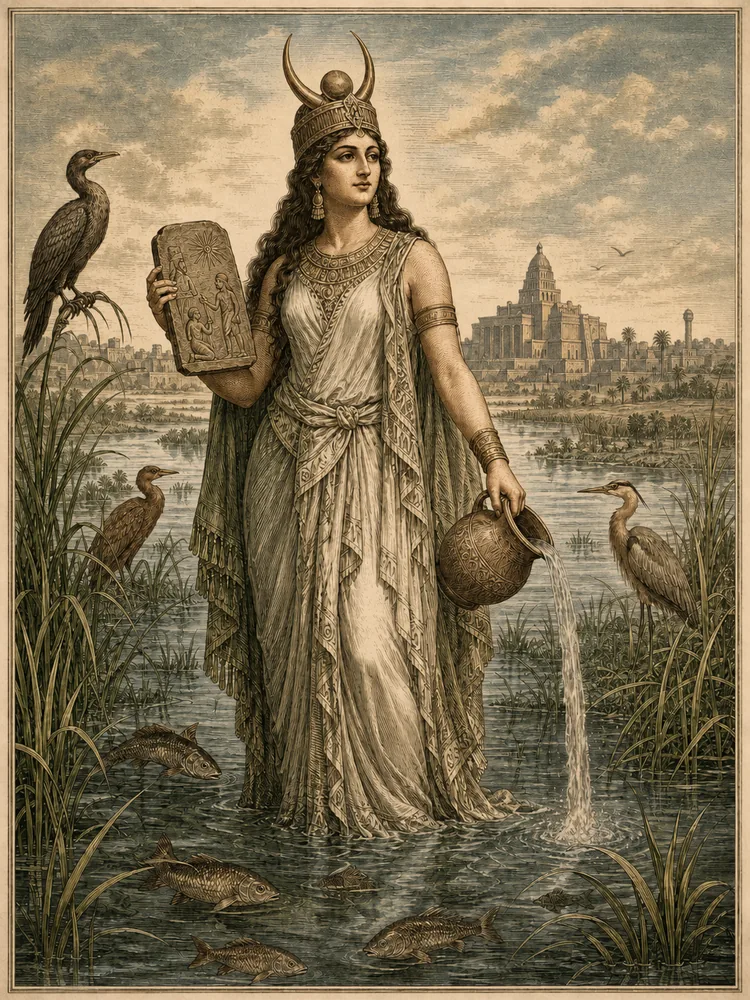
Nanshe was the goddess of the southern marshes, where the Tigris and the Euphrates lose themselves before the Persian Gulf. Her city was Nina, and her sacred bird was the heron; her sacred fish were the carp of the marshes; and dreams were under her interpretation. But her great office was justice, and the watching over the poor: "She knows the orphan, she knows the widow," runs her hymn; "she knows the oppression of man over man." To Nanshe came the petition of those whom no other god would hear; and on her annual festival the slave was given rest, the orphan a meal, and the widow a hearing.
 Before thisNanna
 Next on the wallNergal
Curator’s note
What the sources say, and what later tradition added. The sources for this bay
The Hymn to Nanshe (Sumerian, c. 2000 BCE), preserved in copies from Nippur, is the text from which most of what we know of her ethical office derives. It is one of the most striking documents of social conscience from any ancient civilization, anticipating by centuries similar emphases in the Hebrew prophets. Nanshe's marshland associations connect her with the world of the southern Mesopotamian wetlands — a landscape that survived into the twentieth century as the home of the Madan or Marsh Arabs, and that was largely destroyed in the 1990s by the policies of the Iraqi government, then partially restored after 2003.
When the sources speak
Dated witnesses for Sumer. A date marks when the evidence was written down, not when the belief began. The whole timeline
- c. 3400–3000 BCE
- Uruk-period writing and monumental temple economies create the earliest recoverable administrative setting for named divine institutions.
- c. 2900–2350 BCE
- Early Dynastic city-states preserve local cults, hymns, royal inscriptions, and god lists; later copies often transmit older compositions.
- c. 2334–2154 BCE
- The Akkadian Empire expands bilingual and imperial patterns of divine identification without erasing local cult titles.
- c. 2112–2004 BCE
- Ur III administration and scribal schooling standardize many Sumerian literary and liturgical forms.
- c. 2000–1600 BCE
- Old Babylonian schools copy major myths, laments, hymns, debates, and heroic narratives in the form most often used by modern editors.
- c. 1650–1200 BCE
- Hittite and Hurrian archives at Hattusa transmit Anatolian myths, imported Syrian materials, and ritual compositions.
- c. 1400–1190 BCE
- The tablets of Ugarit preserve the Baal Cycle, Kirta, Aqhat, ritual lists, and a dense Late Bronze Age West Semitic pantheon.
- c. 1000–612 BCE
- Neo-Assyrian and Neo-Babylonian empires collect, revise, and politically reinterpret older learned traditions.