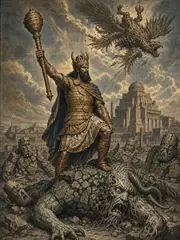
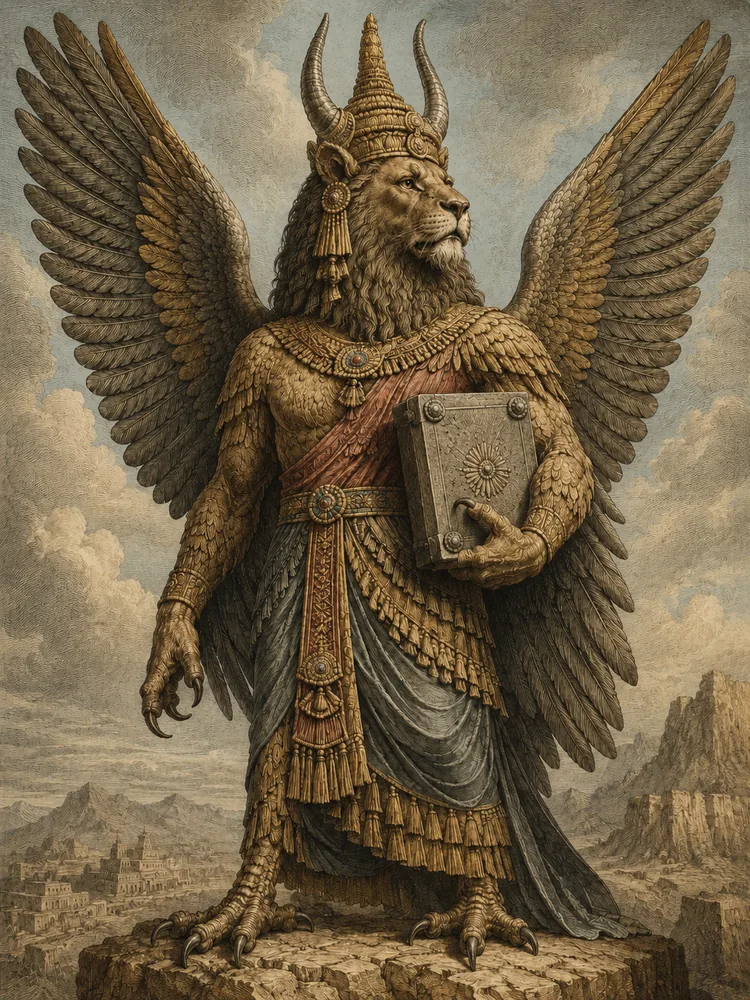
There existed, in the high mountain country at the edge of the world, a great bird with the head of a lion and wings whose span darkened the sky. The Sumerians called him Imdugud, and the Akkadians, Anzu. He was a creature both terrible and primordial, older than the order of the present gods; and his cry, when he opened his beak in the upper air, was like the south wind in storm.
It happened, according to the Akkadian poem which bears his name, that Enlil — the king of the gods — had set down the Tablet of Destinies for a moment to bathe; for the Tablet, in which were inscribed the offices and fates of all things, was too heavy and too holy to be borne always. Anzu watched, and Anzu coveted, and Anzu seized the Tablet and flew off with it to his nest in Mount Sharsharra. The order of the world, with the Tablet gone, was thrown into confusion: decrees fell unspoken, fates lay undecided, the very gods were uncertain who they were.
Several gods were called upon, in council, to recover the Tablet, and several refused; for Anzu in his nest was a dreadful thing to face. At last Ninurta, son of Enlil, accepted the charge. He went up against Anzu in the mountains; he loosed his arrows; the arrows turned back in the air, for Anzu held the Tablet and could command their flight. Then Ea, the wise god, sent counsel: cut the wing-feathers, that the bird may fall. Ninurta loosed an arrow; the feather-tip detached; Anzu fell from the air. Ninurta cut his throat, recovered the Tablet, and returned it to Enlil; and the order of the world was restored.