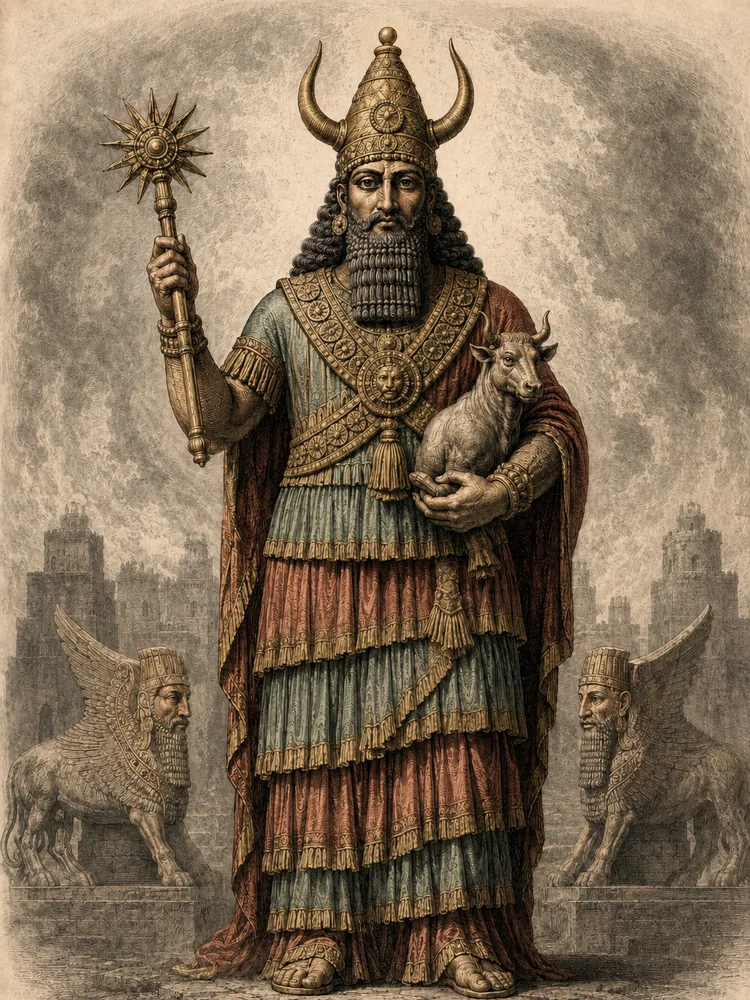
Of the god Nisroch, the cuneiform record knows nothing certain. The name appears only in the Hebrew Bible, in a single passage: "And it came to pass, as Sennacherib king of Assyria was worshipping in the house of Nisroch his god, that Adrammelech and Sharezer his sons smote him with the sword; and they escaped into the land of Armenia. And Esarhaddon his son reigned in his stead" (2 Kings 19:37; cf. Isaiah 37:38). The murder of Sennacherib in 681 BCE is historical and well-documented in Assyrian sources; the assassination is confirmed, and the place — a temple — is corroborated; but the Assyrian sources do not name the god, and the Hebrew name Nisroch corresponds to no securely known Akkadian theonym. Various proposals have been made — that Nisroch is a corruption of Nusku (the lamp-god), or of Marduk, or of an obscure Assyrian deity — but no proposal has carried decisive support, and the god remains a name without a cult.
 Before thisThe Kudurru Deities
 Next on the wallAnzu
Curator’s note
What the sources say, and what later tradition added. The sources for this bay
Nisroch is a textbook case of the difficulty in matching biblical theonyms to attested ancient Near Eastern deities. The biblical text is our only source; the murder is securely dated and corroborated by the Babylonian Chronicle and by Esarhaddon's own retrospective inscriptions, but the temple in question is not named in the Assyrian sources, and the god therefore floats unmoored. Some commentators have proposed that the name represents a deliberate Hebrew distortion (as with Ashtoreth/bosheth) of a known theonym, but no clear candidate has emerged. The best scholarly position is to admit that we do not know.
Kin in the sources
Each tie is quoted from the entry that states it.
 Named as the same god asMarduk
that Nisroch is a corruption of Nusku (the lamp-god), or of Marduk, or of an obscure Assyrian deity
When the sources speak
Dated witnesses for Akkad, Babylon and Assyria. A date marks when the evidence was written down, not when the belief began. The whole timeline
- c. 3400–3000 BCE
- Uruk-period writing and monumental temple economies create the earliest recoverable administrative setting for named divine institutions.
- c. 2900–2350 BCE
- Early Dynastic city-states preserve local cults, hymns, royal inscriptions, and god lists; later copies often transmit older compositions.
- c. 2334–2154 BCE
- The Akkadian Empire expands bilingual and imperial patterns of divine identification without erasing local cult titles.
- c. 2112–2004 BCE
- Ur III administration and scribal schooling standardize many Sumerian literary and liturgical forms.
- c. 2000–1600 BCE
- Old Babylonian schools copy major myths, laments, hymns, debates, and heroic narratives in the form most often used by modern editors.
- c. 1650–1200 BCE
- Hittite and Hurrian archives at Hattusa transmit Anatolian myths, imported Syrian materials, and ritual compositions.
- c. 1400–1190 BCE
- The tablets of Ugarit preserve the Baal Cycle, Kirta, Aqhat, ritual lists, and a dense Late Bronze Age West Semitic pantheon.
- c. 1000–612 BCE
- Neo-Assyrian and Neo-Babylonian empires collect, revise, and politically reinterpret older learned traditions.