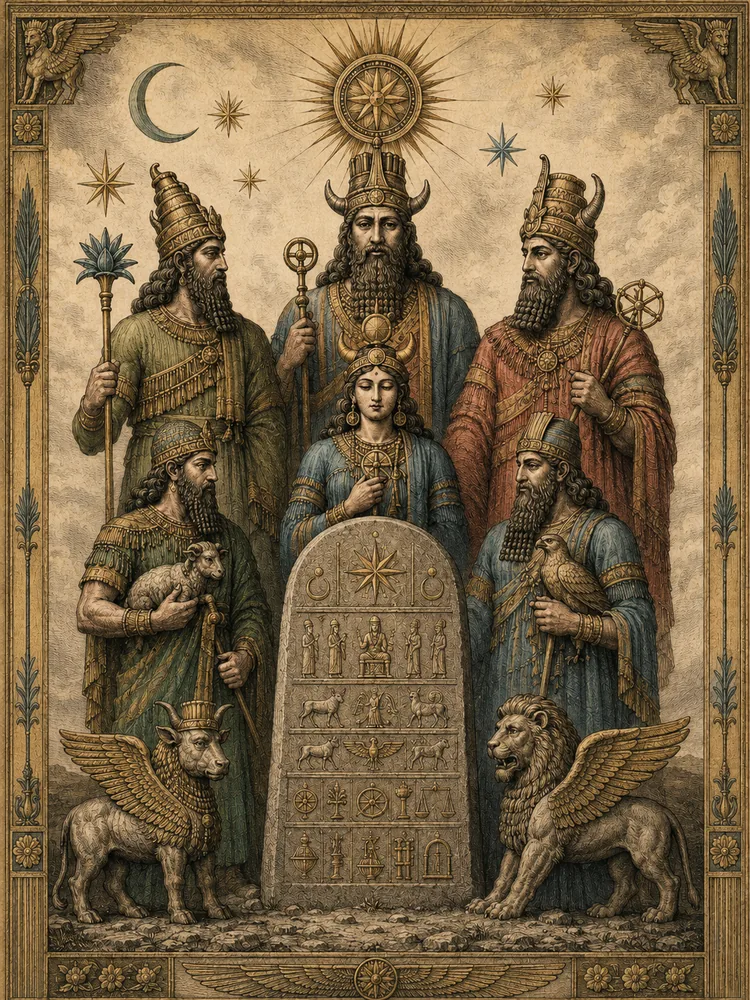
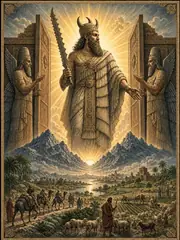
In Babylonia from the late second millennium and through the first, when a king made a grant of land — to a temple, to a noble, to a faithful servant — the boundaries of the grant were inscribed upon a stone monument called a kudurru, and the stone was set up in the temple. The face of the kudurru bore the legal text; its top, sides, and back bore carved emblems of the great gods, who were summoned by name and image to witness the grant and to curse any who should violate it. There was the wedge of Marduk and the stylus of Nabu; the lamp of Nusku, the goat-fish of Ea, the spade of Marduk again, the lightning-fork of Adad mounted on the back of his bull; the eight-pointed star of Ishtar, the crescent of Sin, the disk of Shamash. Snakes, scorpions, dragons, and the Anzud bird filled the lower registers. The whole was a compendium of the divine assembly, summoned in stone.
 Before thisTishpak
 Next on the wallNisroch
Curator’s note
What the sources say, and what later tradition added. The sources for this bay
The kudurrus (singular kudurru, plural kudurrātu) are an extraordinary documentary corpus, surviving from c. 1400 to 600 BCE; they are studied both for their legal content and for their religious iconography, since each emblem may be securely matched with a named deity. They constitute, in effect, a graphic catalogue of the Mesopotamian pantheon as it stood at the height of the Kassite and post-Kassite periods. The exhaustive curse-formulae they bear — "may every god named in this stone curse him with a curse not to be loosed; may his name be forgotten; may his line cease" — are among the most thorough imprecations known from antiquity.
Kin in the sources
Each tie is quoted from the entry that states it.
 Companion ofMarduk
There was the wedge of Marduk and the stylus of Nabu; the lamp of Nusku, the goat-fish of Ea
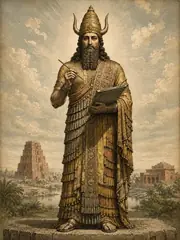 Companion ofNabu
There was the wedge of Marduk and the stylus of Nabu; the lamp of Nusku, the goat-fish of Ea
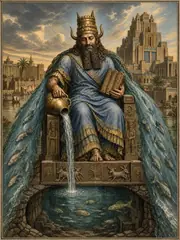 Companion ofEnki
There was the wedge of Marduk and the stylus of Nabu; the lamp of Nusku, the goat-fish of Ea
 Companion ofAdad
the lightning-fork of Adad mounted on the back of his bull
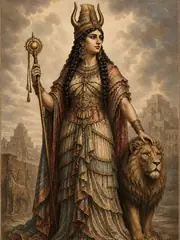 Companion ofIshtar of Nineveh
the eight-pointed star of Ishtar, the crescent of Sin, the disk of Shamash
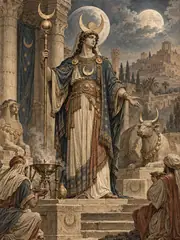 Companion ofSin of Harran
the eight-pointed star of Ishtar, the crescent of Sin, the disk of Shamash
 Companion ofUtu
the eight-pointed star of Ishtar, the crescent of Sin, the disk of Shamash
When the sources speak
Dated witnesses for Akkad, Babylon and Assyria. A date marks when the evidence was written down, not when the belief began. The whole timeline
- c. 3400–3000 BCE
- Uruk-period writing and monumental temple economies create the earliest recoverable administrative setting for named divine institutions.
- c. 2900–2350 BCE
- Early Dynastic city-states preserve local cults, hymns, royal inscriptions, and god lists; later copies often transmit older compositions.
- c. 2334–2154 BCE
- The Akkadian Empire expands bilingual and imperial patterns of divine identification without erasing local cult titles.
- c. 2112–2004 BCE
- Ur III administration and scribal schooling standardize many Sumerian literary and liturgical forms.
- c. 2000–1600 BCE
- Old Babylonian schools copy major myths, laments, hymns, debates, and heroic narratives in the form most often used by modern editors.
- c. 1650–1200 BCE
- Hittite and Hurrian archives at Hattusa transmit Anatolian myths, imported Syrian materials, and ritual compositions.
- c. 1400–1190 BCE
- The tablets of Ugarit preserve the Baal Cycle, Kirta, Aqhat, ritual lists, and a dense Late Bronze Age West Semitic pantheon.
- c. 1000–612 BCE
- Neo-Assyrian and Neo-Babylonian empires collect, revise, and politically reinterpret older learned traditions.