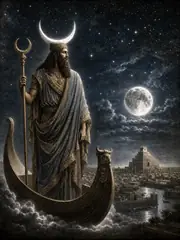
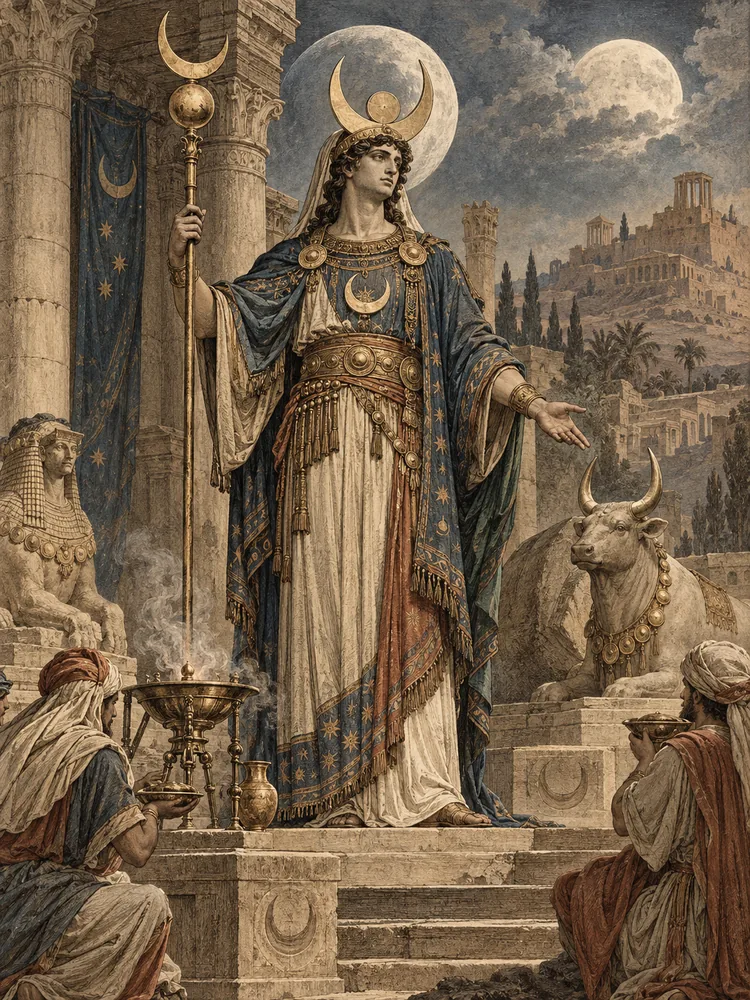
Sin — the moon-god whose great cult-center was at Harran in upper Mesopotamia — has been treated already in our first volume, in his older Sumerian and Akkadian forms. But the cult had a long second life in the Aramaean and Roman-period north Syrian world, and in this later phase Sin of Harran was worshipped in distinctively Aramaean ways that warrant separate treatment here. The temple at Harran (Greek Carrhae) was the great moon-sanctuary of the late ancient world, and its cult survived the Christianization of the Roman empire by several centuries — perhaps the latest organized pagan cult to persist in the Mediterranean east.
The temple of Sin at Harran was already ancient in Roman times. The Babylonian king Nabonidus, in the sixth century before our era, had restored the temple at considerable cost; the Neo-Babylonian inscriptions describe him as Sin's favored servant, and his curious devotion to the moon-god (rather than to the standard Babylonian Marduk) had political consequences, contributing to his eventual deposition by Cyrus the Persian. In the centuries that followed, the temple was maintained under Persian, Hellenistic, Parthian, and Roman rule. Harran lay on the eastern border of the Roman empire, and its religious life remained Aramaean in character into the late imperial period.
The fame of the Harranian moon-cult was such that it became a byword in the late Roman world for stubborn paganism. When the emperor Julian (361-363 of our era) attempted to restore traditional worship in the empire, he made a special pilgrimage to Harran to honor Sin; the contemporary historian Ammianus Marcellinus describes the visit. After Julian's death and the resumption of Christian state policy, the Harranian cult continued underground for several centuries; the so-called Sabians of Harran (a term derived from the Qur'an's reference to a tolerated People of the Book) were the survivors of the moon-cult well into the Islamic period. Caliph al-Ma'mun in the early ninth century is said to have demanded that the Harranian Sabians either convert to one of the recognized Abrahamic religions or be wiped out; they responded by claiming the title of 'Sabians' (technically reserved for an obscure group mentioned in the Qur'an) and so persuading the Islamic authorities to leave them in peace.
Under the Sabian banner, the Harranian moon-cult survived into the eleventh century of our era, when Crusader and Mongol invasions finally extinguished the priesthood. The community had become substantially Hellenized in its philosophical articulation, producing Neoplatonic interpretations of the planetary deities and contributing significantly to the transmission of Greek philosophical and astronomical learning into the Arabic world. The figures of Thabit ibn Qurra (836-901), one of the great mathematicians and translators of the early Abbasid period, was a Harranian Sabian, and his community at Baghdad was an intellectual center for several generations. So the cult of Sin, which had begun in the Sumerian temple at Ur three thousand years before, ended in the Arabic philosophical tradition of the early Middle Ages — one of the longest unbroken religious lines in human history.