A Compendium of the Ancient Gods
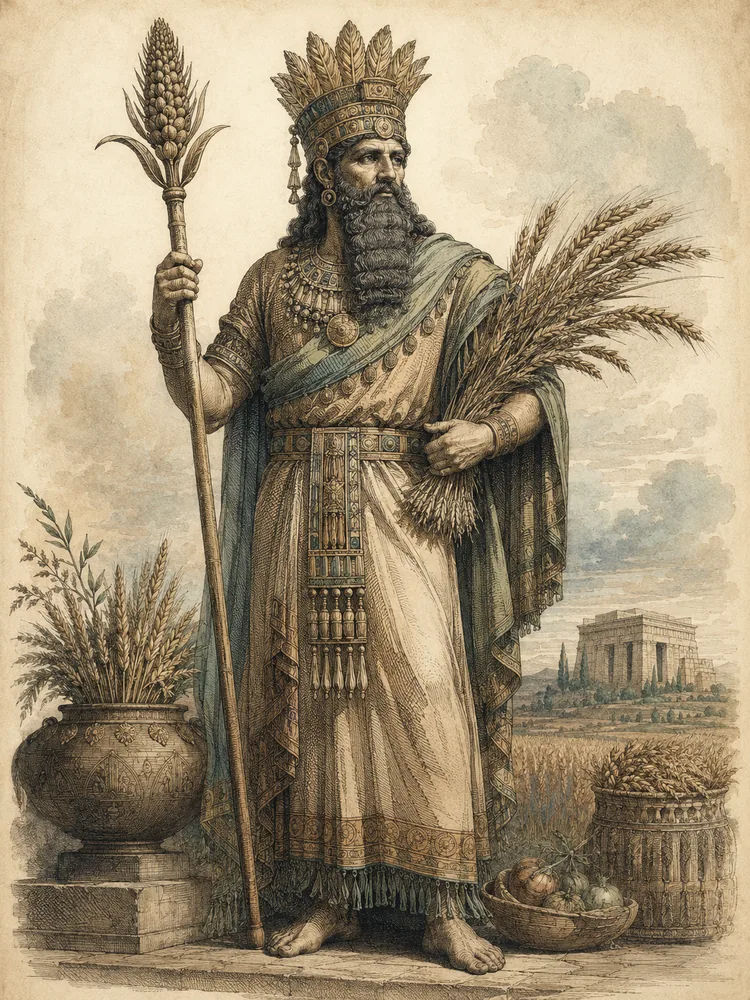
Dagon, plate

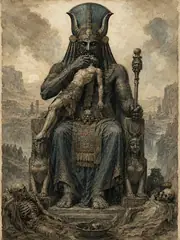
Dagon was an old god of grain, called in the Ugaritic literature the father of Baal: "Mighty Baal, the son of Dagon" is one of Baal's standing titles. His city was Tuttul on the upper Euphrates and, in the historical period, Ashdod and the cities of the Philistine pentapolis; the Bible records his cult prominently among the Philistines, where his temples at Ashdod and Gaza were the scenes of memorable narratives. The much-repeated notion, going back to Jerome and Rashi, that Dagon was a fish-god — based on a fanciful etymology connecting his name to Hebrew dag, "fish" — is now generally rejected; his name is rather connected to dagan, "grain," and his functions are agricultural.

Of his Philistine cult, two stories from the books of Samuel are notable. When the Philistines captured the Ark of the Covenant after the battle of Aphek, they brought it to the temple of Dagon at Ashdod, and set it before the image of Dagon. In the morning, the priests found Dagon's statue fallen on its face; they set it up; the next morning, Dagon had fallen again, and his head and hands had been cut off, leaving only the trunk. So the Ark was sent away. And in the temple of Dagon at Gaza, the blind Samson, brought out for sport, took hold of the central pillars, and pulled the temple down upon himself and the Philistine lords assembled there.
Curator’s note

What the sources say, and what later tradition added. The sources for this bay

Dagon (Ugaritic Dagan) is attested from at least the third millennium BCE in upper Mesopotamia, where Tuttul was his cult-center. The biblical narratives of Dagon are 1 Samuel 5 (the Ark in the temple at Ashdod) and Judges 16 (Samson at Gaza). The fish-god misidentification, while persistent, has been refuted decisively since the publication of the Ugaritic texts; the great H.W. Haussig and J.F. Healey have led the modern philological revision. The Philistine adoption of Dagon — when the Philistines themselves were of Aegean origin, the so-called "Sea Peoples" who arrived in the Levant c. 1180 BCE — is an interesting case of immigrant peoples adopting the gods of their new homeland.

Kin in the sources

Each tie is quoted from the entry that states it.

When the sources speak

Dated witnesses for Canaan and Phoenicia. A date marks when the evidence was written down, not when the belief began. The whole timeline

c. 3400–3000 BCE
Uruk-period writing and monumental temple economies create the earliest recoverable administrative setting for named divine institutions.
c. 2900–2350 BCE
Early Dynastic city-states preserve local cults, hymns, royal inscriptions, and god lists; later copies often transmit older compositions.
c. 2334–2154 BCE
The Akkadian Empire expands bilingual and imperial patterns of divine identification without erasing local cult titles.
c. 2112–2004 BCE
Ur III administration and scribal schooling standardize many Sumerian literary and liturgical forms.
c. 2000–1600 BCE
Old Babylonian schools copy major myths, laments, hymns, debates, and heroic narratives in the form most often used by modern editors.
c. 1650–1200 BCE
Hittite and Hurrian archives at Hattusa transmit Anatolian myths, imported Syrian materials, and ritual compositions.
c. 1400–1190 BCE
The tablets of Ugarit preserve the Baal Cycle, Kirta, Aqhat, ritual lists, and a dense Late Bronze Age West Semitic pantheon.
c. 1000–612 BCE
Neo-Assyrian and Neo-Babylonian empires collect, revise, and politically reinterpret older learned traditions.

Floor plan

The rooms follow one another in the order their peoples first appear in the written record.

  1. The Cradle of Citiesc. 3400 BCE to 395 CE. 115 works
  2. The Gift of the Nilec. 4000 BCE to 395 CE. 73 works
  3. The Olympian Orderc. 1600 BCE to 750 CE. 152 works
  4. The Persian Worldc. 2000 BCE to 1010 CE. 30 works
  5. The Levantine Borderlandsc. 1200 BCE to 500 CE. 20 works
  6. The Edges of Empirec. 2000 BCE to 1500 CE. 33 works
  7. The Etruscan Worldc. 900 BCE to 750 CE. 22 works
  8. The Roman Inheritancec. 1200 BCE to 500 CE. 58 works
  9. The Northern Inheritancec. 2000 BCE to 1600 CE. 131 works