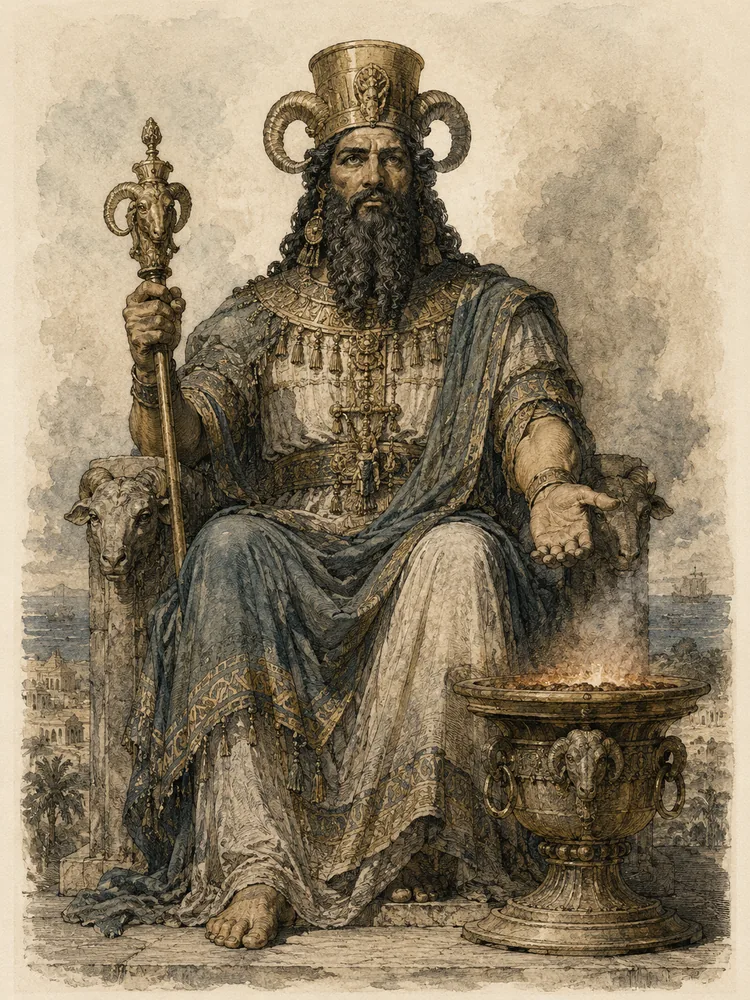
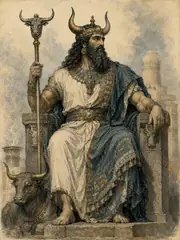
Ba'al Hammon — "Lord Hammon," the second name perhaps signifying "of the brazier" or of the cult-stone — was the chief deity of Carthage, the Phoenician colony in North Africa that became, in the latter centuries of the first millennium before the common era, the great rival of Rome. He was an old god transplanted from the Phoenician homeland, partaking of the qualities of El (the high creator) and of solar attributes; he was paired in the Punic pantheon with Tanit, his consort, the Punic Queen of Heaven. He was depicted as an aged, bearded figure enthroned, often with horns. To him, in the great precinct called the tophet — outside the city walls of Carthage, and of other Punic colonies — were dedicated thousands of urns containing the burned remains of infants and small animals.
 Before thisDagon
 Next on the wallMelqart
Curator’s note
What the sources say, and what later tradition added. The sources for this bay
The cult of Ba'al Hammon is the source of the most controversial evidence for child sacrifice in the Phoenician/Punic world. The tophet of Carthage, excavated in modern Tunis, has yielded thousands of urns; the dedicatory stelae regularly call the offering a molk (cf. biblical Hebrew molek/moloch) and characterize it as fulfilling a vow to Ba'al Hammon and Tanit. Whether the urns represent active sacrifice of healthy children, the burial of stillbirths and natural infant deaths under religious observance, or some combination, has been violently debated since the early twentieth century; the present scholarly consensus, supported by recent osteological work, leans cautiously toward acknowledging at least some active infant sacrifice as a feature of the cult, particularly in moments of state crisis. Classical sources from Plutarch (De Superstitione 13) and Diodorus Siculus (20.14) describe such sacrifices; their reports were long dismissed as Roman propaganda, but the archaeology has tended to corroborate them. The reader should weigh the evidence with care; this remains a live scholarly question.
Kin in the sources
Each tie is quoted from the entry that states it.
 Consort ofTanit
he was paired in the Punic pantheon with Tanit, his consort, the Punic Queen of Heaven.
 Compared withEl
partaking of the qualities of El (the high creator) and of solar attributes
When the sources speak
Dated witnesses for Canaan and Phoenicia. A date marks when the evidence was written down, not when the belief began. The whole timeline
- c. 3400–3000 BCE
- Uruk-period writing and monumental temple economies create the earliest recoverable administrative setting for named divine institutions.
- c. 2900–2350 BCE
- Early Dynastic city-states preserve local cults, hymns, royal inscriptions, and god lists; later copies often transmit older compositions.
- c. 2334–2154 BCE
- The Akkadian Empire expands bilingual and imperial patterns of divine identification without erasing local cult titles.
- c. 2112–2004 BCE
- Ur III administration and scribal schooling standardize many Sumerian literary and liturgical forms.
- c. 2000–1600 BCE
- Old Babylonian schools copy major myths, laments, hymns, debates, and heroic narratives in the form most often used by modern editors.
- c. 1650–1200 BCE
- Hittite and Hurrian archives at Hattusa transmit Anatolian myths, imported Syrian materials, and ritual compositions.
- c. 1400–1190 BCE
- The tablets of Ugarit preserve the Baal Cycle, Kirta, Aqhat, ritual lists, and a dense Late Bronze Age West Semitic pantheon.
- c. 1000–612 BCE
- Neo-Assyrian and Neo-Babylonian empires collect, revise, and politically reinterpret older learned traditions.