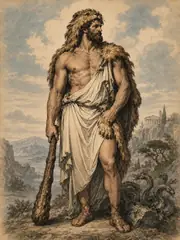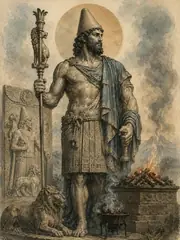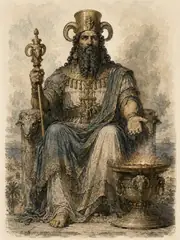
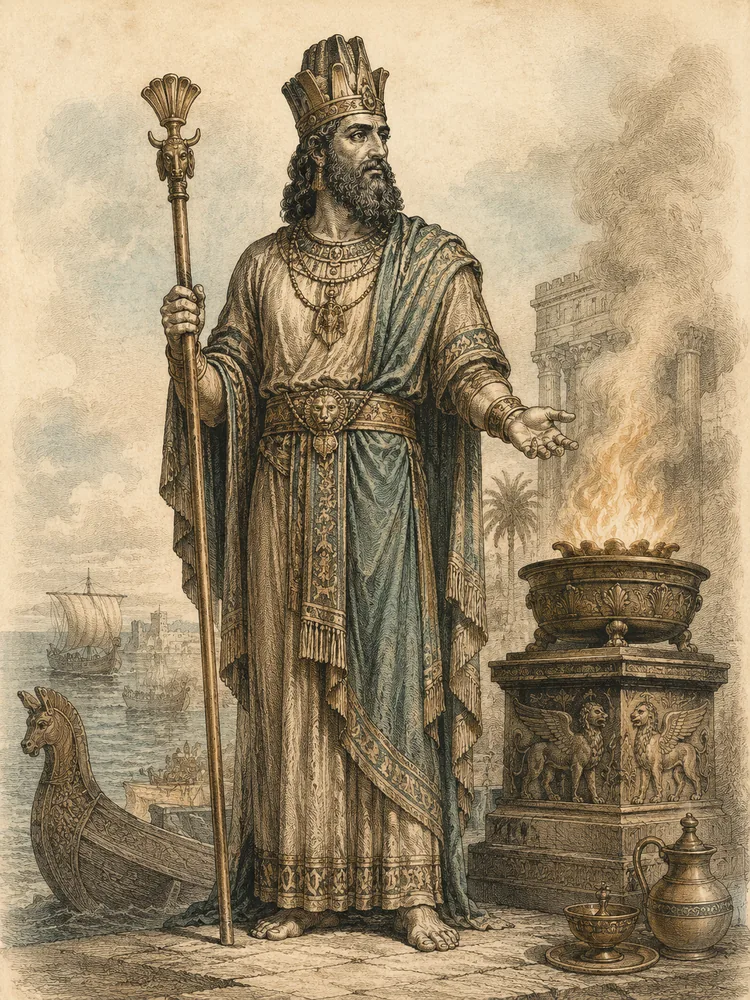
Of all the Phoenician city-gods, the most famous in his own time and the most consequential for posterity was Melqart — Milk-qart, "King of the City" — the patron of Tyre, the god in whose name the Tyrians sailed and traded and founded their colonies from Spain to Cyprus. He was identified by the Greeks with Heracles from the time of their first encounter with him, in the eighth century BCE; and the Heracles whose pillars stood at the Strait of Gibraltar (modern Gibraltar and the African Jebel Musa) was, in the Phoenician understanding, no Greek hero but Melqart of Tyre, master of the western voyage.
His annual festival at Tyre was the Egersis — the "awakening" — celebrated in the spring, in which the god's image was placed upon a great pyre, the pyre kindled, and the god understood to die in the flames. After certain days of mourning, he rose again; the new year began with his resurrection; and the city, refreshed, took up its commercial and political life. The pattern of the dying-and-rising god was, in Melqart, given a particular Tyrian shape, with the fire as its central element rather than the river or the underworld.
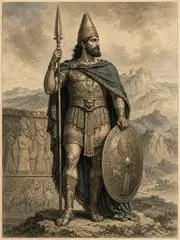
When Tyre's daughter-city Carthage was founded — by tradition in 814 BCE — Melqart went with her, and remained the patron deity of the Carthaginian state alongside Tanit and Baal Hammon. The annual tribute paid by Carthage to Tyre's temple of Melqart, well-attested in Greek and Latin sources, kept the bond alive for centuries. The name of the Carthaginian general Hamilcar — Ḥā-Milkart, "servant of Melqart" — preserves the god's centrality to Carthaginian onomastic and religious life. His son Hannibal, who in 218 BCE invaded Italy with elephants, paused before his march to swear an oath at the temple of Melqart at Cádiz (Phoenician Gadir), so that the god might know what was being undertaken in his name.
His cult survived the destruction of Carthage in 146 BCE, in the form of Hellenized Heracles-cults at Phoenician colonial sites across the Mediterranean, and persisted into the Roman imperial period. The temple of Melqart at Gades remained one of the most famous shrines of the western Mediterranean through the second century CE. Phoenician sailors, in the long centuries of their trade, took their god's pillars to be the western limit of the world; what lay beyond, said the Tyrians, was no longer the king's domain.