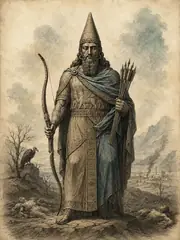
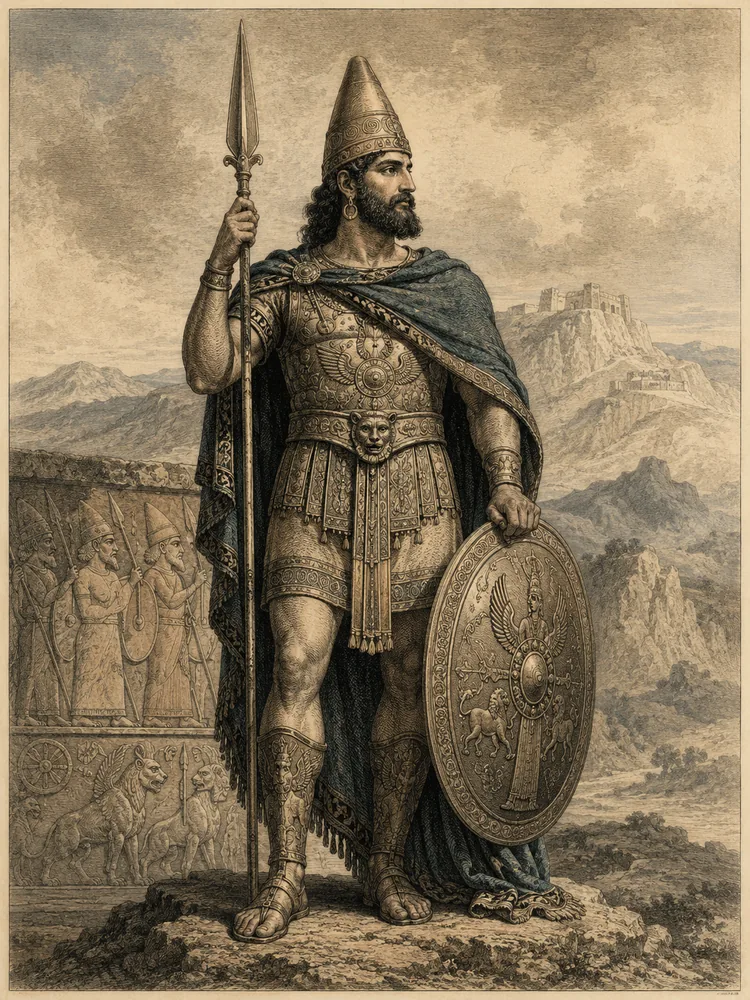
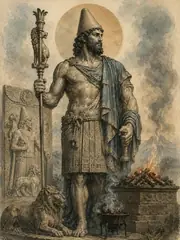
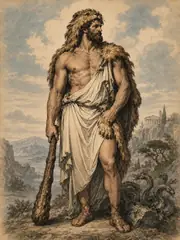
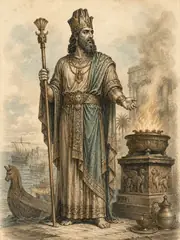
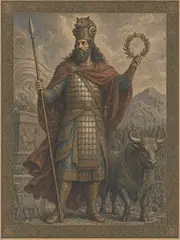
In the Luwian states of southern Anatolia, particularly in the highlands of Cilicia, was worshipped a war-god named Santas (or Šanta) — a deity invoked in oaths and treaty-curses, sometimes paired with a class of attendants called the Marwainzi, who were small chthonic spirits in the manner of demonic helpers. Santas was a hard god; the substitution-rituals offered to him, in which a human or animal stand-in was sent down to the underworld in another's place, give a sense of his ferocity.
His career did not end with the political collapse of the Luwian states. In Cilicia, where Luwian populations endured into the Iron Age and beyond, Santas survived under the name Sandon, and was assimilated by Greek incomers to Heracles. The annual fire-rite at Tarsus — in which a great pyre was built and the god's effigy consumed in flame, then resurrected the following year — was, by the Roman period, the most famous cult of the Cilician metropolis, and bore the marks of its Luwian ancestry beneath a Hellenized surface. He is treated more fully under his Lydian-Cilician name Sandon below.
When the sources speak
Dated witnesses for Anatolia. A date marks when the evidence was written down, not when the belief began. The whole timeline
- c. 3400–3000 BCE
- Uruk-period writing and monumental temple economies create the earliest recoverable administrative setting for named divine institutions.
- c. 2900–2350 BCE
- Early Dynastic city-states preserve local cults, hymns, royal inscriptions, and god lists; later copies often transmit older compositions.
- c. 2334–2154 BCE
- The Akkadian Empire expands bilingual and imperial patterns of divine identification without erasing local cult titles.
- c. 2112–2004 BCE
- Ur III administration and scribal schooling standardize many Sumerian literary and liturgical forms.
- c. 2000–1600 BCE
- Old Babylonian schools copy major myths, laments, hymns, debates, and heroic narratives in the form most often used by modern editors.
- c. 1650–1200 BCE
- Hittite and Hurrian archives at Hattusa transmit Anatolian myths, imported Syrian materials, and ritual compositions.
- c. 1400–1190 BCE
- The tablets of Ugarit preserve the Baal Cycle, Kirta, Aqhat, ritual lists, and a dense Late Bronze Age West Semitic pantheon.
- c. 1000–612 BCE
- Neo-Assyrian and Neo-Babylonian empires collect, revise, and politically reinterpret older learned traditions.