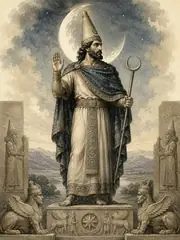
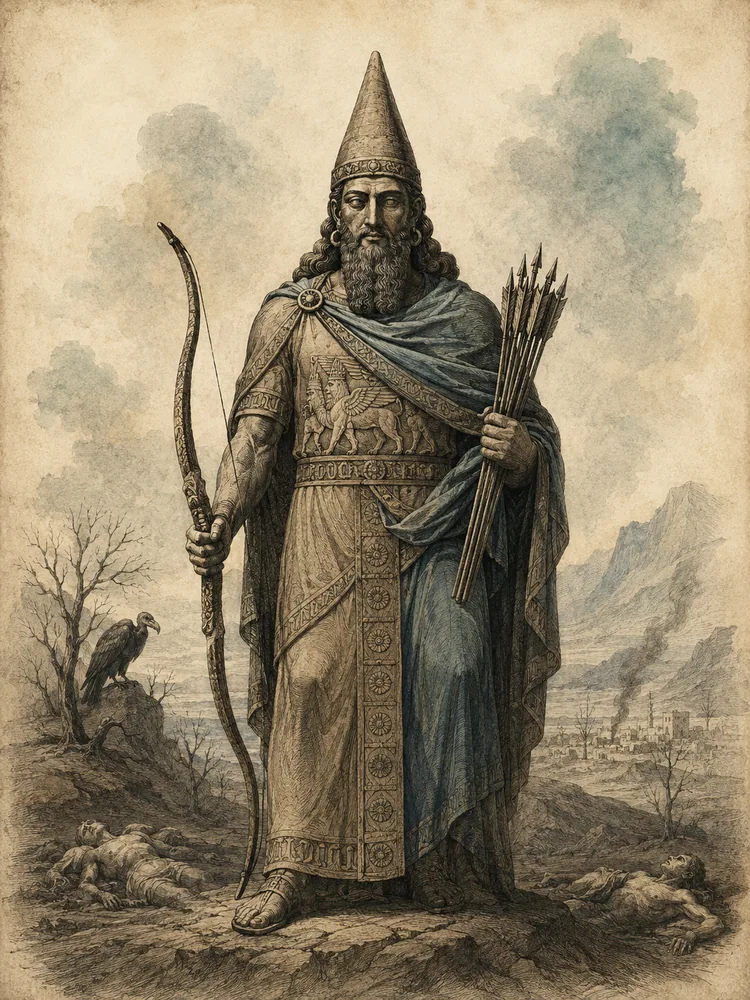
When pestilence struck the Hittite armies on campaign — when soldiers fell suddenly and could not rise — the Hittites looked for the responsible god, and they often named Iyarri, the Luwian-Hittite god of plague. He carried arrows; with them, he could strike a man at any distance, in the camp or in the field; the plague that swept through a Hittite army was, in religious vocabulary, a flight of his shafts.
He appears in the treaty-curses by which Hittite kings bound their vassals — "If you break this oath, may Iyarri shoot you with his plague-arrows" — and in the more ordinary ritual literature of the late Bronze Age. The arrow-of-plague iconography spread broadly in Eastern Mediterranean religion: it appears in the Apollo Smintheus (the plague-shooting Apollo at Troy in Iliad I), in the Levantine god Resheph, and in various Mesopotamian disease-demons. Iyarri stands among the older preserved instances of the type.
When the sources speak
Dated witnesses for Anatolia. A date marks when the evidence was written down, not when the belief began. The whole timeline
- c. 3400–3000 BCE
- Uruk-period writing and monumental temple economies create the earliest recoverable administrative setting for named divine institutions.
- c. 2900–2350 BCE
- Early Dynastic city-states preserve local cults, hymns, royal inscriptions, and god lists; later copies often transmit older compositions.
- c. 2334–2154 BCE
- The Akkadian Empire expands bilingual and imperial patterns of divine identification without erasing local cult titles.
- c. 2112–2004 BCE
- Ur III administration and scribal schooling standardize many Sumerian literary and liturgical forms.
- c. 2000–1600 BCE
- Old Babylonian schools copy major myths, laments, hymns, debates, and heroic narratives in the form most often used by modern editors.
- c. 1650–1200 BCE
- Hittite and Hurrian archives at Hattusa transmit Anatolian myths, imported Syrian materials, and ritual compositions.
- c. 1400–1190 BCE
- The tablets of Ugarit preserve the Baal Cycle, Kirta, Aqhat, ritual lists, and a dense Late Bronze Age West Semitic pantheon.
- c. 1000–612 BCE
- Neo-Assyrian and Neo-Babylonian empires collect, revise, and politically reinterpret older learned traditions.