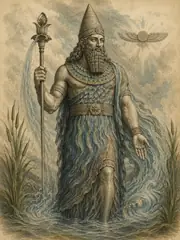
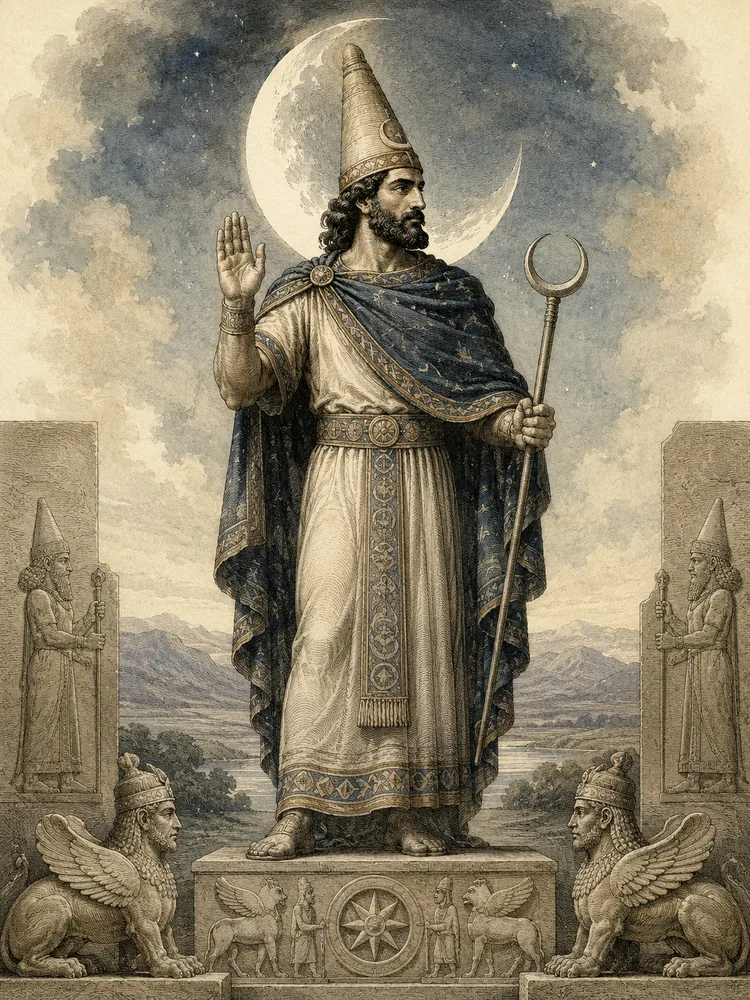
Among the Luwians of southern and western Anatolia, the moon was a male god — Arma, whose crescent shape and steady cycle made him a natural god of oaths and witness. He was sworn to in treaties; he was invoked in the curses laid upon oath-breakers; he was, in Luwian iconographic tradition (which left us reliefs and seals from the Iron Age), shown with the crescent upon his shoulders or above his head, sometimes in association with the winged sun-disk.
His cult continued, after the political decline of the Luwian states, in those Anatolian and Aramaean cities where the moon-religion of the older world persisted; and the great moon-cult at Harran, which drew its origin from Mesopotamian Sin but absorbed Luwian and Aramaean elements over centuries, owed something also to Arma.
Curator’s note
What the sources say, and what later tradition added. The sources for this bay
Arma is documented chiefly in Luwian hieroglyphic inscriptions from Iron Age southeastern Anatolia (Carchemish, Malatya, Karkamiš and related sites), and in ritual texts of the Hittite-Luwian late Bronze Age. His male character makes him distinctively Anatolian-Mesopotamian: lunar deities elsewhere in Indo-European tradition (Greek Selene, Roman Luna) are female. The continuity of moon-religion at Harran, attested from the Old Babylonian period through the Aramaean, Roman, and into the early Islamic centuries, makes the worship of the moon at that site one of the longest-continuous religious traditions of the ancient Near East.
When the sources speak
Dated witnesses for Anatolia. A date marks when the evidence was written down, not when the belief began. The whole timeline
- c. 3400–3000 BCE
- Uruk-period writing and monumental temple economies create the earliest recoverable administrative setting for named divine institutions.
- c. 2900–2350 BCE
- Early Dynastic city-states preserve local cults, hymns, royal inscriptions, and god lists; later copies often transmit older compositions.
- c. 2334–2154 BCE
- The Akkadian Empire expands bilingual and imperial patterns of divine identification without erasing local cult titles.
- c. 2112–2004 BCE
- Ur III administration and scribal schooling standardize many Sumerian literary and liturgical forms.
- c. 2000–1600 BCE
- Old Babylonian schools copy major myths, laments, hymns, debates, and heroic narratives in the form most often used by modern editors.
- c. 1650–1200 BCE
- Hittite and Hurrian archives at Hattusa transmit Anatolian myths, imported Syrian materials, and ritual compositions.
- c. 1400–1190 BCE
- The tablets of Ugarit preserve the Baal Cycle, Kirta, Aqhat, ritual lists, and a dense Late Bronze Age West Semitic pantheon.
- c. 1000–612 BCE
- Neo-Assyrian and Neo-Babylonian empires collect, revise, and politically reinterpret older learned traditions.