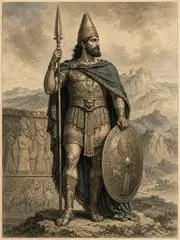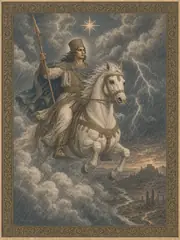
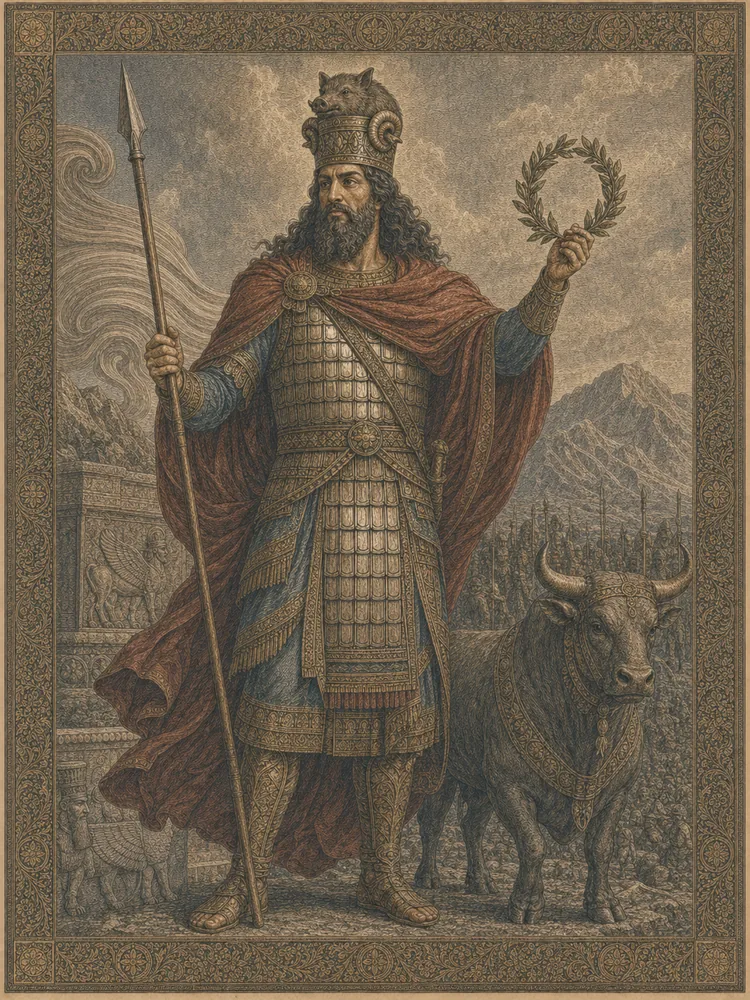
Verethragna — "Smasher of Resistance," "Victorious One," or in the later Middle Persian Bahram — was the yazata of victory, the great Iranian war-god, the patron of the warrior on the battlefield and of the king on his throne. His Avestan hymn (Yasht 14, the Bahram Yasht) describes him in ten incarnations, in each of which he comes to the worshipper bearing the gift of victory: as the wind, as a bull with golden horns, as a white horse with golden ears, as a male camel rutting and aggressive, as a wild boar, as a fifteen-year-old youth, as the falcon of war, as a ram, as a wild goat, and as a warrior bearing a golden sword.
The series of incarnations is unique in the Iranian theology — most yazatas have a single iconography — and probably preserves a layered tradition in which various older figures of victory have been merged into Verethragna. The boar form is particularly noteworthy: the wild boar was the totem-animal of the Iranian warrior aristocracy, and to fight "like a boar" was the highest praise. The fifteen-year-old youth represents the warrior in his prime, the age at which a young man took his place in the battle-line. The falcon is a distinctively Indo-Iranian war-symbol, prominent also in the Vedic tradition.
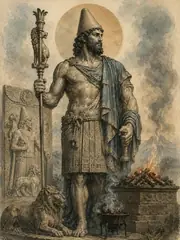
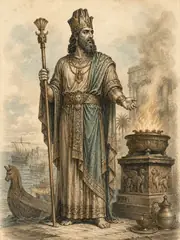
Under the Sasanian dynasty (224-651 CE), Verethragna in his form Bahram was the special patron of the kings, and several of the kings took his name: Bahram I, Bahram II, Bahram III, Bahram IV, Bahram V ("Bahram Gor," the great hunter-king), Bahram VI Chobin (the usurper), and so on. The royal cult of Bahram included great fires named for him — the Atash-i Bahram or "Fire of Victory" — and the maintenance of these fires was a sign of the king's commitment to the protection of the Iranian people.
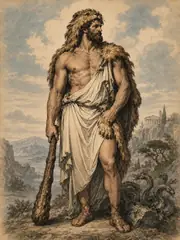
After the Islamic conquest, Bahram passed into Persian heroic legend as a great king and warrior, with cycles of stories preserved in the Shahnameh and elsewhere. The Bahram of these later tales is partly historical (the Sasanian kings who bore the name) and partly mythological (the war-yazata behind them); the two layers are sometimes hard to distinguish. The figure was also identified by the Greeks with Heracles, and on coins of the Indo-Iranian successors of Alexander, Verethragna and Heracles appear interchangeably as a club-bearing warrior — a syncretism that lasted for several centuries.