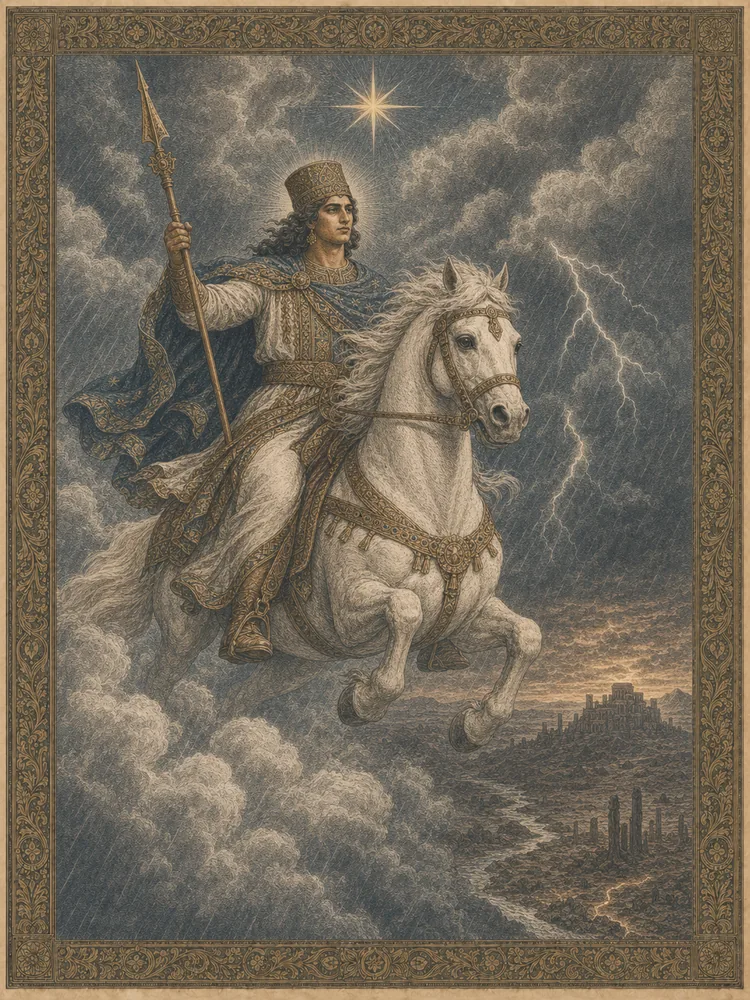
Tishtrya was the yazata of the star Sirius — the brightest fixed star in the night sky — and the bringer of the seasonal rains that were essential to Iranian agriculture. His great mythological deed was the annual battle with the drought-demon Apaosha, recounted in Yasht 8, the Tir Yasht. Each year, when the rains were due, Tishtrya rose into the heavens in the form of a beautiful young man on a white horse and engaged Apaosha in combat over the heavenly sea Vourukasha; if Tishtrya prevailed, the sea overflowed and the rains came down to nourish the earth; if Apaosha prevailed, the drought continued and the world suffered.
The first year, the Yasht recounts, Tishtrya was insufficiently strengthened by the prayers and offerings of men, and Apaosha drove him back; the world suffered drought. Then the prayers were redoubled and the offerings increased, and Tishtrya in the second year defeated Apaosha; the rains came, and the world flourished. The lesson of the myth was simple: the gods needed the prayers of men to do their work; the cosmic battle was waged in part through human ritual support; if men failed in their devotion, the world suffered.
Tishtrya's identification with Sirius is one of the clearest cases of an astronomical-mythological correspondence in any ancient religion. The heliacal rising of Sirius — the moment when the star reappears in the eastern sky just before dawn after a period of invisibility — coincides in Iran with the late summer, the time when the seasonal monsoon-fed rains begin in some parts of the Iranian plateau. The Egyptians had made a similar association of Sirius with the annual Nile flood (under the name Sopdet, treated in Volume II of this anthology); the Iranians made the parallel association with the seasonal rains.
Tishtrya was particularly the patron of farmers, who depended on the rains for their crops, and his hymn was recited at planting and again at harvest as a thanksgiving. His day in the Iranian calendar was the thirteenth of each month, and his month was the fourth, in which the heliacal rising of Sirius would have been particularly noticed.