A Compendium of the Ancient Gods
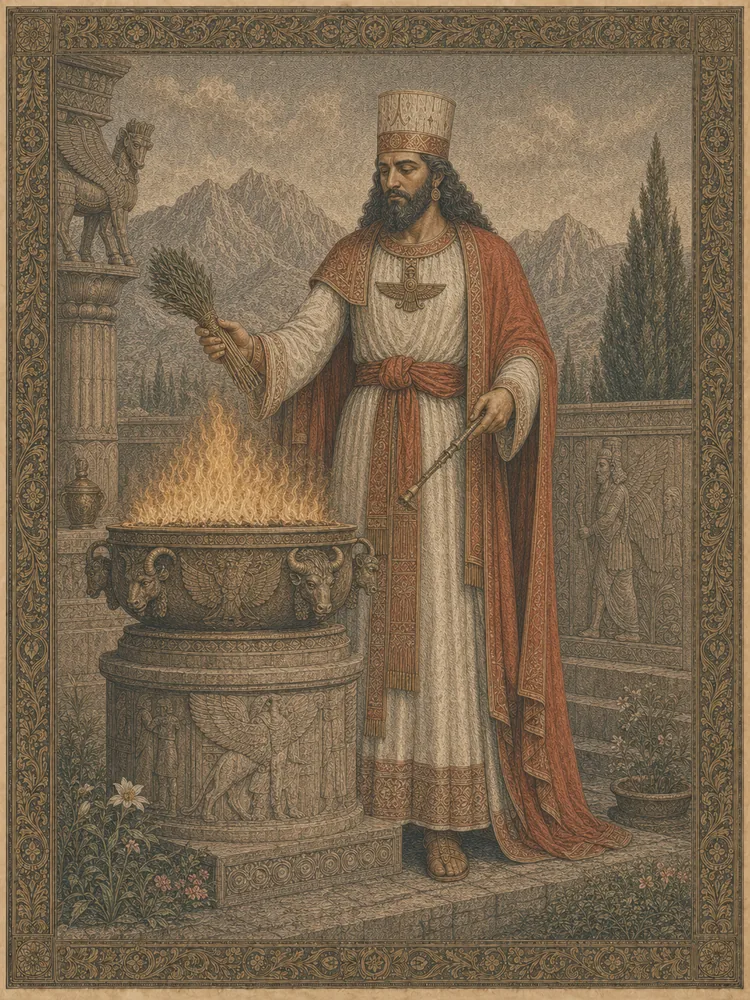
Atar, plate

Atar — "Fire" — was the yazata of the sacred fire, called the Son of Ahura Mazda. He was the visible presence of the divine in the world, the medium through which the worshipper approached the gods, the element by which sacrifices were transformed and prayers carried upward. The cult of fire was the most distinctive practice of the Zoroastrian religion, and Atar's preservation was the priestly task above all others.

There were three grades of sacred fire among the Zoroastrians: the Atash Bahram ("Fire of Victory"), the highest grade, which required a complex consecration ritual involving fires gathered from sixteen different sources — including a fire ignited by lightning, a fire from a corpse-burning, a fire from a copper-smelter, fires from various trades — and which once consecrated could never be allowed to go out; the Atash Adaran ("Fire of Fires"), an intermediate grade for parish-temples; and the Atash Dadgah ("Fire of the Place"), the household fire of the family hearth. Each grade had its own ritual demands, its own scope of use, its own theological significance.

Five fires were named in the Avesta (Yasna 17): the fire Berezisavah (which burns before Ahura Mazda in heaven), the fire Vohu Fryana (which burns in the bodies of men and animals), the fire Urvazishta (which burns in the plants), the fire Vazishta (which is the lightning), and the fire Spenishta (the consecrated temple-fire). All these were aspects of Atar, and the worshipper at any sacred fire was addressing the same divine presence under whatever local form.

After the Islamic conquest of Iran, the maintenance of sacred fires became more difficult, and many of the great Atash Bahrams were extinguished. But some have been preserved in unbroken continuity for many centuries; the Atash Bahram of Yazd in central Iran has been kept burning, by traditional accounts, since the year 470 of our era — almost sixteen hundred years — and is the longest continuously burning sacred fire on earth. The Parsi communities of India maintain several Atash Bahrams of considerable antiquity, including the Iranshah at Udvada, brought from Iran in the eighth century with the original Parsi exodus. So Atar continues, against all odds, to burn.
Curator’s note

What the sources say, and what later tradition added. The sources for this bay

Atar is invoked throughout the Avesta. The Yasna 17 fivefold classification of fires is the locus classicus. The Atash Niyayishn (a short prayer to the fire) and the Atash Nyaish (the longer hymn) are the principal liturgical texts. Bundahishn 18 and the Pahlavi Rivayats describe the consecration rituals of the Atash Bahram. The Yazd Atash Bahram is documented in modern times; the Iranshah at Udvada is described by James Hinnells, Mary Boyce, and others. Boyce's Stronghold of Zoroastrianism (1977, 1989) is a sympathetic ethnographic account of the surviving Iranian Zoroastrian communities.

Kin in the sources

Each tie is quoted from the entry that states it.

When the sources speak

Dated witnesses for The Yazatas. A date marks when the evidence was written down, not when the belief began. The whole timeline

late 2nd–early 1st millennium BCE, debated
The Old Avestan Gathas and Yasna Haptanghaiti emerge in an eastern Iranian ritual-poetic setting; Zarathustra’s date remains disputed.
1st millennium BCE
Younger Avestan hymns, ritual texts, and legal-purity materials develop over a long period of oral transmission.
c. 550–330 BCE
Achaemenid inscriptions invoke Ahuramazda in imperial royal ideology; their relationship to later Zoroastrian orthodoxy requires care.
330 BCE–224 CE
Hellenistic and Parthian eras preserve Iranian cults through sparse and regionally varied evidence.
224–651 CE
Sasanian institutions sponsor priestly learning and the redactional organization associated with the Avesta and Zand.
7th–10th centuries CE
After the Islamic conquest, Middle Persian books record cosmology, law, exegesis, and summaries of lost material.
c. 9th century CE
The Bundahišn, Dēnkard, Wizīdagīhā ī Zādspram, and related works preserve systematic late antique and early Islamic syntheses.
c. 977–1010 CE
Ferdowsi composes the Shāhnāmeh from epic and royal traditions with both pre-Islamic and Islamic-period mediation.

Floor plan

The rooms follow one another in the order their peoples first appear in the written record.

  1. The Cradle of Citiesc. 3400 BCE to 395 CE. 115 works
  2. The Gift of the Nilec. 4000 BCE to 395 CE. 73 works
  3. The Olympian Orderc. 1600 BCE to 750 CE. 152 works
  4. The Persian Worldc. 2000 BCE to 1010 CE. 30 works
  5. The Levantine Borderlandsc. 1200 BCE to 500 CE. 20 works
  6. The Edges of Empirec. 2000 BCE to 1500 CE. 33 works
  7. The Etruscan Worldc. 900 BCE to 750 CE. 22 works
  8. The Roman Inheritancec. 1200 BCE to 500 CE. 58 works
  9. The Northern Inheritancec. 2000 BCE to 1600 CE. 131 works