A Compendium of the Ancient Gods
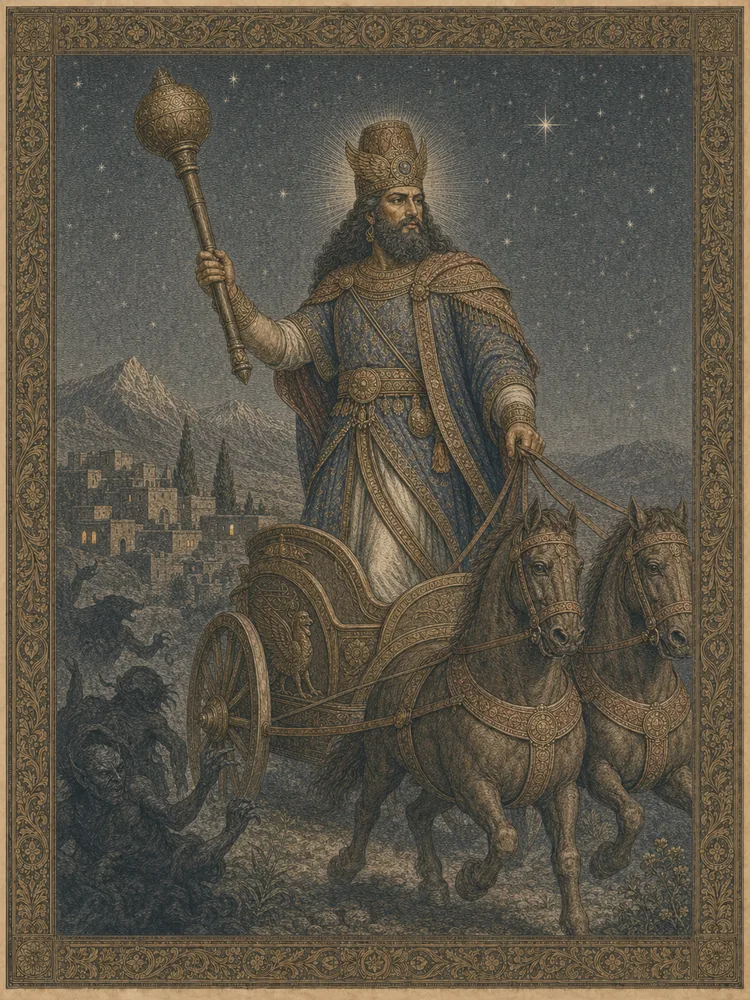
Sraosha, plate

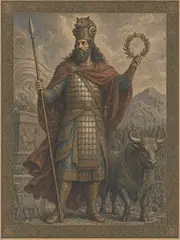
Sraosha — "Obedience," or "Hearkening" — was the yazata of attentive listening to the divine word, of religious obedience, of the discipline by which the worshipper aligned himself with the will of Ahura Mazda. He was particularly the protector against the demons of the night: when the sun set and the world was in darkness, Sraosha rode upon his chariot to guard the righteous from the assaults of the daevas. He carried a great mace, the symbol of his power against demons; he stood always on alert; he never slept.

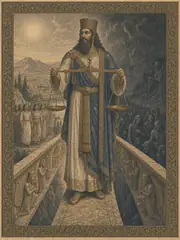
Sraosha had a special role in the post-mortem judgment of souls. When a human being died, his soul lingered for three days near the body, contemplating its life. On the dawn of the fourth day the soul was conducted to the Chinvat Bridge — the Bridge of the Separator — where the dead were judged. There Sraosha stood with two other yazatas, Mithra and Rashnu (the latter to be treated below), to oversee the judgment. The righteous soul found the bridge wide and easy to cross, and was met on the far side by a beautiful maiden (his own daena, his religious conscience, made personally visible) who led him to paradise. The wicked soul found the bridge thin as a razor; he fell from it into hell, where he was met by an ugly hag (his own daena in her degraded form) who led him to torment.

Sraosha's function as protector and as judge made him the closest of the yazatas to the daily life of the worshipper. He was invoked at the boundary moments — at sunset, at dawn, at the moment of falling asleep, at the death of a relative. The Sraosha Yasht (Yasna 57) is one of the most-recited prayers in the Zoroastrian liturgy, and his name appears in numerous Iranian personal names through history (Old Persian Suxra-, Middle Persian Surōs).

After the Islamic conquest, Sraosha's name in the form Surōsh / Sorush was preserved in Persian poetic and folk tradition as the angel of inspired speech, who came to the poet at moments of inspiration to whisper in his ear. The Persian poets of the Islamic period invoke Sorush in this sense — the inner voice of poetic and prophetic insight — long after the formal religion of Iran had changed.
Curator’s note

What the sources say, and what later tradition added. The sources for this bay

Sraosha is the central figure of Yasna 57 (the Sraosha Yasht in the standard liturgy) and of Yasht 11. His role at the Chinvat Bridge is described in Vendidad 19, in the Hadhokht Nask, and in various Pahlavi texts (notably the Arda Viraf Namag). The post-Islamic survival as Sorush in Persian poetry is widespread; Hafez and Rumi both invoke him. The name Sraosha is from a root meaning "to hear, to obey," cognate with Vedic śraviṣṭha (the Iranian semantic shift to "obedience" is from "hearing").

Kin in the sources

Each tie is quoted from the entry that states it.

When the sources speak

Dated witnesses for The Yazatas. A date marks when the evidence was written down, not when the belief began. The whole timeline

late 2nd–early 1st millennium BCE, debated
The Old Avestan Gathas and Yasna Haptanghaiti emerge in an eastern Iranian ritual-poetic setting; Zarathustra’s date remains disputed.
1st millennium BCE
Younger Avestan hymns, ritual texts, and legal-purity materials develop over a long period of oral transmission.
c. 550–330 BCE
Achaemenid inscriptions invoke Ahuramazda in imperial royal ideology; their relationship to later Zoroastrian orthodoxy requires care.
330 BCE–224 CE
Hellenistic and Parthian eras preserve Iranian cults through sparse and regionally varied evidence.
224–651 CE
Sasanian institutions sponsor priestly learning and the redactional organization associated with the Avesta and Zand.
7th–10th centuries CE
After the Islamic conquest, Middle Persian books record cosmology, law, exegesis, and summaries of lost material.
c. 9th century CE
The Bundahišn, Dēnkard, Wizīdagīhā ī Zādspram, and related works preserve systematic late antique and early Islamic syntheses.
c. 977–1010 CE
Ferdowsi composes the Shāhnāmeh from epic and royal traditions with both pre-Islamic and Islamic-period mediation.

Floor plan

The rooms follow one another in the order their peoples first appear in the written record.

  1. The Cradle of Citiesc. 3400 BCE to 395 CE. 115 works
  2. The Gift of the Nilec. 4000 BCE to 395 CE. 73 works
  3. The Olympian Orderc. 1600 BCE to 750 CE. 152 works
  4. The Persian Worldc. 2000 BCE to 1010 CE. 30 works
  5. The Levantine Borderlandsc. 1200 BCE to 500 CE. 20 works
  6. The Edges of Empirec. 2000 BCE to 1500 CE. 33 works
  7. The Etruscan Worldc. 900 BCE to 750 CE. 22 works
  8. The Roman Inheritancec. 1200 BCE to 500 CE. 58 works
  9. The Northern Inheritancec. 2000 BCE to 1600 CE. 131 works