
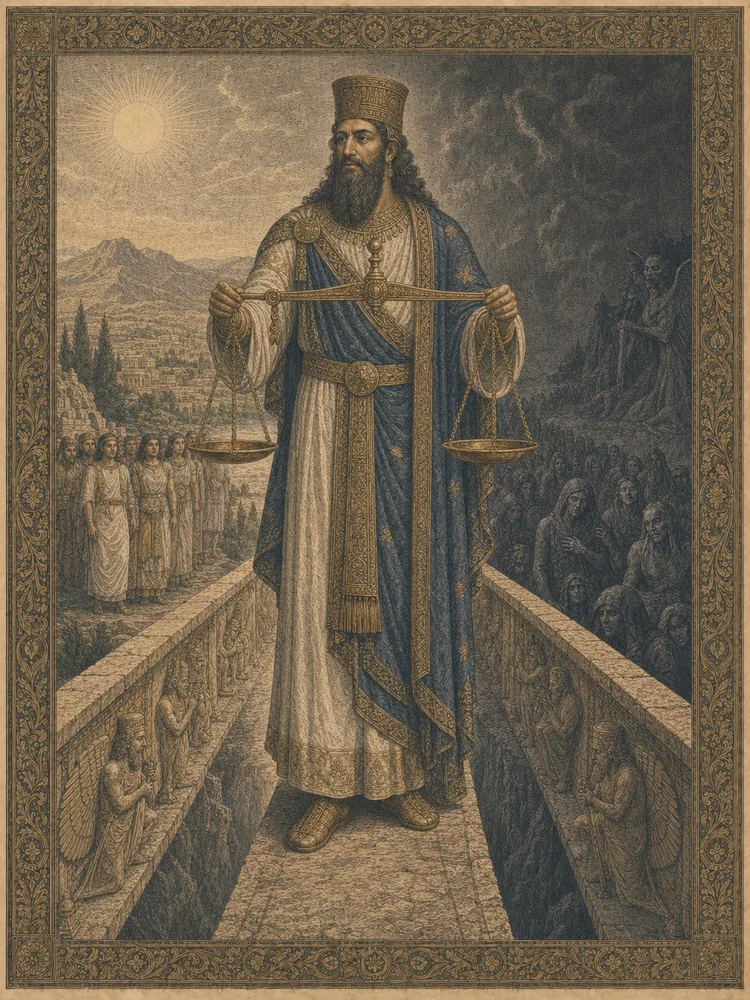

Rashnu — "the Just" or "the Right" — was the yazata of justice, particularly the justice rendered at the post-mortem judgment of souls. Where Sraosha protected the righteous and presided over the boundary moment of dying, Rashnu stood at the Chinvat Bridge with a great pair of golden scales, weighing the soul's good deeds against its bad. The scales did not lie; the decision was final; from Rashnu's verdict there was no appeal.
His Avestan hymn (Yasht 12, the Rashn Yasht) lists in detail all the places where Rashnu might be located — wherever justice was needed, there Rashnu was — and the catalog runs from the heights of heaven to the ends of the earth, from the roots of the great trees to the depths of the seas, from the king's court to the poor man's hearth. The point of the catalog was that no place was hidden from the god of justice; nowhere could a man hope to escape the scales by going to a distant region or by trusting in the privacy of his actions.
The triad of Mithra, Sraosha, and Rashnu at the Chinvat Bridge gave the Iranian post-mortem judgment a peculiarly judicial character — three judges, each with his proper office, the case heard, the verdict pronounced, the soul dispatched. This conception was inherited (with various modifications) by the late Jewish, Christian, and Islamic eschatologies, all of which retain the notion of the judgment-after-death as a juridical proceeding overseen by named angelic figures. The Christian conception of the Particular Judgment, in which the soul at death is judged immediately and consigned to its provisional destiny, descends ultimately from the Iranian original through the Jewish-apocalyptic intermediary.
Rashnu was particularly invoked in oaths and in legal proceedings. To swear by Rashnu was to swear by the truth itself, with full awareness that the god of justice would judge any falsehood. The Vendidad — the Zoroastrian law-code — invokes Rashnu repeatedly in its prescriptions for the trial of disputes; the ordeal-by-water and the ordeal-by-fire, in which an accused proved his innocence by surviving an immersion or a passage through flames, were under Rashnu's supervision.