A Compendium of the Ancient Gods
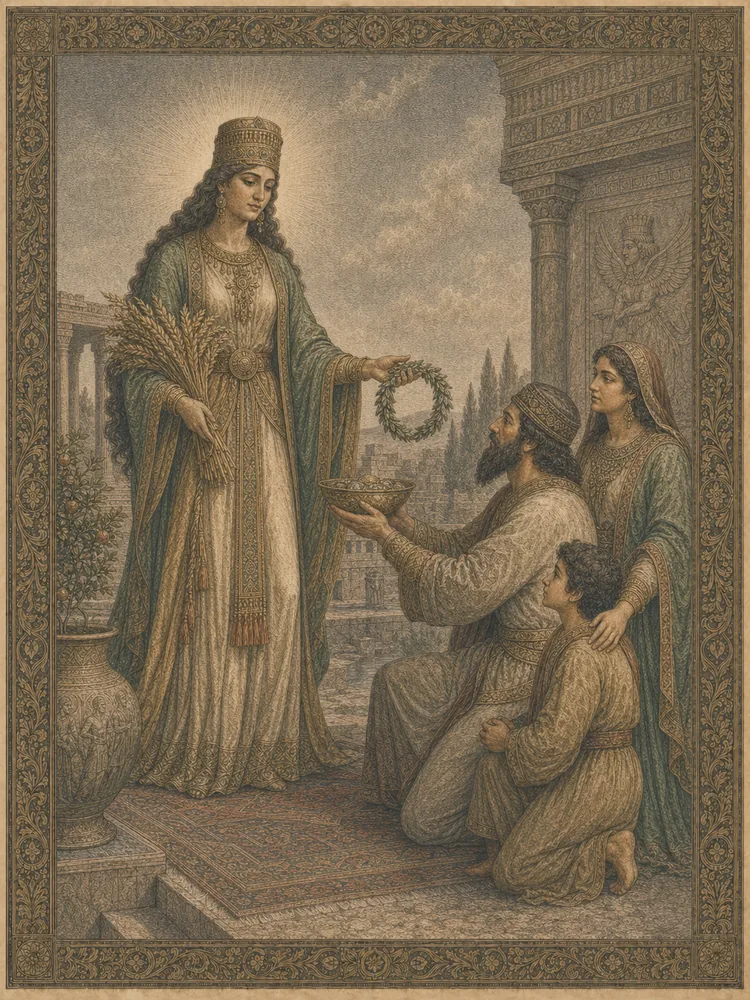
Ashi, plate

Ashi — "Reward," or "Right Recompense," or simply "Fortune" — was the yazata who brought to the righteous the rewards their good lives deserved. She was the personification of the principle that the good deed is repaid; that the man who follows Asha (Truth) does not labor in vain, but receives in proper measure both the goods of this world (cattle, children, prosperity) and the rewards of the next (paradise, the Best Existence). Her name is closely related to Asha — both come from the same Indo-Iranian root — and she is the Asha-principle in its rewarding aspect, the cosmic order's way of compensating those who serve it.

Her great Avestan hymn (Yasht 17, the Ashi Yasht, also called the Ard Yasht in some traditions) is one of the most beautiful in the corpus. It describes Ashi as a beautiful maiden, daughter of Ahura Mazda and Spenta Armaiti, sister of the Amesha Spentas; she dwells on a high mountain, riding in a chariot, descending to bestow her gifts on those who deserve them. The hymn catalogs the categories of people whom Ashi rewards (the priests, the warriors, the cultivators, the artisans, the children of righteous parents) and those whom she withholds her favor from (those who have not produced offspring, those who have lived in idleness, those who have followed the lie). The catalog is one of the few in Iranian religious literature to focus directly on the social and economic dimensions of righteous living.

Ashi's reward was both material and spiritual. To the righteous in this life, she gave wealth, fertility, abundance — the visible signs of divine favor. To the righteous after death, she gave the rewards of paradise. The doctrine that prosperity in this life is a sign of righteousness, and that righteousness is the path to prosperity, was distinctively Zoroastrian in its early forms; the doctrine that righteousness is its own reward and that material success is irrelevant came later (and, when it came, came under the influence of more austere religious philosophies). In the original Avestan religion, Ashi's rewards were to be sought and enjoyed; the prosperity of the world was the gift of Ahura Mazda, mediated through her, to the souls who served him.


Curator’s note

What the sources say, and what later tradition added. The sources for this bay

Ashi is the central figure of Yasht 17. The relation between Ashi and Asha (the Amesha Spenta of Truth) is etymological — both from a root *ar- meaning "order, fitting, right" — and theological, with Ashi being Asha's outward manifestation in the form of reward. Mary Boyce's article "Ashi" in the Encyclopaedia Iranica is the standard treatment. The doctrine of material prosperity as a reward for righteousness has been compared with similar themes in the Hebrew wisdom literature (Psalms, Proverbs); the influence may have run from Iran to Israel during the Persian period of Jewish history.

Kin in the sources

Each tie is quoted from the entry that states it.

When the sources speak

Dated witnesses for The Yazatas. A date marks when the evidence was written down, not when the belief began. The whole timeline

late 2nd–early 1st millennium BCE, debated
The Old Avestan Gathas and Yasna Haptanghaiti emerge in an eastern Iranian ritual-poetic setting; Zarathustra’s date remains disputed.
1st millennium BCE
Younger Avestan hymns, ritual texts, and legal-purity materials develop over a long period of oral transmission.
c. 550–330 BCE
Achaemenid inscriptions invoke Ahuramazda in imperial royal ideology; their relationship to later Zoroastrian orthodoxy requires care.
330 BCE–224 CE
Hellenistic and Parthian eras preserve Iranian cults through sparse and regionally varied evidence.
224–651 CE
Sasanian institutions sponsor priestly learning and the redactional organization associated with the Avesta and Zand.
7th–10th centuries CE
After the Islamic conquest, Middle Persian books record cosmology, law, exegesis, and summaries of lost material.
c. 9th century CE
The Bundahišn, Dēnkard, Wizīdagīhā ī Zādspram, and related works preserve systematic late antique and early Islamic syntheses.
c. 977–1010 CE
Ferdowsi composes the Shāhnāmeh from epic and royal traditions with both pre-Islamic and Islamic-period mediation.

Floor plan

The rooms follow one another in the order their peoples first appear in the written record.

  1. The Cradle of Citiesc. 3400 BCE to 395 CE. 115 works
  2. The Gift of the Nilec. 4000 BCE to 395 CE. 73 works
  3. The Olympian Orderc. 1600 BCE to 750 CE. 152 works
  4. The Persian Worldc. 2000 BCE to 1010 CE. 30 works
  5. The Levantine Borderlandsc. 1200 BCE to 500 CE. 20 works
  6. The Edges of Empirec. 2000 BCE to 1500 CE. 33 works
  7. The Etruscan Worldc. 900 BCE to 750 CE. 22 works
  8. The Roman Inheritancec. 1200 BCE to 500 CE. 58 works
  9. The Northern Inheritancec. 2000 BCE to 1600 CE. 131 works