A Compendium of the Ancient Gods
Daena, plate

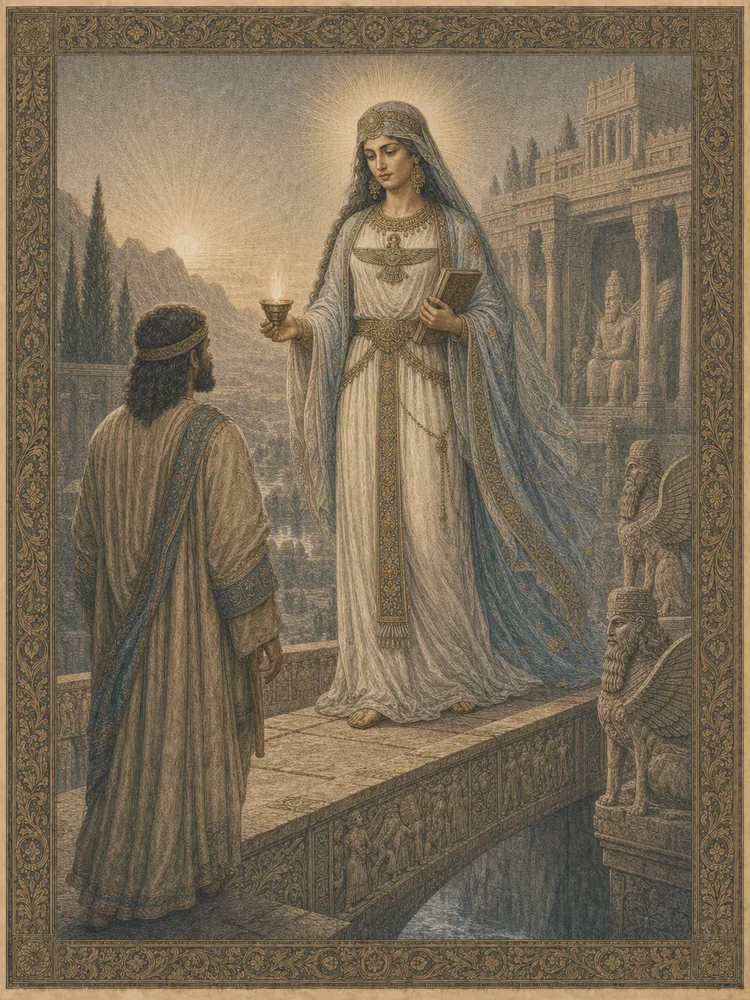
Daena — a word that meant in Avestan something like "religion," "religious teaching," or "conscience" — was the yazata of religious life as it was lived inwardly by the worshipper. She was at once a doctrine (the religion of Ahura Mazda) and a personification (the religion considered as a divine being to be served). Each Zoroastrian had his own daena — that is, his own inner religious life, his own accumulation of right thought, right speech, and right action — and the quality of his daena determined his post-mortem destiny.

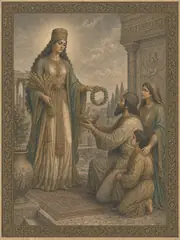
The most striking expression of the Daena doctrine was the post-mortem encounter described in the Hadhokht Nask. When the righteous soul had crossed the Chinvat Bridge, he was met on the far side by a beautiful maiden of fifteen years, more beautiful than any earthly woman; he asked her, "Who art thou, fairer than any I have ever seen?" She answered, "I am thy own daena, thy religious life, and through thy good thoughts and good words and good deeds I have become beautiful. Thou hast made me what I am." She then led him into paradise.

The wicked soul met the same encounter but inverted: instead of a beautiful maiden, an ugly old hag, foul and stinking, who said, "I am thy own daena. Thou hast made me what I am, through evil thoughts and evil words and evil deeds. Thou hast made me ugly." She then dragged him into hell. So the religious life of the worshipper was made visible after death as a personification of his own conduct — a sublime conception, in which the reward and punishment were not external but were the worshipper himself, his own soul reflected back to him as he had shaped it.

The doctrine influenced later religious thinking deeply. The Christian conception of the soul shaped by its own choices, the Islamic conception of the deeds-made-flesh meeting the dead, the Buddhist doctrine of karma manifesting in the next life — all bear some relation to the Daena conception, whether by direct inheritance or by parallel reflection on the same human predicament. In its native Iranian form, however, the doctrine was distinctively Zoroastrian, and the Daena Yasht (Yasht 16) and the Hadhokht Nask passage are its great monuments.

Curator’s note

What the sources say, and what later tradition added. The sources for this bay

Daena is invoked in Yasht 16 (the Din Yasht). The post-mortem encounter is described in the Hadhokht Nask Yasht (Yasht 22) and in the Pahlavi Arda Viraf Namag chapters 4-5 (where the tour of heaven and hell is set up by an opening encounter at the Chinvat Bridge). The doctrine has been treated extensively; Shaul Shaked's articles, Mary Boyce's History, and J. R. Russell's various pieces are key references. The cognate Sanskrit dhī "thought, intuition" is in the same range of meaning, and the New Persian dīn "religion" descends directly from Avestan daena.

When the sources speak

Dated witnesses for The Yazatas. A date marks when the evidence was written down, not when the belief began. The whole timeline

late 2nd–early 1st millennium BCE, debated
The Old Avestan Gathas and Yasna Haptanghaiti emerge in an eastern Iranian ritual-poetic setting; Zarathustra’s date remains disputed.
1st millennium BCE
Younger Avestan hymns, ritual texts, and legal-purity materials develop over a long period of oral transmission.
c. 550–330 BCE
Achaemenid inscriptions invoke Ahuramazda in imperial royal ideology; their relationship to later Zoroastrian orthodoxy requires care.
330 BCE–224 CE
Hellenistic and Parthian eras preserve Iranian cults through sparse and regionally varied evidence.
224–651 CE
Sasanian institutions sponsor priestly learning and the redactional organization associated with the Avesta and Zand.
7th–10th centuries CE
After the Islamic conquest, Middle Persian books record cosmology, law, exegesis, and summaries of lost material.
c. 9th century CE
The Bundahišn, Dēnkard, Wizīdagīhā ī Zādspram, and related works preserve systematic late antique and early Islamic syntheses.
c. 977–1010 CE
Ferdowsi composes the Shāhnāmeh from epic and royal traditions with both pre-Islamic and Islamic-period mediation.

Floor plan

The rooms follow one another in the order their peoples first appear in the written record.

  1. The Cradle of Citiesc. 3400 BCE to 395 CE. 115 works
  2. The Gift of the Nilec. 4000 BCE to 395 CE. 73 works
  3. The Olympian Orderc. 1600 BCE to 750 CE. 152 works
  4. The Persian Worldc. 2000 BCE to 1010 CE. 30 works
  5. The Levantine Borderlandsc. 1200 BCE to 500 CE. 20 works
  6. The Edges of Empirec. 2000 BCE to 1500 CE. 33 works
  7. The Etruscan Worldc. 900 BCE to 750 CE. 22 works
  8. The Roman Inheritancec. 1200 BCE to 500 CE. 58 works
  9. The Northern Inheritancec. 2000 BCE to 1600 CE. 131 works