A Compendium of the Ancient Gods
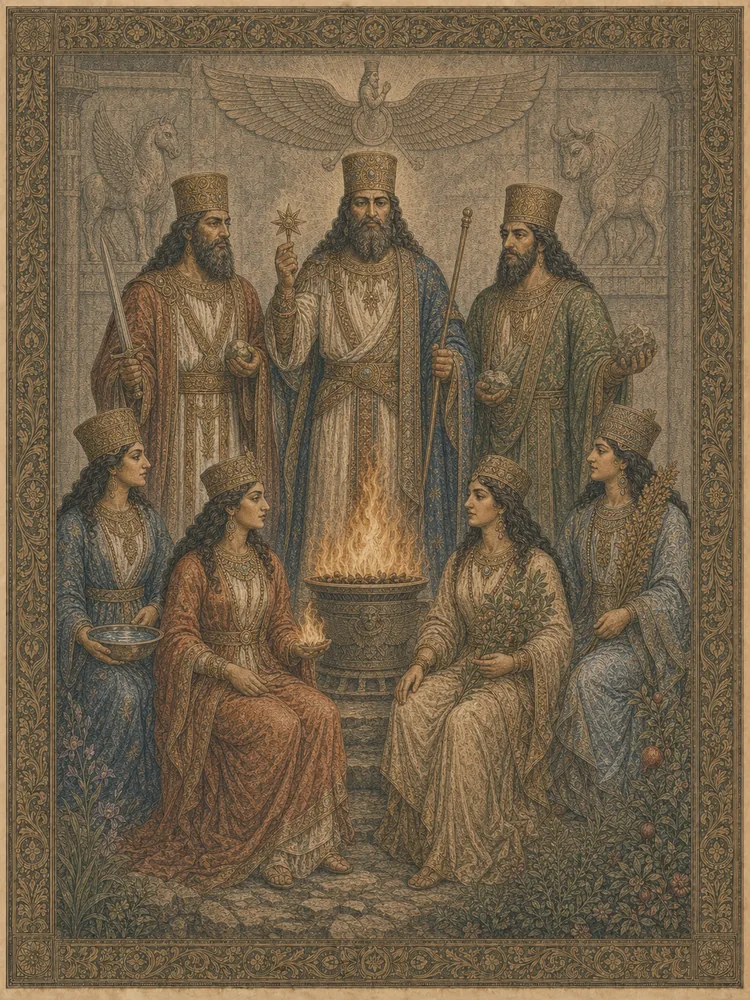
The Amesha Spentas, plate

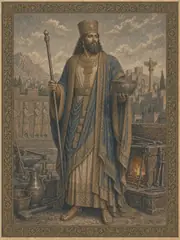
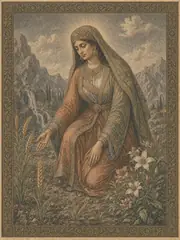
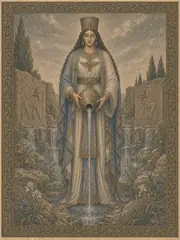
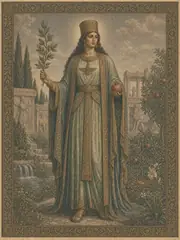
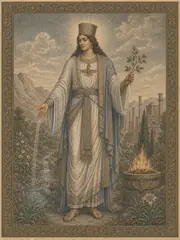
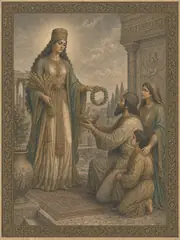
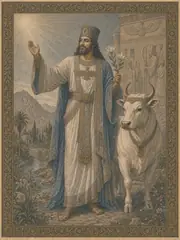
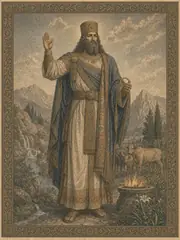
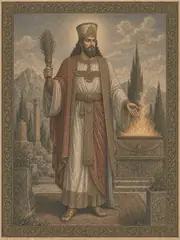
Around Ahura Mazda stood the Amesha Spentas, the seven Holy Immortals, who were the principles by which he had created and now sustained the world. They were not separate gods in the older sense — gods with their own histories, their own marriages, their own conflicts — but personified aspects of the Wise Lord's own nature, modes of his creative activity, the seven facets through which the divine acted in the cosmos. Each of them was assigned a special domain among the seven created things — the sky, the waters, the earth, the plants, the cattle, humankind, and fire — and each was to be honored on a particular day of the month, in a particular season of the year, and through a particular virtue of the human life.

The seven were Vohu Manah, the Good Mind, who presided over the cattle; Asha Vahishta, the Best Truth, who presided over fire; Khshathra Vairya, the Ideal Dominion, who presided over metals; Spenta Armaiti, the Holy Devotion, who presided over the earth; Haurvatat, the Wholeness, who presided over the waters; Ameretat, the Immortality, who presided over the plants; and the Holy Spirit himself, Spenta Mainyu, who presided over humankind. Together they completed the heptad through which the world was made and kept.

Their festivals — the Gahanbars — divided the year into six (later seven) seasons, each one celebrated as the anniversary of the creation of one of the seven created things. Their virtues — good thought, true speech, just action, devout love of the earth, wholeness of body, life everlasting — were to be cultivated by every worshipper as the proper response to the Holy Immortals' patronage. The Zoroastrian was not just to invoke the Amesha Spentas in his prayers but to become like them, to embody in his own conduct the virtues they were.

The doctrine had immense influence beyond Iran. The Jewish angelology of the post-exilic period, with its named archangels (Michael, Gabriel, Raphael, Uriel, and the rest), shows clear marks of Iranian influence; the seven archangels of Christian tradition descend through this Jewish development from the seven Amesha Spentas of the Avestan original. The doctrine of the seven gifts of the Holy Spirit in Christian theology, the seven virtues of medieval moral psychology, even the seven planets of the Hermetic-Hellenistic cosmology — all bear some inherited debt to the Iranian conception.
Curator’s note

What the sources say, and what later tradition added. The sources for this bay

The Amesha Spentas are named throughout the Avesta. The Yasna preserves multiple invocations (e.g., Yasna 4, 14, 25); the Gathas address them by name (Yasna 28-34, 43-51, 53). The Pahlavi Bundahishn (chapters 3 and 26) gives the systematic doctrine of the seven creations and their guardians. The doctrine has been studied extensively; standard references include Mary Boyce's History (Vols. 1 and 2), Almut Hintze's various articles in the Encyclopaedia Iranica, and Stanley Insler's Gathas. The transmission to Jewish angelology through the Achaemenid period (when Israel was a Persian province) is documented in many places; the influence on Christian and Islamic angelology runs through the Jewish channel.

Kin in the sources

Each tie is quoted from the entry that states it.

When the sources speak

Dated witnesses for The Amesha Spentas. A date marks when the evidence was written down, not when the belief began. The whole timeline

late 2nd–early 1st millennium BCE, debated
The Old Avestan Gathas and Yasna Haptanghaiti emerge in an eastern Iranian ritual-poetic setting; Zarathustra’s date remains disputed.
1st millennium BCE
Younger Avestan hymns, ritual texts, and legal-purity materials develop over a long period of oral transmission.
c. 550–330 BCE
Achaemenid inscriptions invoke Ahuramazda in imperial royal ideology; their relationship to later Zoroastrian orthodoxy requires care.
330 BCE–224 CE
Hellenistic and Parthian eras preserve Iranian cults through sparse and regionally varied evidence.
224–651 CE
Sasanian institutions sponsor priestly learning and the redactional organization associated with the Avesta and Zand.
7th–10th centuries CE
After the Islamic conquest, Middle Persian books record cosmology, law, exegesis, and summaries of lost material.
c. 9th century CE
The Bundahišn, Dēnkard, Wizīdagīhā ī Zādspram, and related works preserve systematic late antique and early Islamic syntheses.
c. 977–1010 CE
Ferdowsi composes the Shāhnāmeh from epic and royal traditions with both pre-Islamic and Islamic-period mediation.

Floor plan

The rooms follow one another in the order their peoples first appear in the written record.

  1. The Cradle of Citiesc. 3400 BCE to 395 CE. 115 works
  2. The Gift of the Nilec. 4000 BCE to 395 CE. 73 works
  3. The Olympian Orderc. 1600 BCE to 750 CE. 152 works
  4. The Persian Worldc. 2000 BCE to 1010 CE. 30 works
  5. The Levantine Borderlandsc. 1200 BCE to 500 CE. 20 works
  6. The Edges of Empirec. 2000 BCE to 1500 CE. 33 works
  7. The Etruscan Worldc. 900 BCE to 750 CE. 22 works
  8. The Roman Inheritancec. 1200 BCE to 500 CE. 58 works
  9. The Northern Inheritancec. 2000 BCE to 1600 CE. 131 works