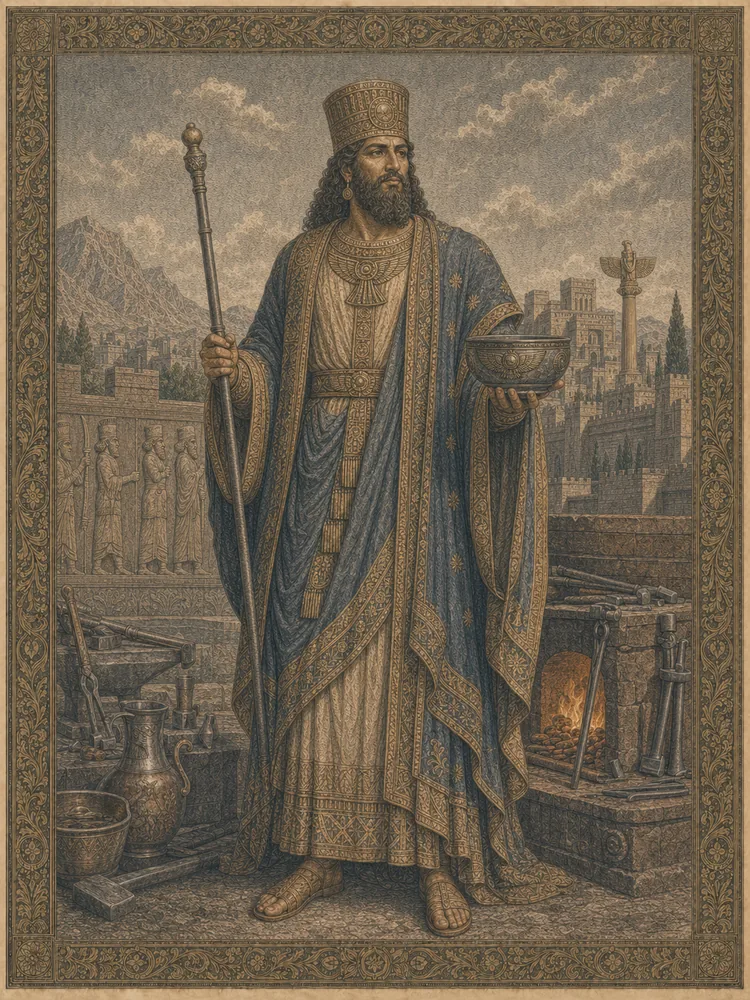
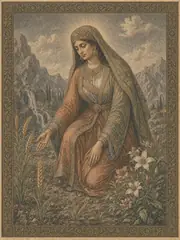
Khshathra Vairya — "Ideal Dominion," or "Wishful Sovereignty," or simply "the Kingdom Worth Having" — was the Amesha Spenta of right rule. He was the personified principle of just sovereignty, both as it was to be practiced by kings on earth and as it was to be realized in the cosmic order at the end of time. His day in the calendar was the fourth day of each month, and his element among the created things was the metals — for the metals were what kingship was made of, the gold of the crown, the iron of the sword, the silver of the treasury.
The doctrine of Khshathra Vairya was particularly important in Achaemenid royal ideology. The kings of the Achaemenid empire (Cyrus, Darius, Xerxes, and their successors) were understood to rule in fulfillment of Khshathra Vairya — that is, their kingdom was to be an embodiment of the ideal kingdom that the Amesha Spenta represented. The royal inscriptions consistently invoke Ahura Mazda's bestowal of khshathra upon the king as the ground of his authority. To rule justly was to participate in Khshathra Vairya; to rule unjustly was to fall away from him.
But the doctrine had also an eschatological dimension. The full realization of Khshathra Vairya — the perfect kingdom of truth and right — would come only at the end of time, when Ahura Mazda's victory was complete and the world was renewed. Until that day, every just earthly kingdom was an approximation, and every unjust one a perversion. The Zoroastrian eschatology of the Saoshyant — the saviour who would come at the end to renew the world — promised the final establishment of Khshathra Vairya as the kingdom over all things.
His element of metals had also a more particular sense. In the cosmogonic schema of the Bundahishn, the metals (gold, silver, copper, iron) were among the primal substances of the world, made by Ahura Mazda at the beginning, and they were under Khshathra Vairya's special care. The smiths and metalworkers of Iran were therefore in some sense his servants, and the proper handling of metals (the forging of weapons, the minting of coins, the working of fine objects) was an act of religious significance. At the eschatological renewal, a great molten flood of metal would purify the world; the just would walk through it as through warm milk, the unjust would be consumed.