Asha Vahishta — "Best Truth," or "Best Right Order" — was perhaps the most important of the Amesha Spentas in the practical religious life of the Zoroastrian, for the cultivation of Asha was the supreme ethical task. Asha was at once cosmic order (the proper way the world is structured), ritual rightness (the proper way the rites are performed), and ethical truthfulness (the proper way a man speaks and acts). All three meanings flowed into a single great concept: Asha was the way things are when they are right.
The opposition was Druj, the Lie — the cosmic counter-principle whose treatment we have already met. To follow Asha was to be an ashavan; to follow Druj was to be a drugvant; and the great division of all human beings ran between these two categories. Asha Vahishta, as the personified principle of Asha, was the patron of the ashavan and the divine warrant for his way of life.
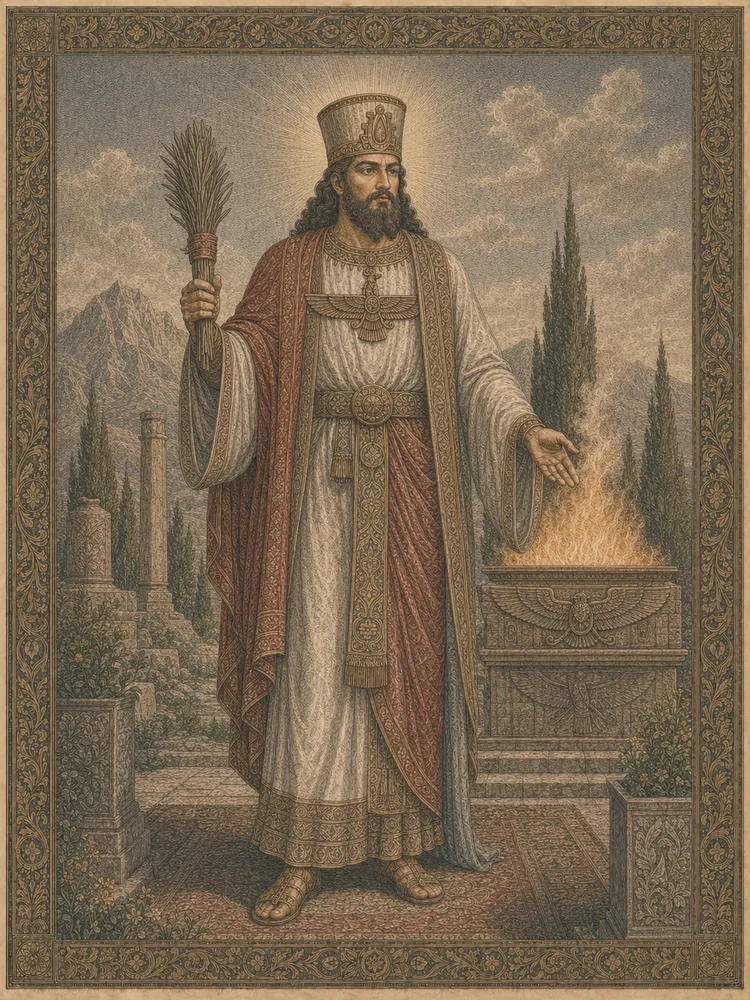
His element was fire, and the fires of the Zoroastrian sanctuaries were considered visible manifestations of his presence. The great fires (the atash bahram, "Fire of Victory," the highest grade of sacred fire) were maintained by the priesthood with elaborate ceremonies that took years to consecrate, and were never permitted to go out. To extinguish a fire was an act of the deepest impiety, an attack on Asha himself; to maintain a fire was an act of the deepest piety. The Zoroastrian was a fire-tender as much as a god-worshipper, and the two activities were inseparable.
Asha Vahishta's day in the calendar was the third day of the month, and his month was the second month of the year; many Iranian personal names through the Achaemenid and Sasanian periods incorporate the Asha element (Artaxerxes, in the Greek form, is from Old Persian Artakhshathra — "having Asha as his realm"). Through the centuries, Asha was the principal name by which Iranian civilization expressed its conviction that the world was rightly ordered and that the human being's duty was to align himself with that order.